Schedule of Readings and Assignments
Week 1: Introductions
Monday, 8/20: The course plan
Introduction to course, syllabus, expectations, research projects, etc.
Wednesday, 8/22: The significance of trails
- James E. Snead, Clark L. Erickson, and J. Andrew Darling, “Making Human Space: The Archaeology of Trails, Paths, and Roads,” in Landscapes of Movement: Trails, Paths, and Roads in Anthropological Perspective, ed. James E. Snead, Clark L. Erickson, and J. Andrew Darling (University of Pennsylvania Press, 2010), 1–19. PDF
- Explore the histories of the NTIR Historic Trails.
Noteworthy
- Timothy Earle, “Routes through the Landscape: A Comparative Approach,” in Landscapes of Movement: Trails, Paths, and Roads in Anthropological Perspective, ed. James E. Snead, Clark L. Erickson, and J. Andrew Darling (University of Pennsylvania Press, 2010), 253–70.
- James E. Snead, “Trails of Tradition: Movement, Meaning, and Place,” in Landscapes of Movement: Trails, Paths, and Roads in Anthropological Perspective, ed. James E. Snead, Clark L. Erickson, and J. Andrew Darling (University of Pennsylvania Press, 2010), 42–60.
Friday, 8/24: NTIR Visit by Frank Norris
Today we’ll have a guest lecture by NPS-NTIR historian Frank Norris, who’ll provide an overview and administrative history of the trail system. To provide a bit of concrete detail about trail administration, skim before class (nevermind the details, just get an impression of the challenges faced in trail interpretation):
Technical references
Week 2: The Challenge of Public History
Monday, 8/27: The Heroic Trail
All of the following should be read for overall flavor—don’t get bogged down in historical detail. You’ll get some very interesting history of a few trails (and we’ll read more recent stuff later), but more importantly we want to pay attention to the historiography here—the way these histories are written, which are representative of early trail histories (and much of western history) generally. We read (for last Wednesday) the Snead (et al.) chapter to get an overview of ways of thinking about trails; what kinds of assumptions do the authors make about trails? What are their analytical frameworks? Who or what are these histories about? Who are the actors? Who is left out? Whose story is this?
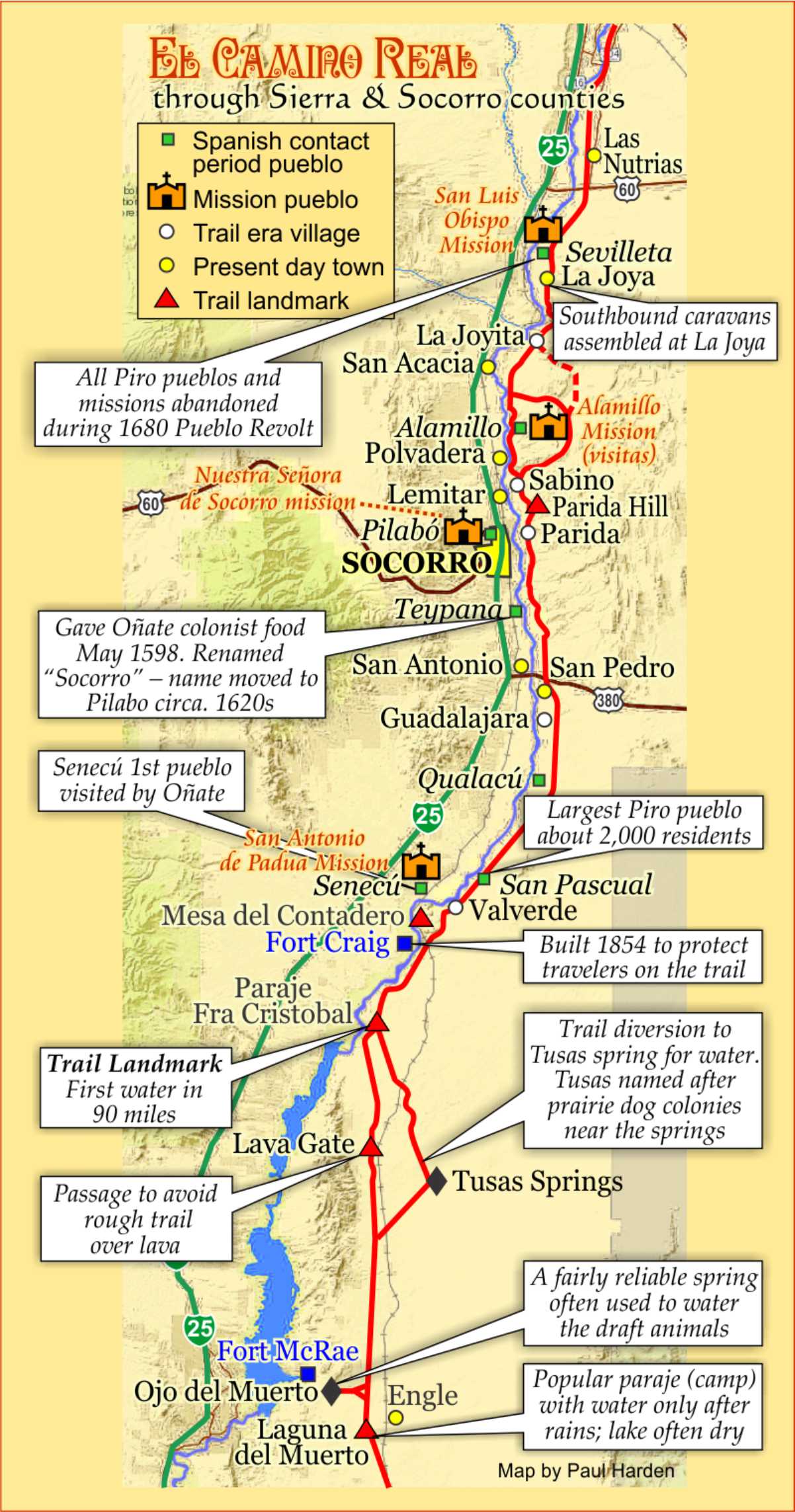
Some of these readings provide maps, but the cartographic representation of the trails is generally lacking. I encourage you to view the maps of the trails on the NPS-NTIR website to get a better geographical sense of where the trails go. How much does geography matter in these older histories for today?
- F. G. Young, “The Oregon Trail” 1, no. 4 (1900): 339–70. JSTOR or Internet Archive
- F. F. Stephens, “Missouri and the Santa Fe Trade,” The Missouri Historical Review 10.4 (1916): 233–62. In Zotero and SHSM
- LeRoy R. Hafen, “The Old Spanish Trail, Santa Fe to Los Angeles,” Huntington Library Quarterly 11.2 (1948): 149–60. JSTOR
- Max L. Moorhead, “Blazing the Camino Real,” in New Mexico’s Royal Road: Trade and Travel on the Chihuahua Trail (Norman: University of Oklahoma Press, 1958), 3–27. Google Books
Wednesday, 8/29: Popularizing the Trail
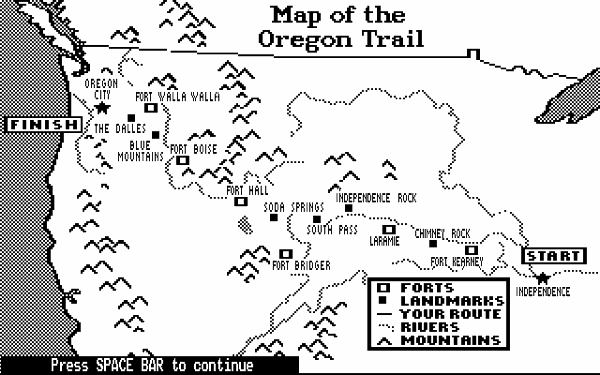
Today we’re reading more direct critiques of trail interpretation, about historic signage and about the Oregon Trail (1990) video game. While these critiques have their own specific targets, they raise numerous issues that apply to any interpretive effort regarding national trails, including books, signage, websites, mobile apps, etc. Therefore, we should keep these critiques in mind whenever we read anything about the trail. What implicit messages do interpretations send to readers?
Do all of these in order, please!
Friday, 8/31: Modern Meditations
Continuing our critiques of trail interpretation, and applying concerns from last time to more modern instances:
For an engaging philosophical approach to thinking about trails:
-
Robert Moor, On Trails: An Exploration (London: Quarto, 2017), 161–202. PDF
-
Building on our guest lecture from Frank Norris, skim through a few very short essays at the 50th Anniversary of the Trail System Blog to get a sense of modern “administration” and interpreting the modern trail.
Week 3: Firsthand accounts
Monday, 9/3: LABOR DAY: NO CLASS
Wednesday, 9/5: Original voices
Spend some time with each of the below selections. At least read the first few chapters of each—but I think/hope you’ll find them kind of addictive and read if not skim a bit more. If you get bored, at least skip around through the books until you get to a section that captures your attention. In class, we’ll talk about how these both echo and diverge from what we’ve read for class so far. How would you characterize the tone of these books? What are the assumptions and cultural frameworks of the authors? To what extent is it possible to capture the richness of these experiences/accounts in modern trail interpretation and administration? Or maybe we should put them behind us and keep them out of view?
Beyond the first few chapters (as noted above), I have recommended some pages that provide a diverse set of descriptions, but should feel free to read just the beginnings of each or skip around randomly as well.
- Francis Parkman, The Oregon Trail: Adventures on the Prairie in the 1840’s (Santa Barbara, Calif.: Narrative Press, 2001). ProQuest
- Ezra Meeker, Personal Experiences on the Oregon Trail Sixty Years Ago (St. Louis: McAdoo printing co., 1912), Internet Archive Read the beginning bits, but also skim through the whole thing—note all the monuments and places mentioned in the video game (esp starting after p. 46). How is the context different here? Can you imagine how the game would be different if not for Meeker’s efforts?
- Josiah Gregg, Commerce of the Prairies: Or, the Journal of a Santa Fé Trader, during Eight Expeditions across the Great Western Prairies, and a Residence of Nearly Nine Years in Northern Mexico Vol. II, 5th ed. (Philadelphia: J. W. Moore, 1855). Google Books Recommended: 105-158. What did you learn about commerce?
- James A. Little, What I Saw on the Old Santa Fe Trail: A Condensed Story of Frontier Life Half a Century Ago (Plainfield, IN: Friends Press, 1904). Google Books Recommended: All the random stuff before the table of contents; also, 11-38.
- Lewis H. Garrard, Wah-to-Yah and the Taos Trail (Cincinnati: H. W. Derby & Co., 1850). Internet Archive Recommended: 157-198.
Noteworthy
- Thomas Bullock and Will Bagley, The Pioneer Camp of the Saints: The 1846 and 1847 Mormon Trail Journals of Thomas Bullock (Logan: Utah State University Press, 2001).
- John David Unruh, “Introduction: The Historians and the Overlanders,” in The Plains Across : The Overland Emigrants and the Trans-Mississippi West, 1840-60 (Urbana: University of Illinois Press, 1979), 3–27.
Friday, 9/7: NO CLASS
Week 4: Space, Landscape, and Maps
Monday, 9/10: Spatial History
- Yi-Fu Tuan, “Humanistic Geography,” Annals of the Association of American Geographers 66.2 (1976): 266–76.
- Richard White, What Is Spatial History?. (Stanford Spatial History Project, 2010).
- David J. Bodenhamer, “Creating a Landscape of Memory: The Potential of Humanities GIS,” International Journal of Humanities and Arts Computing 1.2 (2007): 97–110.
Noteworthy
- Yi-fu Tuan, Space and Place: The Perspective of Experience (Minneapolis: University of Minnesota Press, 1977).
- Yi-Fu Tuan, “Space and Place: Humanistic Perspective,” in Philosophy in Geography, ed. Stephen Gale and Gunnar Olsson (Boston: D. Reidel Publishing Company, 1979), 387–427.
Wednesday, 9/12: Deconstructing Maps
Today we’re reading two classics on cartographic literacy. Come to class prepared to talk about what kinds concerns we should keep in mind when reading/evaluating/critiquing maps about National Historic Trails. How can we combine the concerns presented in the readings for Monday, today, and earlier stuff on public history?
-
J. B. Harley, “Deconstructing the Map,” Cartographica 26, no. 2 (1989): 1–20.
Note that Harley can veer into the philosophical weeds at times, but it’s never for very long, so don’t give up. On the whole, he makes a lot of very important points about reading and understanding maps that are stated very clearly.
-
Denis Wood, The Power of Maps. New York: Guilford Press, 1992, 28-47 (Chapter 2).
Noteworthy
- Mark Monmonier and H. J. de Blij, How to Lie with Maps, 2nd edition (Chicago: University of Chicago Press, 1996)
Friday, 9/14: NO CLASS
Week 5: Environmental + American history
Monday, 9/17: Mythical and Natural Environments
- DUE: Map comparison
- ~750 words, 12pt font, double-spaced, 1” margins
- bring hard copies to class on Monday
- pick 1 map to deeply analyze, or pick 2 to comparatively analyze, or pick 4 to broadly compare (picking 1 or 2 is what I would recommend, but I leave it up to you)
- minimize description in favor of analysis according to map critique techniques discussed in readings and in class
- in other words, explain the presumptions of the cartographers, hidden agendas, biases, etc (just as our readings for Wednesday foregrounded)
- describe how what’s left off of the map shapes our sense of reality
- draw extensively from previous course readings—not only the space/map readings—and cite them like (Bodenhamer, 12).
Our readings for this week are meant to call into question the changing meaning of what seem like unalterable categories, like frontier, nature, or wilderness. First, skim the classic and still important Turner article (referenced in Cronon) and think about how what he describes gets reflected in histories of national historic trails. You’re reading mostly for familiarity rather than deep knowledge, so read quickly. Focus your attention on Cronon’s article and, again, think about how we can apply it to trails work generally.
- SKIM: Frederick Jackson Turner, “The Significance of the Frontier in American History,” Annual Report of the American Historical Association, 1894, 197–227.
- William Cronon, “The Trouble with Wilderness: Or, Getting Back to the Wrong Nature,” Environmental History 1, no. 1 (1996): 7–28.
Noteworthy
- Walter Prescott Webb, “The American Approach to the Great Plains,” in The Great Plains (Boston: Ginn and Co., 1931), 140–204.
- Henry Nash Smith, “The Garden of the World,” in Virgin Land: The American West as Symbol and Myth (Cambridge, Mass.: Harvard University Press, 1950): 123–264.
- Elliot West, The Contested Plains: Indians, Goldseekers, and the Rush to Colorado (Lawrence: University Press of Kansas, 1998).
- prologue and/or chapter 3 (“Frontiers and Visions”)
Wednesday, 9/19: Flora, Fauna, and Food
How does Dunmire’s story challenge Turner’s notion of the frontier?
- William W. Dunmire, “The Corridor into Texas,” in Gardens of New Spain: How Mediterranean Plants and Foods Changed America (Austin: University of Texas Press, 2004), 229–261.
Noteworthy
- Elliott West, The Way to the West: Essays on the Central Plains (Albuquerque: University of New Mexico Press, 1995), 51–84.
- Thomas B. Hall, Medicine on the Santa Fe Trail (Dayton, Ohio: Morningside Bookshop, 1971).
- Samuel P. Arnold, Eating Up the Santa Fe Trail: Recipes and Lore from the Old West (Golden, Colo.: Fulcrum Publishing, 2001).
- Fabiola Cabeza De Baca Gilbert, Good Life: New Mexico Traditions And Food, (Albuquerque: Museum of New Mexico Press, 2005).
Friday, 9/21: Problems of Memory
- Michael J. Zogry, “Wide Open Spaces: The Trail of Tears, the Lewis and Clark Expedition, and Gaps in the National Memory,” in New Territories, New Perspectives: The Religious Impact of the Louisiana Purchase, ed. Richard J. Callahan, Jr. (Columbia, Mo: University of Missouri, 2008), 56–82.
- SKIM: Jackson B. Miller, “Coyote’s Tale on the Old Oregon Trail: Challenging Cultural Memory through Narrative at the Tamástslikt Cultural Institute,” Text & Performance Quarterly 25.3 (2005): 220–38.
- PLAY WITH: Guy McClellan,
Noteworthy
- Marion Blackburn, “Return to the Trail of Tears,” Archaeology, no. 2 (2012): 53.
- Raymond Cross, “‘Twice Born’ from the Waters': The Two-Hundred-Year Journey of the Mandan, Hidatsa, and Arikara Indians,” in Lewis & Clark : Legacies, Memories, and New Perspectives, ed. Kris Fresonke and Mark David Spence (Berkeley: University of California Press, 2004), 117–42.
- Peter B. Dedek, “‘Wild’ Lands and ‘Tamed’ Indians: Cultural Stereotypes and Route 66,” in Hip to the Trip : A Cultural History of Route 66 (Albuquerque : University of New Mexico Press, 2007), 9–27.
Week 6: Economic Histories and Commodity Flows
Monday, 9/24: Intercultural Commerce
- Christopher L. Miller and George R. Hamell, “A New Perspective on Indian-White Contact: Cultural Symbols and Colonial Trade,” The Journal of American History 73, no. 2 (1986): 311–28.
Noteworthy
- Juliana Barr, “Womanly ‘Captivation’: Political Economies of Hostage Taking and Hospitality,” in Peace Came in the Form of a Woman: Indians and Spaniards in the Texas Borderlands (Chapel Hill: University of North Carolina Press, 2014), 240–76.
- Susan Calafate Boyle, “Going Down the Royal Road,” in Los Capitalistas : Hispano Merchants and the Santa Fe Trade (Albuquerque : University of New Mexico Press, 1997), 28–44.
- Douglas C. Comer, Ritual Ground: Bent’s Old Fort, World Formation, and the Annexation of the Southwest (Berkeley: University of California Press, 1996).
- William Patrick O’Brien, Merchants of Independence : International Trade on the Santa Fe Trail, 1827-1860 (Kirksville, Mo. : Truman State University Press, 2013).
- Andrés Reséndez, “The Spirit of Mercantile Enterprise,” in Changing National Identities at the Frontier: Texas and New Mexico, 1800–1850 (Cambridge [England]: Cambridge University Press, 2004), 93–123.
- Thomas Frank Schilz and Donald E. Worcester, “The Spread of Firearms among the Indian Tribes on the Northern Frontier of New Spain,” American Indian Quarterly 11, no. 1 (1987): 1–10.
Wednesday, 9/26: Cities, Capitalists, and Commodities
- Jay Gitlin, “Beyond St. Louis: Negotiating the Course of Empire, “ in The Bourgeois Frontier: French Towns, French Traders, and American Expansion (New Haven, Conn.: Yale University Press, 2010), 83–109 (skim); 109-123 (read closely).
- Susan Calafate Boyle, "New Mexican Merchants and Mercantile Capitalism," in Los Capitalistas: Hispano Merchants and the Santa Fe Trade (Albuquerque: University of New Mexico Press, 2000), 57–72.
Noteworthy
- Richard C. Wade, The Urban Frontier: The Rise of Western Cities, 1790-1830 (Urbana: University of Illinois Press, 1996).
- Adam Arenson, “The Double Life of St. Louis: Narratives of Origins and Maturity in Wade’s Urban Frontier,” Indiana Magazine of History, no. 3 (2009): 246.
- William J. Parish, The Charles Ilfeld Company: A Study of the Rise and Decline of Mercantile Capitalism in New Mexico (Cambridge, Mass.: Harvard University Press, 1961).
- Morris F. Taylor, First Mail West : Stagecoach Lines on the Santa Fe Trail (Albuquerque: University of New Mexico Press, 2000).
- David Lavender, Bent’s Fort (Lincoln : University of Nebraska Press, 1972).
- Darlis A. Miller, Soldiers and Settlers: Military Supply in the Southwest, 1861-1885 (Albuquerque: University of New Mexico Press, 1989).
Friday, 9/28: NPS-NTIR Historical Vignettes Project
We’ll discuss our first assignment from National Park Service—to write 3-5 page historical vignettes about significant people from the two Camino Real historic trails. Each person will write one vignette. More deadlines will be posted soon.
We’ve been given some examples, which you should read before class. We’ll critique these together (along the lines of all the other critiques we’ve done together) to get clear about how we want to write our own vignettes. We have a distinct advantage of having read and discussed many historical accounts and perspectives about the trails. So, finally, we get to put all our critical reading into practice.
Also today: we’ll walk through the process for researching your particular person so that you have a clear path forward as you begin the research and writing process.
Week 7: Native history along/among the trails
Monday, 10/1: Native space
- Juliana Barr, “Geographies of Power: Mapping Indian Borders in the ‘Borderlands’ of the Early Southwest,” William and Mary Quarterly 68, no. 1 (2011): 5–46.
Noteworthy
- Juliana Barr, Peace Came in the Form of a Woman: Indians and Spaniards in the Texas Borderlands (Chapel Hill, NC: University of North Carolina Press, 2014).
- T.J. Ferguson, G. Lennis Berlin, and Leigh J. Kuwanwisiwma, “Kukheypa: Searching for Hopi Trails,” in Landscapes of Movement: Trails, Paths, and Roads in Anthropological Perspective, ed. James E. Snead, Clark L. Erickson, and J. Andrew Darling (University of Pennsylvania Press, 2010), 20–41.
- Pekka Hämäläinen, The Comanche Empire (New Haven: Yale University Press, 2009).
- Anne F. Hyde, Empires, Nations, and Families: A New History of the North American West, 1800-1860, Reprint edition (New York: Ecco, 2012).
- Daniel Goodenough, Jr., “Lost on Cold Creek,” Montana: The Magazine of Western History 24, no. 4 (1974): 16–29.
Wednesday, 10/3: Spatial Displacement
- Ned Blackhawk, Violence over the Land: Indians and Empires in the Early American West (Harvard University Press, 2008).
- We will divide everyone into three groups, each to read one of the following: Chapter 2 (“The Making of the New Mexican-Ute Borderlands”), Chapter 5 (“Great Basin Indians in the Era of Lewis & Clark”), and Chapter 7 (“Utah’s Indians and the Crisis of Mormon Settlement”).
- Come to class having noted down the most important 3-5 points that Blackhawk makes in the chapter you read.
Friday, 10/5: Gender and family travel westward
- Conevery Bolton Valenčius, “Gender and the Economy of Health on the Santa Fe Trail,” Osiris 19 (2004): 79–92.
- Looking ahead to the assignment due Monday, bring bibliography / research questions to class!
Noteworthy
- Johnny Faragher and Christine Stansell, “Women and Their Families on the Overland Trail to California and Oregon, 1842-1867,” Feminist Studies 2, no. 2/3 (1975): 150–66.
- John Mack Faragher, Women and Men on the Overland Trail (New Haven, Conn. : Yale University Press, 2001).
- Julie Jeffrey, Frontier Women: “Civilizing” the West? 1840-1880 (New York: Hill and Wang, 1998).
- Virginia Scharff, “The Hearth of Darkness: Susan Magoffin on Suspect Terrain,” in Twenty Thousand Roads: Women, Movement, and the West (Berkeley: University of California Press, 2003).
- Elliott West, “Families,” in The Way to the West: Essays on the Central Plains (Albuquerque: University of New Mexico Press, 1995), 85–126.
Week 8: RELAX
Monday, 10/8: Research Projects
No reading for today!
DUE: Research notes!
Write out:
Wednesday, 10/10: NO CLASS (PRE FALL BREAK)
Friday, 10/12: NO CLASS (FALL BREAK)
Week 9: Ends and Beginnings
Monday, 10/15: Primary Sources: Women in their own words
Today we’re practicing reading primary sources (trail diaries), which you will likely encounter and should use during your own research (if not for the vignettes then for the next project). You’ll read one article that tries to make sense of Susan Magoffin’s diary from the Santa Fe Trail in 1846. Then, you’ll apply those techniques to interpreting the diary of Harriett Shaw, who traveled the SFT in 1851, who we also will read for Monday.
First, read quickly through this article that very clearly describes how to interpret this kind of source. We’ve read some interesting descriptions of life on the trail, but nothing approaches the vibrancy of first-hand accounts. Don’t worry about the details, but do appreciate how the author of the article is trying to read between the lines of the diary and extract larger meaning from the minutia recorded therein.
- “Susan Shelby Magoffin: A Wandering Princess on the Santa Fe Trail,” in Deborah Lawrence, Writing the Trail: Five Women’s Frontier Narratives (Iowa City: University of Iowa Press, 2006), 9–34.
Next, Consult the diaries of Harriett Bidwell Shaw, available here. Note the handwriting and how fun it would be to read it in the original. Luckily, someone has already done very useful transcription work for us, so to actually read the diary, click on the “text version” button. You don’t need to read every entry, but the more the better. It’s kind of fun! Read enough to get a sense of her worldview, and what her diary tells us about trail travel in the mid nineteenth century. Think of the map critique assignment and how you commented on what wasn’t there as much as what was, and how seemingly trivial details can be very revealing. Please come to class ready to discuss how the diary can tell us something about the themes and categories that we’ve considered in class and, in general, what we can learn from Ms. Shaw.
Remember, we’ll be writing about the Santa Fe Trail for our next and main research project. So both of these readings will be super helpful for establishing general context of the trail experience.
It’s always a bit trying to restart after break, but we should have a fun discussion on Monday morning!
Noteworthy
- Ho for California!: Women’s Overland Diaries from the Huntington Library Sandra L. Myres, ed., (San Marino, Calif.: Huntington Library Press, 2007), esp. Mary Stuart Bailey, Helen McCowen, Harriet Bunyard, and Maria Hargrave Schrode.
- Susan Shelby Magoffin and Howard R. Lamar, Down the Santa Fe Trail and into Mexico: The Diary of Susan Shelby Magoffin, 1846-1847, ed. Stella M. Drumm (Lincoln, Neb.: Bison Books, 1982).
- Isabella Lucy Bird and Daniel J. Boorstin, A Lady’s Life in the Rocky Mountains (Norman: University of Oklahoma Press, 1975).
- Sandra L. Myres, Westward Ho! Women on the Overland Trails (Albuquerque: University of New Mexico Press, 1982).
We have completed the required reading portion of the course!
Wednesday, 10/17: FIRST DRAFTS
DUE: Bring a printed copy of your first draft to class for our first peer review session during class.
- Hathitrust: lots of older books and government reports, complete with a useful full-text search tool
- Archive.org: specializes in multimedia, but some scans may be better quality than others
- Rocky Mountain Online Archive: digitized photos, maps, and documents from libraries around the Southwest
- New Mexico Digital Collections: New Mexico-specific online archive with legal documents, diagrams, and historic newspapers
- Google Books: perfect for older sources that are now in the public domain
Important Tips for Success
- I say “first draft”, but I mean first draft that is worth showing to someone else. This should be closer to 3rd or 4th draft. Quality over quantity.
- Every historical claim (or set of claims if they are closely related and from the same source), should have a citation like (AUTHOR-LAST-NAME, PAGE-NUMBER).
- Attach to your draft a complete bibliography. Complete means everything you’ve looked at to this point, but it may grow as you continue work on them.
- The better your draft, the better the final version, and the higher your grade. And the less aggravated I’ll be, which is generally better for everyone.
- Even more than usual, it’s SUPER annoying to deal with people who come in late. Highly discouraged.
Friday, 10/19: SECOND DRAFTS
DUE: Your “second” draft that incorporates feedback from the peer review session and other improvements from general discussions. Bring a printed copy to class and you’ll exchange with someone else (to critique them over the weekend) to get another set of eyes on your text.
Week 10: Finish Vignettes and new research project discussion
Monday, 10/22: SAFE Critiques
Wednesday, 10/24: BRING FINAL ESSAYS!
Friday, 10/26: NO CLASS
Week 11: Research Projects
Monday, 10/29
- Lecture: History of the Santa Fe Trail
Wednesday, 10/31
DO NOT MISS CLASS!
Or you will create a lot of confusion for yourself and waste time trying to sort through it. What we’re doing cannot be explained over email, and I will not teach this class again to you personally during office hours—so you need to be in class. We will be using these tools the rest of the semester, so you can’t wait for them to go away.
Peruse these beforehand:
- Introduction to Markdown
- Introduction to GitHub. Read through this tutorial, but do not actually do all the steps—just try to understand what’s going on and we’ll go over it.
As soon as possible after class
- Create a free and secure account at GitHub. You can pick any username you want—it’s independent from UNM and Zotero.
- Email Guy (gmcclell@unm.edu) your GitHub username. He’ll invite you to join our GitHub “Team”. Like Zotero, You’ll get an email asking if you want to accept the invitation. Do it!
- Use either Dillinger or a text editor (like Atom) to create a plaintext Markdown file with some dummy text that includes some Markdown formatting. Be sure to save it as
FIRSTNAME-LASTNAME.md. The content of your markdown file is irrelevant, but be sure your filename has no spaces and ends with .md.
- Add that Markdown file to our repository. Be sure you are logged into GitHub when you do this: Click on the
testfiles folder, then drag and drop your file onto your browser window.
- If you are confused about Markdown, go back to our Markdown tutorial; for syntax help, consult the cheat sheet
Friday, 11/02
- Solve GitHub and Markdown problems
- More Itinerary Project Details. We will start to put all our work in our Itinerary sandbox
- Historically Significant Site selections. You need to pick a site from this list
- Research Outline Reminder
Week 12: Itinerary Drafts
Monday, 11/05
- Lecture on the National Historic Registry
Wednesday, 11/07
- READ selections an NPS Santa Fe History. This is a a kind of historic registry nomination form that we’ve been looking at but intended to be for all historic sites near the Santa Fe Trail. It begins with a long and thorough history (with just under 800 footnotes), and also has a long bibliography that we’ll want to keep an eye on. We’re reading from section E (Statement of Historic Contexts), which starts on page 3 of the PDF, but is labeled as E1 on the document (yay bureaucracy!). All pages are as listed in the document, not what your PDF reader says.
- Make sure you at least skim everything and read carefully what interests you. Some paragraphs have lots of detail to support a larger point; obviously we’re not concerned with minute detail, but it helps indicate what we know and what we don’t about the Trail. Read extra quickly over those bits.
- Introduction (1-6)
- Part I (13-38)
- Part II (39-44)
- Part III (44-47)
- Part IV (57-middle 59)
- Part V (62-top 67)
- Registration Form Assignments
- Go over Itinerary Outlines DUE MONDAY
Friday, 11/09: NO CLASS
Week 13: More Drafts
Monday, 11/12
- DUE: ITINERARY OUTLINES
- Note there is a sample outline HERE
- This is very much, like your outlines, a work in progress, but notice:
- the general topics are clear, distinct, and in a reasonable (not necessarily final) order
- the topic sentences convey the topic, but are generally shite as far as style goes. SUBSTANCE OVER STYLE AT THIS POINT
- it’s clear what i have sources for and what i need to research further
- although clearly super rough, it’s a solid base to build on and that’s what you need to have by Monday.
- please note the formatting, which makes it easy to skim as an outline.
- Need to produce COMPLETE outline–the main work is in pulling out the main points from the registration forms and ordering it appropriately for a general audience.
- Use 1-2 sentences (even if incomplete) that will ultimately become topic sentences of your paragraphs. They can be rough an sketchy now, but the ideas should be clear.
- For each paragraph, have 2-3 sub-bullets (of things to mention, research etc)
- Use specific citations; or note where more research is needed
- Minimum 10 sources in Zotero collection (start with sources on registration forms).
- Name your file according to your site like
blue-mills.md
- use dashes, NOT spaces
- all lower case
.md extension
- Add your file to the new sites folder in our repository
Wednesday, 11/14
- NOTE REPOSITORY RE-ORG:
- Your outlines are now officially “versioned” and preserved in our
outlines folder; don’t edit these anymore.
- For you first drafts, you should EDIT or REPLACE copies of your outline files in the
first-drafts folder here.
- We will start using the
docs/sites folder again for revised drafts due next Monday.
- IN CLASS: Public History Writing Exercise
- The Return of the Vignettes, and notes for better first drafts.
- As you finish drafting your essays for Friday, review existing site essays from the Charleston travel itinerary. Notice the scope of these essays and get excited about the perspectives we’re able to bring to our site histories.
Friday, 11/16
- DUE: COMPLETE Itinerary Drafts
- Flesh out your outlines into a full draft with section headings
- Write in plain text + Markdown, commit your files to our repository (see link above)
- Include notes notes about what needs more research if awaiting sources
- BRING A PAPER COPY to class
- IN CLASS: Research questions
- IN CLASS: Peer Review
Week 14: Research Projects
Monday, 11/19
- DUE: Revised Itinerary Drafts due on GitHub.
- Image research and captioning tips
- Finding related articles, people, places (as per our Charleston model)
- Technical details on how to put images in your essay and hyperlinks
- Note that your drafts due next Wednesday will be graded.
Wednesday, 11/21: NO CLASS (pre-Thanksgiving)
Friday, 11/23: NO CLASS (Thanksgiving)
LINKS we will use all the time
Week 15
Monday, 11/26
- DUE: THIRD DRAFT with appropriate images and captions integrated into narrative. All essays should work within our website framework. See things to do over break. Start noting relevant people, places, and articles and writing improvements due Wednesday.
- IN CLASS: review of general formatting, intro paragraphs, and skimmable topic sentences. Also, hyperlinks.
Wednesday, 11/28
- DUE: All itinerary pages should be ENTIRELY COMPLETE, including clear section headings, clear and focused paragraphs, clear narrative thread, images (with captions), hyperlinks, and related people, places, and articles.
- NOTE: THESE DRAFTS WILL BE GRADED
- NEW NOTE: They will be graded according to THIS RUBRIC
- Website layout and features that need work
- IN CLASS: How to create a directory of sites via a Google Sheet
- Clean Zotero Collections DUE FRIDAY!
Friday, 11/30
As taken from NPS.gov. Choose whichever is easier for your particular form.
EITHER
National Register of Historic Places, property name, town, county, state, reference number.
National Register of Historic Places, Lamesa Farm Workers Community Historic District, Los Ybanez, Dawson County, Texas, National Register #93000771.
OR
Straw, Elizabeth A. “Cumberland Homesteads Historic District.” National Register of Historic Places Inventory/Nomination Form. Tennessee Historic Commission, Nashville, September 20, 1988.
(Elizabeth A. Straw wrote the nomination; she worked for the Tennessee Historical Commission; and the date is the date the property was listed in the National Register of Historic Places.)
Week 16: Loose Ends and Final Submissions
Monday, 12/03
- Final website walk-thru. What else does Gibbs need to do?
Wednesday, 12/05
- What have we done?
- What have we learned?
- What can you do now?
All work due December 12 at 5:00pm.