AI, student research, and the public histories that never made it into the record.
Speaker
Fred Gibbs
Affiliation
Department of History & Amaranth, University of New Mexico
fredgibbs.net
Where I’m standing
A studio, not a service desk.
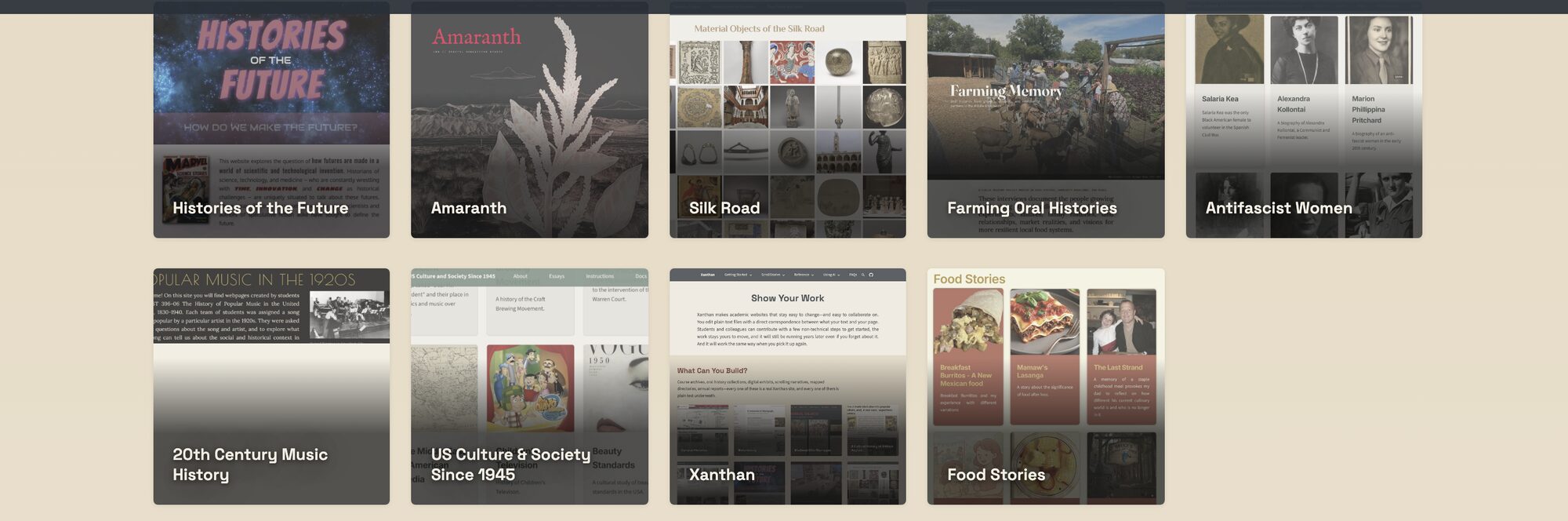
UNM’s digital humanities studio: websites, scroll-driven narratives, oral history, 3D printing, and AI-assisted research — made with students, in public, on infrastructure the authors keep.
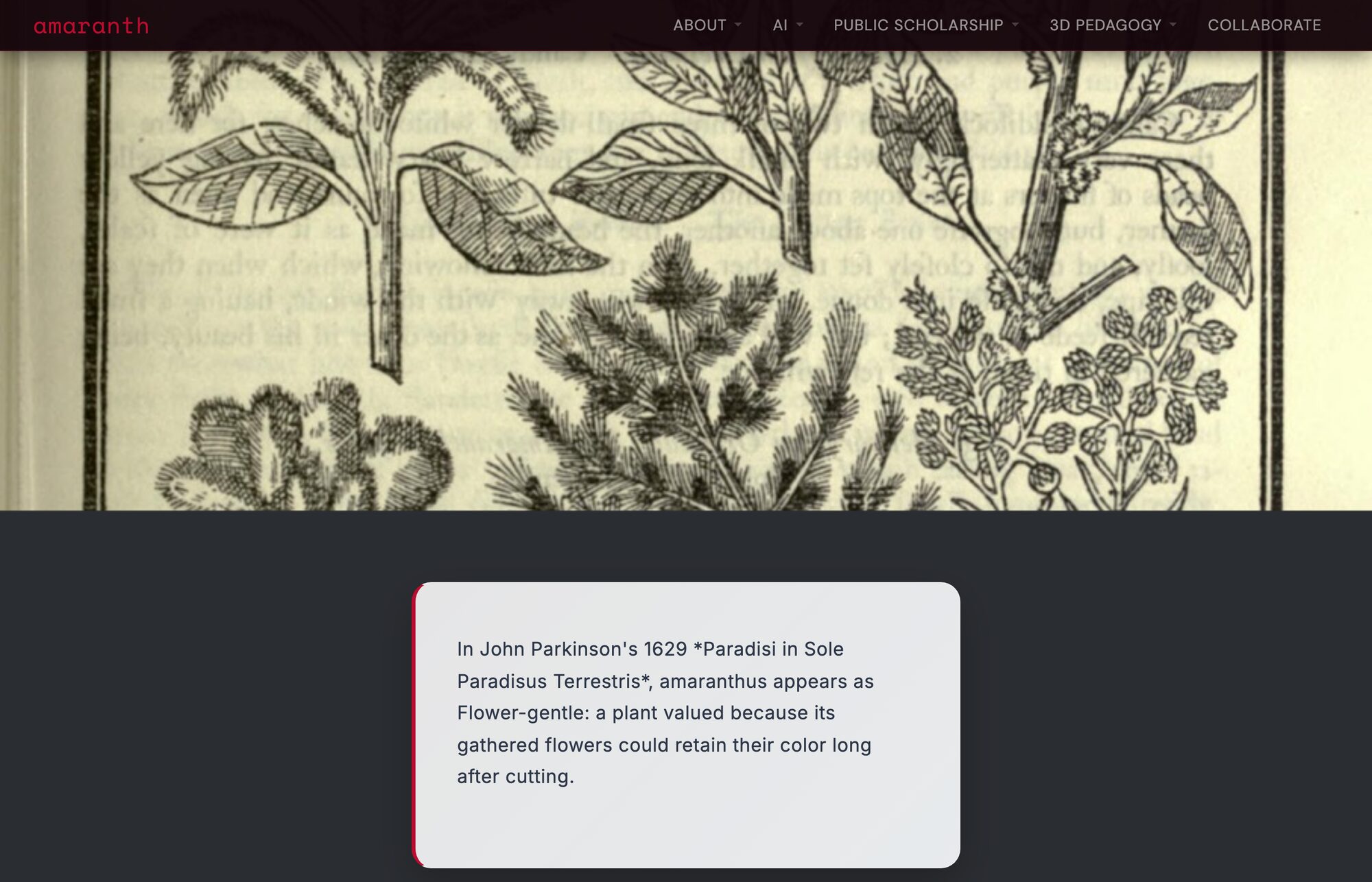
amaranth.unm.edu
Everything that follows was built by undergraduates and one faculty member.
Pedagogy
Whoever holds the question holds the authority.
AI does the technical translation. The student keeps the question, the evidence, and the responsibility for both. That division isn’t a caveat on the syllabus — it is the syllabus.
xanthan-web.github.io
Infrastructure
Plain text. Named parts. No landlord.
Jekyll and GitHub Pages. Free to host, nothing to renew.
Every part of a page has a name — which is what lets an AI change one thing instead of rewriting the site.
Some of these haven’t been touched in nearly a decade. They still work.
Student-driven research
A campus surveyed by the people who live in it.
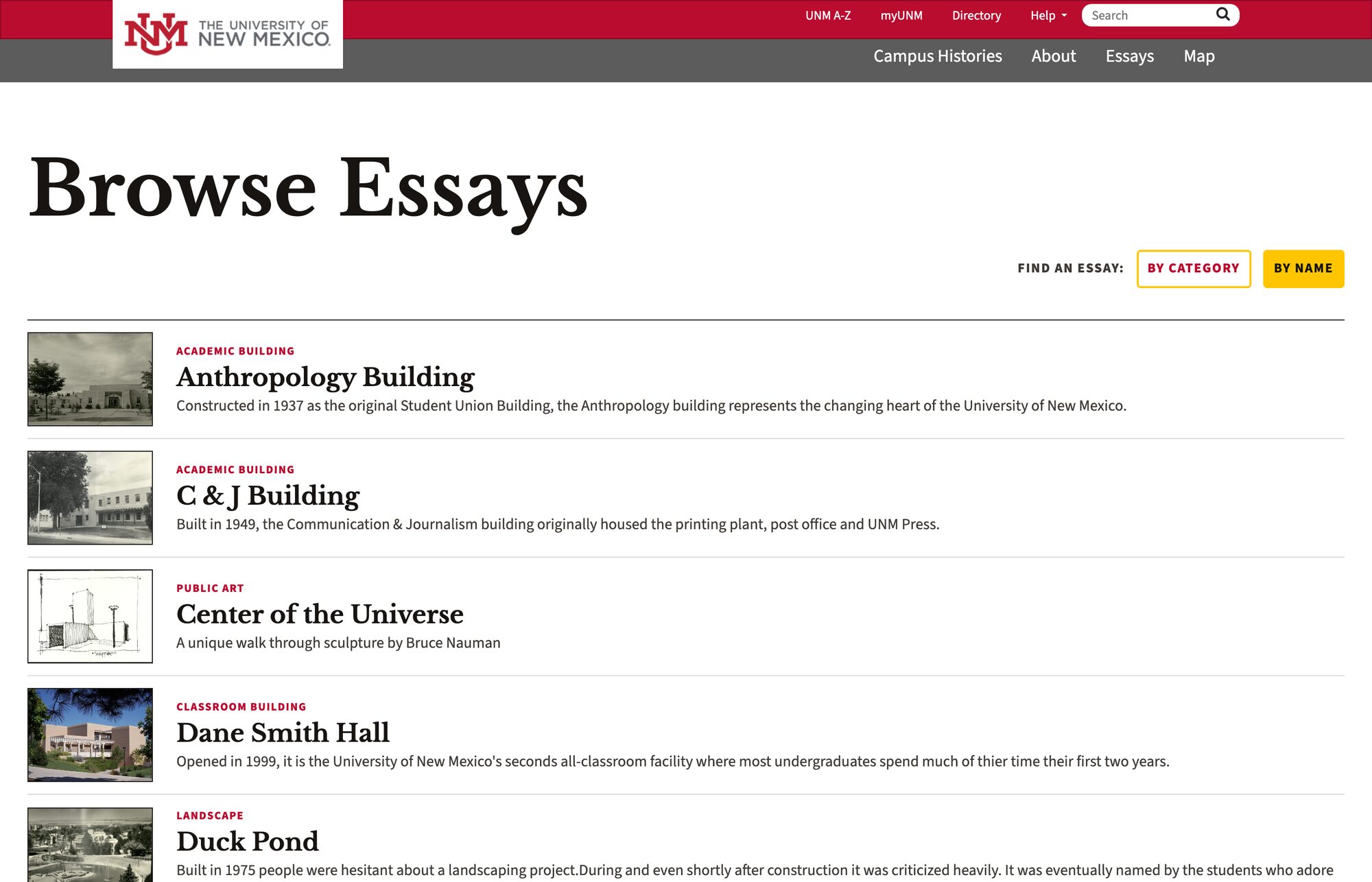
UNM Campus Histories — a multi-semester project. Each cohort builds on what the last one made.
amaranth.unm.edu/campus-history
amaranth.unm.edu/campus-history/all-essays
What they produced
An inventory, with a typology.
Academic building. Classroom building. Public art. Landscape.
Nobody assigned those categories. Students needed them once the collection got large enough to browse — and inventing a classification is preservation work, whether or not you call it that.
One essay
Brutalism, argued over by undergraduates.
An award-winning building that much of its campus dislikes. The essay has to hold both facts at once — which is the whole problem of postwar preservation, arriving early and by accident.
UNM Humanities Building — student essay, Campus Histories
Why the form matters
The paper was never the point. The site is the deliverable.
When public scholarship is the default output rather than something translated out of a seminar paper afterwards, the incentives change on day one. Students write for readers, cite for strangers, and design for someone arriving by search. Preservation research nobody can find is preservation research that didn’t happen.
Community storytelling
The knowledge is already in the community.
Oral Histories of Farming along the Middle Rio Grande — farmer profiles from student interviews.
Cross-course collaboration
What actually changed
Forty hours of tape, searchable by Thursday.
Transcription used to be the budget line that killed the project. Now it’s the cheap part — and it needs checking, because machines mangle names, accents, and every term specific to a place. The expensive work moved back where it belongs: deciding what a collection means, and who gets to say so.
amaranth.unm.edu/studio/name-origins
Form
Scroll rate is pacing.
The background holds; the text moves over it. Images change under fixed prose, at a moment the author chooses.
So pacing becomes an argument — the same claim lands differently depending on what you’re looking at when you read it.
The author writes Markdown and names an image. There is no code.
Who is in the record
The building committee speaks. The women do not.
UNM administrative memo on dormitory construction, read in a scrollstory.
Mesa Vista Hall
Method
Narrative restraint, the refusal to fill in the gaps and provide closure, is a requirement of this method.
Saidiya Hartman, “Venus in Two Acts,” Small Axe 26 (2008)
The problem with the machine
A model will never tell you the archive was silent.
It fills. Fluently, plausibly, without a seam. Hartman demands restraint at precisely the point where a language model is least capable of it — which makes AI a genuinely dangerous instrument here, and a genuinely useful one, but only if the invention is marked as invention.
In the classroom
Three moves, in this order.
01 / GENERATE
Voice the person who isn’t there.
Ask the model to narrate the building from the position the record omits. It will comply, immediately and well.
02 / SOURCE
Make it show its footing.
Demand a source for every sentence. Watch most of them evaporate. This is the lesson; the generated text was only the bait.
03 / MARK
Publish the seam, not the smoothness.
What survives gets published as invention, labelled, beside the document it departs from. The seam is the scholarship.
The other direction
Scan it — then put it back in a hand.
Romanesque to Gothic, five capitals, one table. The stylistic transition stops being a claim in a textbook and becomes something you see by turning two objects.
A student is scanning Peruvian artifacts at UNM’s Maxwell Museum and documenting the workflow so the next person can repeat it. The pipeline is the scholarship.
Scanning the past
A scan records what survived. Most of it didn’t.
LiDAR, photogrammetry, structured light — every one of them presupposes a thing still standing. But the buildings that shaped how a place understands itself are very often the ones that are gone.
Albuquerque
1902 — 1970
The Alvarado Hotel. Charles Whittlesey for the Santa Fe Railway; Mission Revival; the largest of the Harvey hotels. Demolished in 1970 over citizen protest — a loss the preservationist Susan Dewitt called “the most serious loss of a landmark the city has sustained.” It is a large part of why this city has a preservation movement at all.
Alvarado · AR● Tracking
Arcade · photographedWindows · inferredRoofline · no source
Alvarado Hotel
1902–1970 · Demolished · You are standing in the lobby
Simulation — not a working app
Stand on the site. Hold up a phone.
I didn’t build this. It’s a drawing of a proposal. But every piece of it — the model, the tracking, the interface — is now within reach of one person over a few weekends rather than a funded team over three years.
Solid — documented in photographs
Dashed — inferred from building type
Dotted — invented; no surviving source
The catch
Every reconstruction is an argument with the confidence turned up.
Photogrammetry at least fails visibly: a gap in a point cloud looks like a gap. A generated elevation looks finished whether or not anyone alive knows what was there. If we build these, the drawing convention has to carry the evidence — or we hand the public a memory of a building that never existed.
Ending
Scan what survived. Then argue, in public, about the rest.
The tools got cheap enough that a student can make the argument. Whether the argument is any good is still entirely up to us.