What AI changes about humanities research, and how it recalibrates trustwork.
Fred Gibbs
fredgibbs.net
History
history.unm.edu
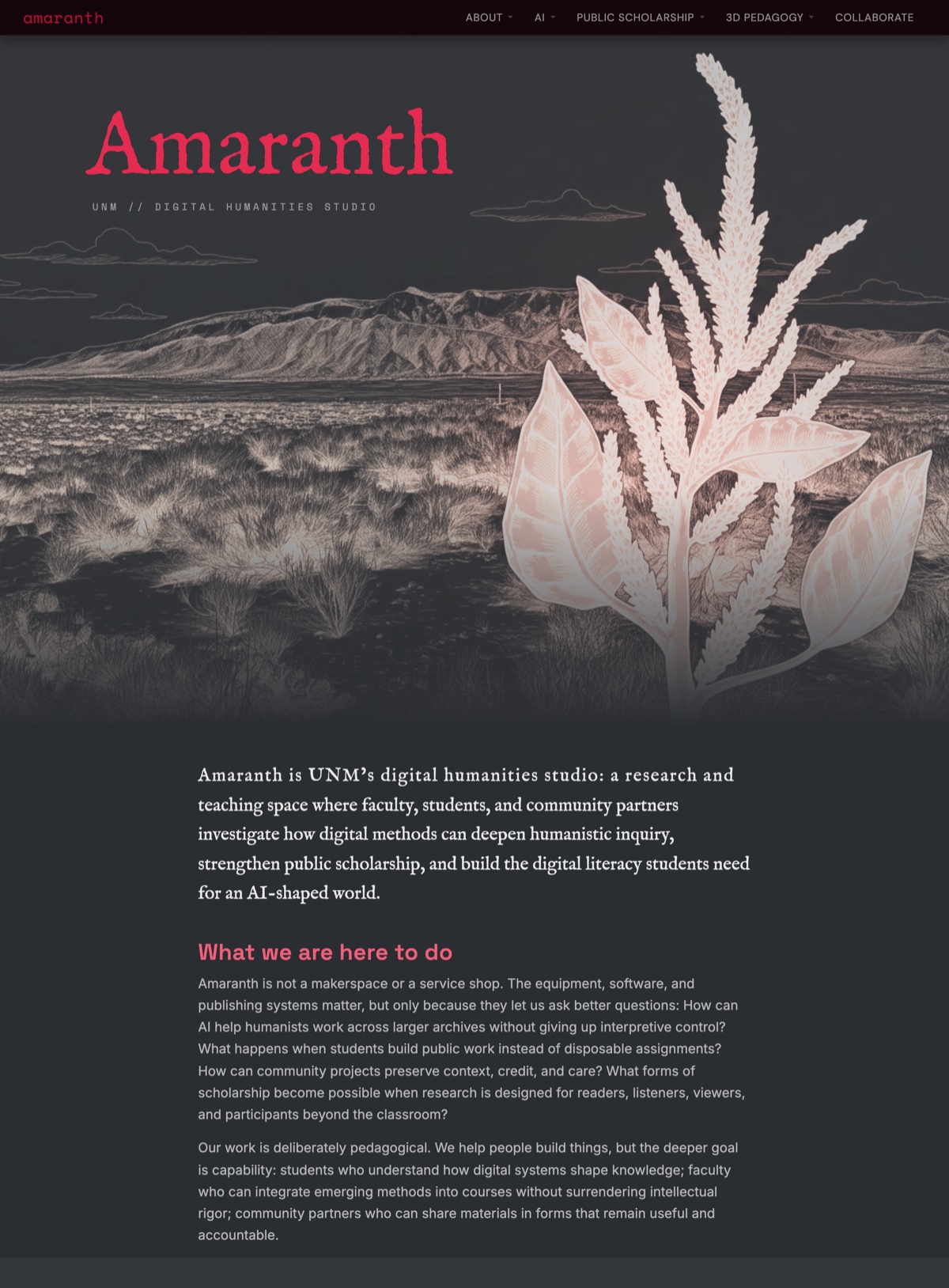
Amaranth
amaranth.unm.edu
Digital? Humanities workflows
Techne is no longer an issue
The Digital Humanities have long championed working at scale, exploring data, and methodological experiments. The main constraint is no longer technical capacity, it is judgment and competency. Old epistemology questions are back!
AI for humanities research
New reach, and new ways to be wrong.
01 / ACROSS TEXTS
Read ten thousand pages you haven’t read.
Themes traced across a whole corpus, language shifting over decades, patterns no close reading would surface.
You are now vouching for a pattern you did not see. But what does seeing mean?
02 / IN SPEECH
Forty hours of stories, searchable tomorrow.
Draft transcripts of an entire oral history collection in days rather than months, and build an index.
It mangles the names, the Spanish, and the place words. But aren’t they correctable?
03 / IN THE LITERATURE
Transcend disciplines.
The major positions, the live debates, the search terms, chart a route into a literature you have not read.
It invents sources. But can’t better rules mitigate that?
Reconstruction
Every reconstruction is an argument with the confidence turned up.
LiDAR and photogrammetry fail visibly: a gap in a point cloud looks like a gap. A generated elevation looks finished whether or not anyone alive knows what was there. If we use AI to re-imagine history, how do we address uncertainty?
AI-generated image
Ninety-four per cent confident. Of what?
Both halves are generated — the “reality” on the left is not a photograph either. Nothing in the reconstruction is sourced to anything, and the number measures nothing at all.
Provocation
We can already trust AI.
Do you trust me to write history with AI? That is the real issue. AI is trustworthy in the sense that skilled users know what to expect and that AI output is already consistent (while improving). The question we need to answer is how do we know when to trust those who use it?
Research experiment
Texts prescribe. Bodies record.
Two literatures that barely cite each other.
01 / THE TEXTS
Medieval dietetics
Regimen literature, Galenic and Islamicate. Food as the first instrument of medicine — what learned practice told people to eat, and on what theory.
My field. I can tell when a reading is wrong.
02 / THE BODIES
Bioarchaeology
Stable isotopes, dental calculus, paleopathology. What skeletons record about what people actually ate, decades at a time.
Not my field. I cannot tell when a reading is wrong.
03 / THE GAP
One cemetery at a time
Integration already happens — but site by site, small samples, told as a narrative about that site.
The synthesis at scale “has yet to materialize.”
Method
Not prompts. Protocol.
Every source runs the same pipeline — read, note, synthesize, outline, draft — with a written rule governing each hand-off, and a file left behind at every stage. Historians do all of this constantly and never write it down: we learn it by apprenticeship and then it goes tacit. Tacit method cannot be applied evenly across two fields. Written method can — and can be checked.
AGENTS.md
## Workflow — trigger-map (when → what → where)

| Trigger (when it fires)     | Do               | Detail lives in   |
|-----------------------------|------------------|-------------------|
| On every read of a source   | Write a note     | reading-protocol  |
| Every 3 sources read        | OFFER a red team | interrogation-log |
| Tension with our OWN thesis | Log it           | emergent-ideas    |
| Workflow changes            | Record the why   | methods-log       |

## Working rules (no silent fallbacks)

- Closed corpus. Every factual claim must cite a source in
  sources/ with page number. If no source covers a claim,
  flag it as a GAP — never fill from general knowledge
  without marking it [UNVERIFIED — from model knowledge].
How the project is organized
Not folders. Triggers.
Not “here is where things live” but when this happens, do this. A rule that fires at the moment it is needed, instead of sitting in a document nobody rereads.
notes/Muldner-2009-…isotopes.md
# Notes: Müldner, "Investigating Medieval Diet and Society by# Stable Isotope Analysis of Human Bone" (2009)
**Status:** ✅ READ from the corpus PDF (verified close read)
**Evidence type:** field review of C/N isotope analysis, written
for a non-specialist audience
**Role in chapter:** ⭐⭐⭐ best orienting source for M2/M4
## Why it positions the M4 gap-claim
- The prescription-vs-practice comparison IS established — she
reviews it. So M4 must NOT claim to invent this.
- BUT she states the FIELD'S LIMIT plainly: "Many of the
currently available publications are focused on individualsites or cemeteries. The number of individuals analysed
… often relatively small." (p. 340)
→ single-site, small-n, narrative. This is the gap M4 fills.## Citation profile — how to cite THIS source
- (a) Pinpoint [P]: the "individual sites / small-n" limitation
- (b) Orienting [O]: best overview cite for isotopes + diet
Stage one — the note
Read it on its own terms first.
Fifty-six of these, all the same shape. The source’s own emphasis and its own polemical target go down before a word about what the chapter wants from it.
synthesis/emergent-ideas.md
# Emergent Ideas — hypotheses the research surfaces
Ideas, reframings and tensions that arise FROM the reading and
cross-reading — things NOT in the original abstract.
An emergent idea is a LIVE hypothesis. When one matures it
migrates to the conclusions ledger and stages a proposedabstract revision (proposed, not silent). When one is
contradicted, mark it so.
Status: 🌱 live · ↑ strengthening · ⛔ contradicted · ✅ matured
## EI-001 courses, not emulsion — THE SPINE, all sections
Texts and bodies are two distinct interpretive registers,
read in conjunction — neither is ground truth.
↳ M2: bodies are not ground truth (construct + plasticity)
↳ M4: productive divergence — the gap IS the finding## EI-003 the gap-claim genre — M3 + M4 + Conclusion
The chapter's own AI gap-claim: own it reflexively.
Stage two — the synthesis
The file I read hardest.
Built out of the notes by cross-reading. These are claims about my argument rather than about anybody’s evidence — which is exactly why they need a human on them.
drafts/chapter-skeleton.md
# Chapter Skeleton — "Food, Diet, and Health"# (Ch. 24, Cambridge History of Medicine vol. 2)
**What this is:** the single whole-chapter view — every section's
job, its argument beats, the sources it surveys. Built to confirm
the story reads coherently end-to-end BEFORE any prose.
**Length target:** 8,000 words final
**Structure:** Part 1 (diagnosis) = Movements 1–3
Part 2 (case study) = Movement 4
## Standing guardrails (bind every section)
(1) anti-Whig / alterity — changing frameworks, not progress
toward modern nutrition; don't manufacture a presentist foil
(2) European focus, reflexively named — Islamicate and
Chinese as gesture, not coverage
(3) ch. 25 (Regimen) boundary — gesture, don't anatomize
(4) Provisional accumulation, not verdicts — "hasn't
materialized in the corpus," never "doesn't exist"
Stage three — the outline
Argue it before you write it.
The whole chapter end to end, while it is still cheap to change. The guardrails at the bottom bind every section of the prose that follows.
Where it went wrong
Neither of these is a hallucination.
CATCH 01 / THE INVENTED OPPONENT
It argued against nobody.
The draft kept pushing back on the idea that medieval diet was primitive proto-nutrition — a debate the field retired decades ago. I asked who actually holds that view. Nobody does. It dropped the foil and reached for a second one within the hour.
The rule that came out of it: don’t argue against a position no one in your conversation actually holds.
CATCH 02 / THE PREMATURE VERDICT
It closed a question.
It wrote that a line of enquiry had “collapsed” and could be closed. We had read dozens of studies out of hundreds, in a field where one good study changes everything.
The rule that came out of it: “nothing in the current corpus” — never “there is no such thing.”
Why history
“Unprecedented” is a way of not looking.
Every conversation in every department treats AI and trust as a brand-new problem — which conveniently means nobody has to find out what happened last time. Twice, a technology for making knowledge arrived faster than any means of checking it. Both times trust had to be manufactured: deliberately, by people, over decades. Those are the only two experiments we have, and we are inside the third.
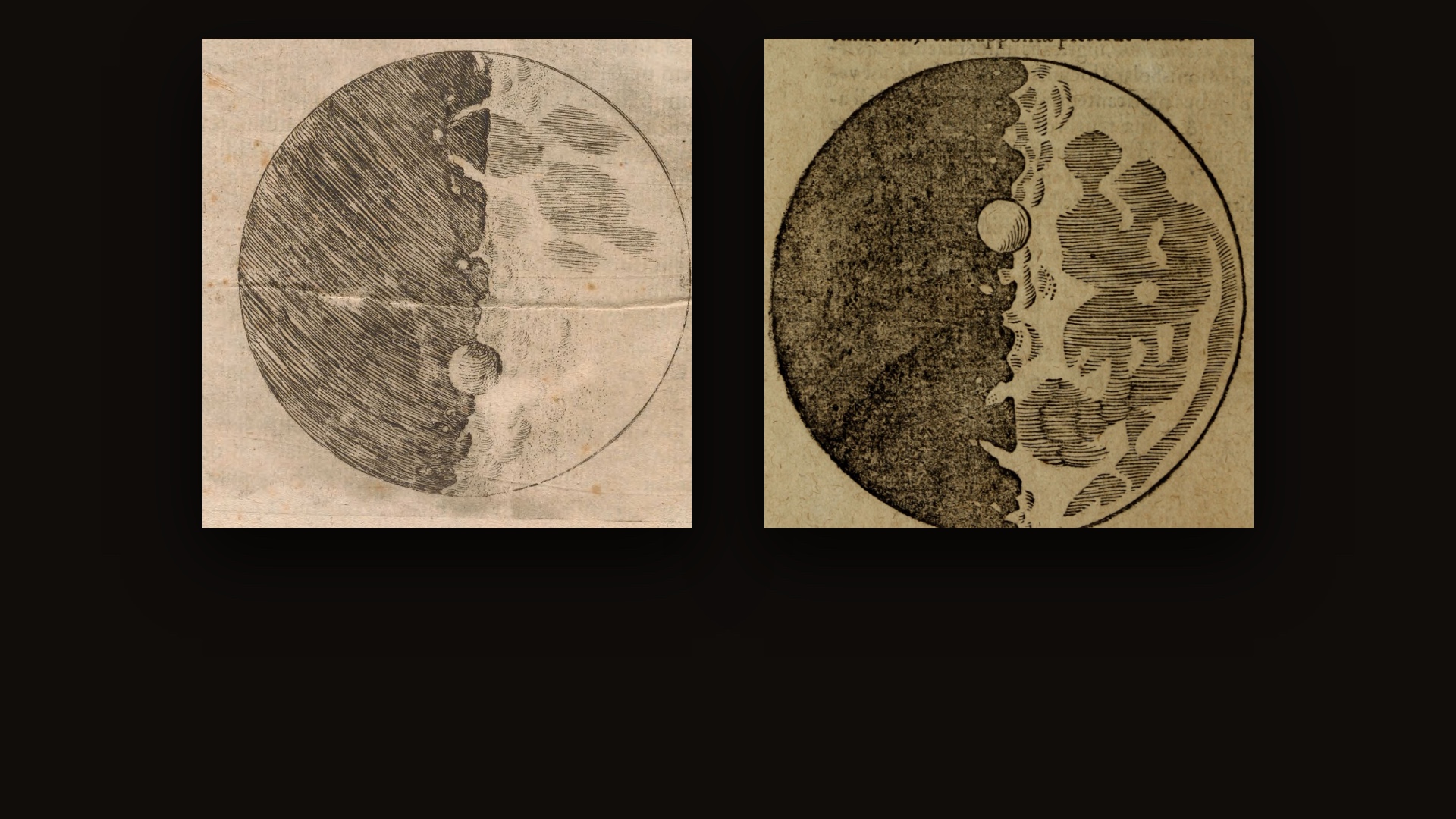
Venice 1610 · etchedFrankfurt 1610 · pirated
Precedent 1
Print was not automatically trustworthy.
The same Moon, the same year. Galileo’s own etching on the left; on the right a Frankfurt piracy, recut in wood and printed upside down with stronger contrast. The latter was far more reprinted. Which is, or becomes, true?
Precedent 2
Science had to build its trust network.
A demonstration is worthless unless someone credible saw it. The apparatus was never the hard part — assembling people whose word would be taken was, and it took decades.
What is to be done?
Critical Thinking via AI
Not a policy, and not a disclosure checkbox. The thing print eventually got: somewhere the work is done in the open, a record of who checked what, and a generation of students who have done the checking themselves and know what it costs.
amaranth.unm.edu
A digital humanities studio
Amaranth is a research and teaching space where faculty, students, and community partners investigate how digital methods can deepen humanistic inquiry, strengthen public scholarship, and build the digital literacy students need for an AI-shaped world.
Teaching
Teach peer review
When public scholarship is the default output, the possibilities and incentives change from day one: students write for readers, cite for strangers, and think about trust.
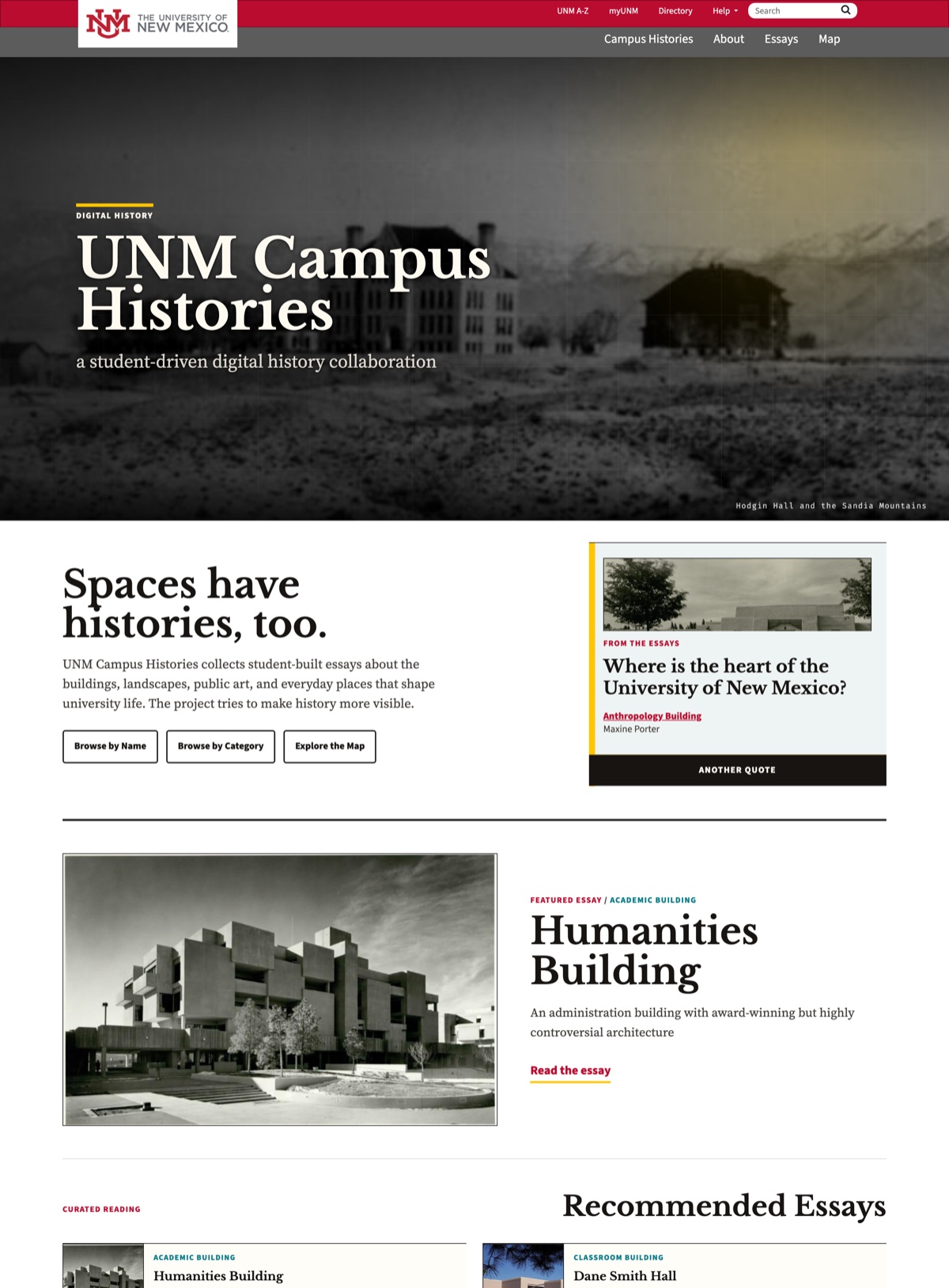
UNM Campus Histories — a multi-semester project. Each cohort builds on what the last one made.
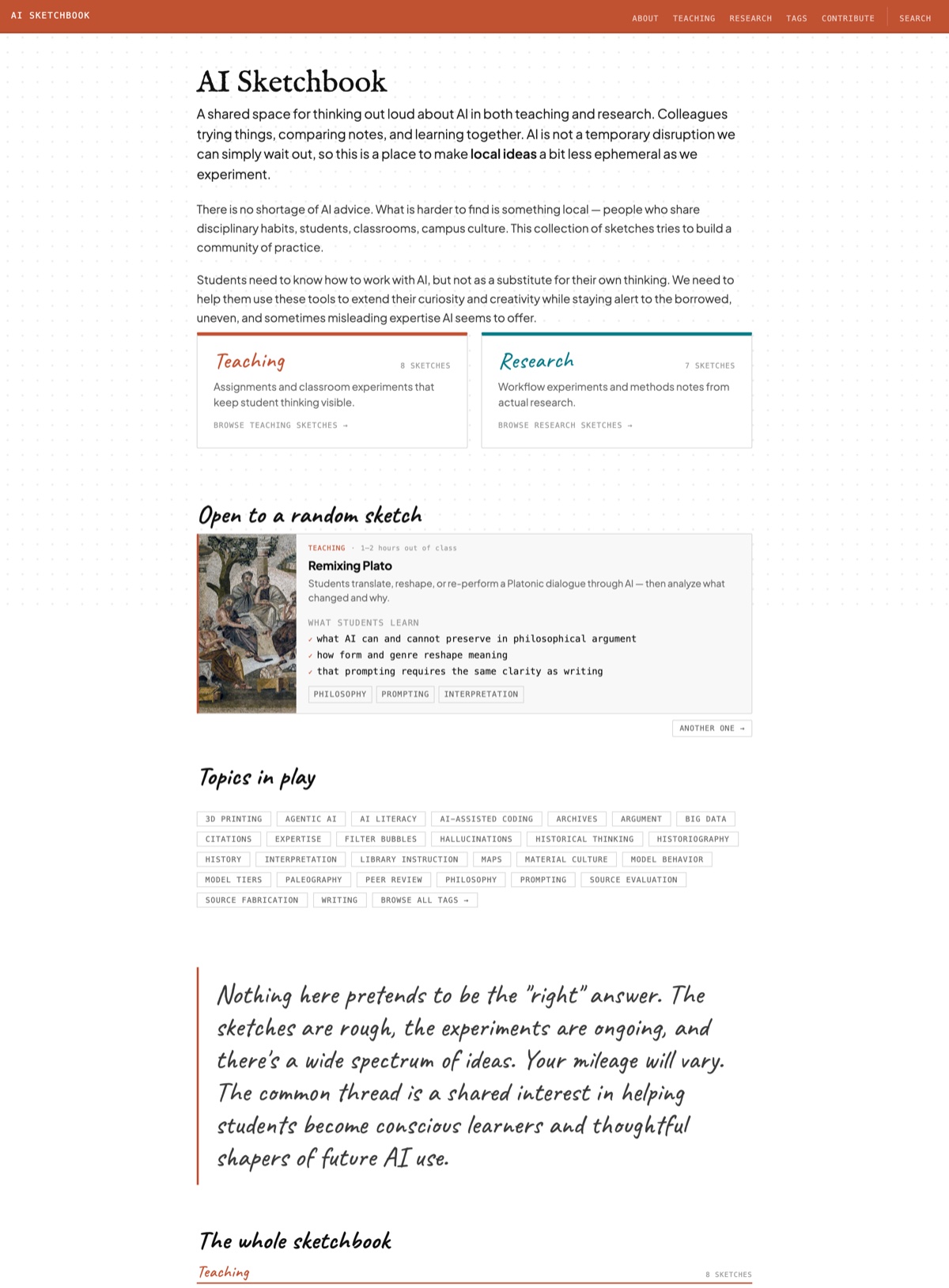
AI Sketchbook
Field notes, especially the failures.
A shared space where colleagues try something, write down what happened, and tag it. Fifteen sketches so far with fieldnotes — because the honest takeaway is usually that it half worked.
amaranth.unm.edu/ai-sketchbook
Critical Thinking through AI
What here is real? What isn’t?
A generated landscape of cliff dwellings. No site, no survey, no scale. Students are asked which parts they would defend, on what evidence, and what would settle it.
The questions
These slides are AI-generated
But what does that mean? Are they less trustworthy?
Does AI use matter when carefully mediated?
I have history credentials. What do AI credentials look like?
 Venice 1610 · etched
Frankfurt 1610 · pirated
Venice 1610 · etched
Frankfurt 1610 · pirated