Making History • HIST 1105 • Week 9.1
Inventing Nations
- Background: Sarah Maza, Thinking About History (2017), ch. 2: “The History of Where?”, 45–82
- Benedict Anderson, Imagined Communities (1983), Introduction, 1–7
- Partha Chatterjee, “Whose Imagined Community?” (1993), 214–225
Anderson is cited by the page of the Verso edition. Chatterjee’s essay first appeared as ch. 1 of The Nation and Its Fragments (1993); pages are those of the course PDF, its reprint in Gopal Balakrishnan, ed., Mapping the Nation (1996).
Today in context
What makes history happen?
Week 6.2 · Scott, 1986
Gender, as the system that makes arrangements of power look natural.
Week 7.1 · Ginzburg, 1976
One miller’s cosmos, and what a single case can be made to carry.
Week 9.1 · Maza, with Anderson and Chatterjee
Nations, which turn out to be recent, imagined, and partly the work of historians.
Week 9.2 · Trouillot and Said
Power, at every stage from making a source to telling the story.
Part one · the national frame
Until about 1800, Western history was not usually written nation by nation
“Before the nineteenth century, ‘the nation’ was not usually the context or object of Western historical writing.”
So how did the nation come to seem natural, and worth dying for?
Today’s map
Most countries are younger than a century, with borders drawn by Western empires
“Most of the countries on today’s world maps did not exist a hundred years ago: they secured independence within boundaries initially drawn by Western imperialists whose own nations resulted from eighteenth- and nineteenth-century revolutionary movements.”
Compare · 9.2
Said: describing and teaching “the Orient” was one of the ways the West ruled it.
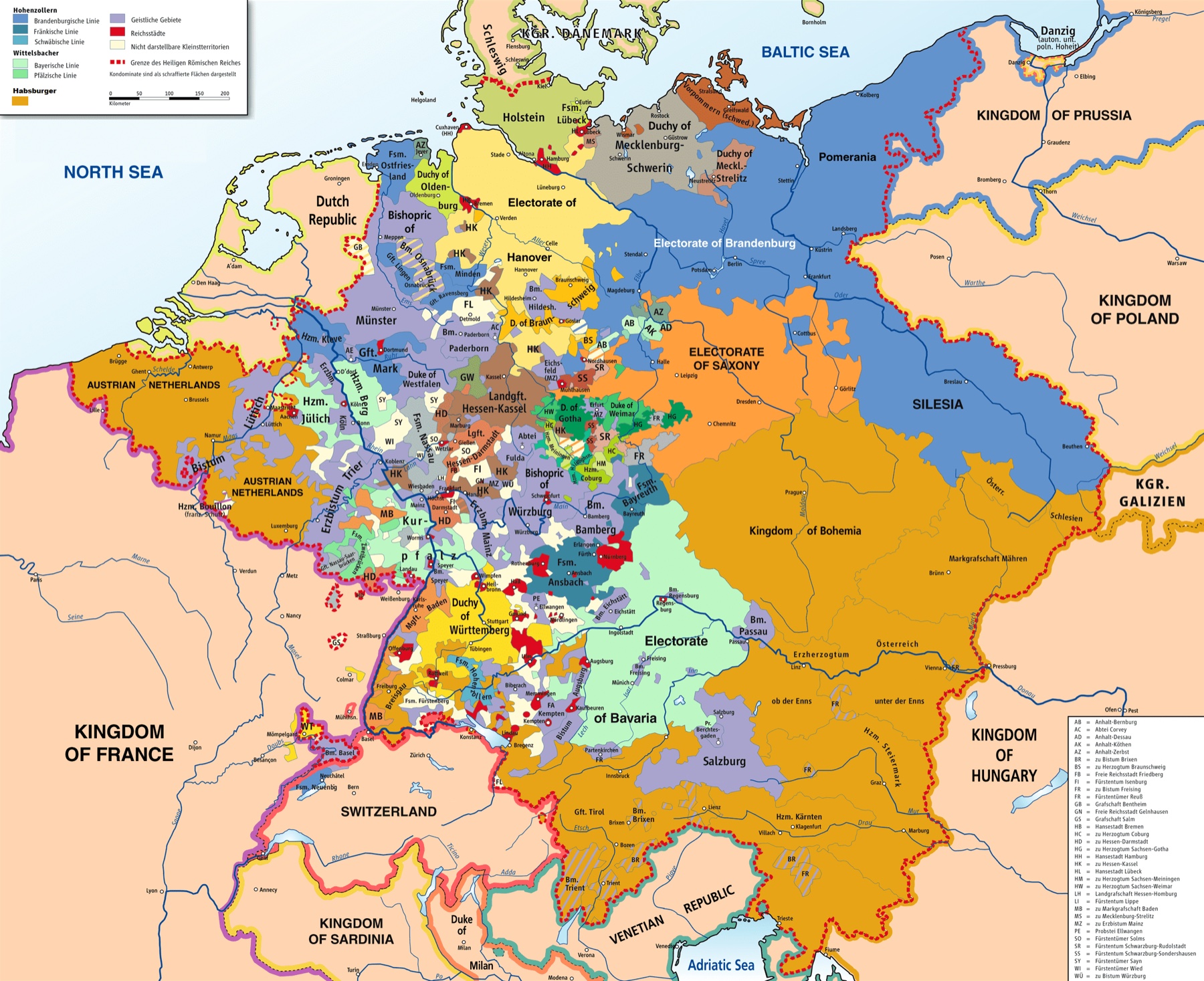
(Robert Alfers, after Putzger, 2008. Wikimedia Commons, CC BY-SA 3.0.)
Before 1800
Before 1800, most states belonged to rulers, not to the people in them
France · 1700s
The king’s kingdom
Subjects owed loyalty to the Bourbon king; in 1789 perhaps half of them spoke no French.
Habsburg lands · 1740
One family’s inheritance
Austria, Bohemia, Hungary and Milan, tied together by a dynasty rather than a language.
Venice · until 1797
A city that was a state
Merchant families governed it, and it held ports down the Adriatic until Napoleon ended it.
Ottoman Empire · 1700s
Subjects sorted by faith
From Algiers to Baghdad, the sultan’s subjects were grouped largely by religion, not by language.
Before 1800 · national feeling
National feeling is much older, but it was mostly defined against neighbors
“you knew you were Dutch in the sixteenth century because you loathed the Spaniards, British in the eighteenth century because you despised the French.”
Compare · Week 3
Bede wrote of “the English people,” the gens Anglorum, in 731, when there were only rival kingdoms.
The age of revolutions · 1776–1820s
What was new after 1776 was the nation as the source of power
“that state power should represent the collective will of a particular population or ‘citizenry’ that lived within the borders of a large, well-defined territory.”
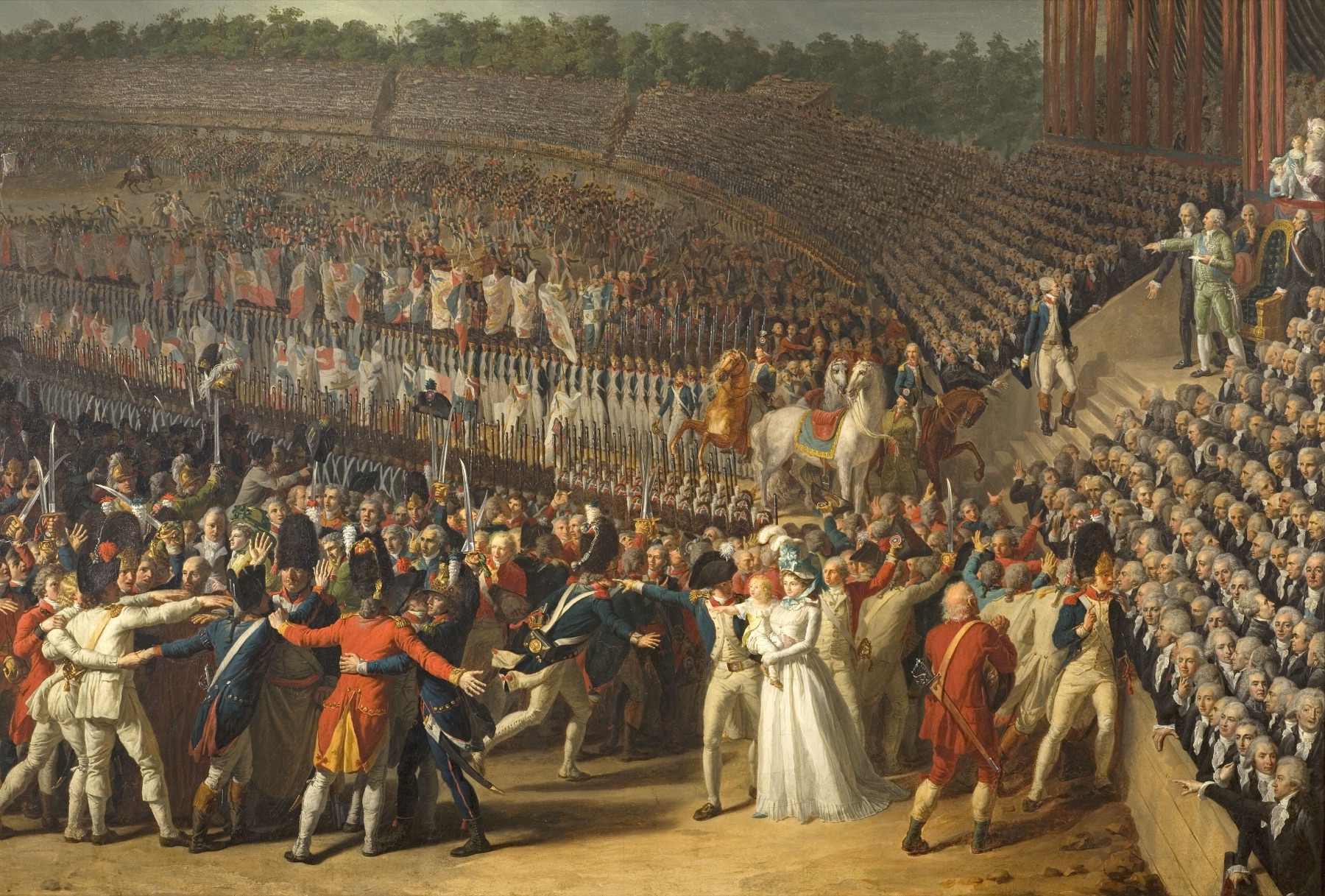
(Musée Carnavalet. CC0.)
The nineteenth century · national histories
Then historians wrote each nation an admirable past
“leading historians in various parts of the West published classic works of national history built around the premise that their country’s past illustrated the advent of admirable values and ideals embodied in its people.”
The nineteenth century · the profession
The first professional historians mostly celebrated their own nations
“It was natural, if not inevitable, for the first generations of ‘professional’ historians to focus on, and usually celebrate, the history of their respective nations.”
Ranke · 1824
Ranke’s scientific history, too, began with the nations he counted as kin
“the author will remain close to the racially kindred nations of either purely Germanic or Latin-Germanic origin whose history forms the heart of all modern history.”
Compare · Week 4
Treitschke, trained under Ranke, made Bismarck’s unification of Germany look inevitable.
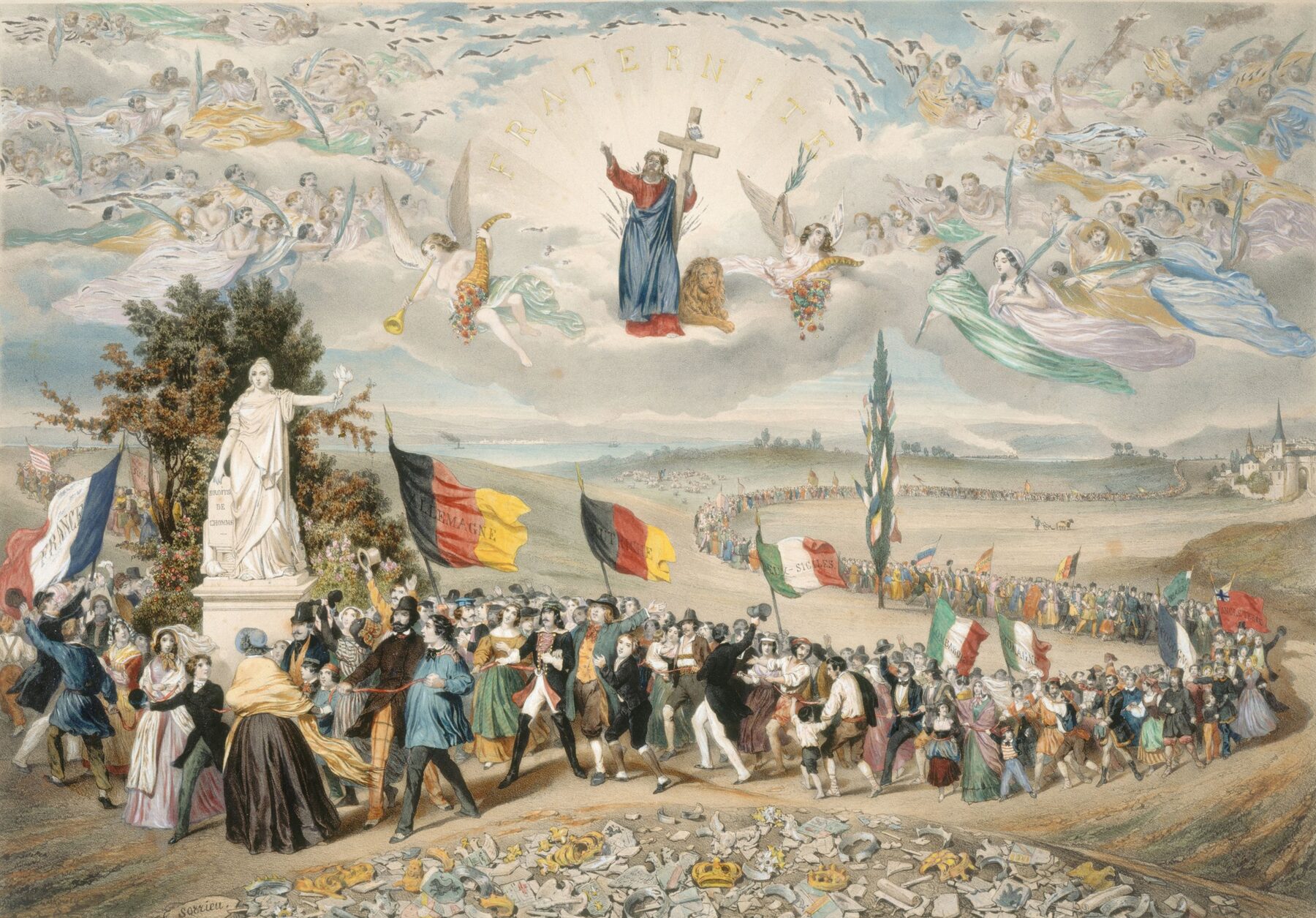
(Musée Carnavalet, Paris. CC0.)
Part two · 1914
In 1914 nationalism was at its height
“soldiers marched off in a haze of patriotic fervor, and almost nobody questioned the need to slaughter fellow Europeans or the glory of a battlefield death.”
After 1914 · doubts
After the wars and the end of empire, nationalism stopped looking natural
“Extreme nationalism was tainted in the mid-twentieth century by its association with murderously repressive regimes in Spain, Italy, Japan, and especially Germany. And in subsequent decades, critics of the West began to point out that standard concepts of the nation and nationalism were Euro-American inventions arbitrarily imposed upon colonized peoples.”
Then, in the academy
Scholars turned to “‘denaturalizing’ nationhood, that is, exposing its artificiality by looking at how and why this particular way of conceiving of human communities came about” (p. 51).
Anderson · 1983
Anderson asked why such recent communities demand such sacrifice
“what makes the shrunken imaginings of recent history (scarcely more than two centuries) generate such colossal sacrifices?”
Anderson · 1983
His starting point: nations are imagined, since members never meet most of the others
“it is an imagined political community – and imagined as both inherently limited and sovereign.”
Anderson · 1983 · how
His mechanism: print capitalism let strangers read the same news on the same day
“Nationalism might be visceral and idealistic, Anderson argues, but it grew out of eighteenth- and nineteenth-century technological and commercial developments such as the ‘print capitalism’ that gave us the daily national newspaper. Readers who consume the same information, the same day, in a language particular to their country, are constantly made aware of the existence of others to whom they are virtually connected by such time- and space-bound rituals.”
Anderson · 1983 · why
His second answer: nations took over religion’s work of linking the dead and the unborn
“with the decline of religion as a way of explaining broader public and historical forces, membership in a ‘nation,’ with a particular, redemptive destiny, became a way of linking random individual fates to a larger purpose, of ‘creating links between the dead and the yet unborn.’”
The 1880s and 1890s · symbols
Meanwhile, historians found that many “timeless” symbols dated from the 1880s and 1890s
“In Europe and America most of the major symbols of national belonging—flags, national capitals, anthems, monuments, and commemorative holidays—date from the last quarter of the nineteenth century”
United States · 1892
The first national Columbus Day, in 1892, was built around schools and the flag
“Let the national flag float over every schoolhouse in the country and the exercises be such as shall impress upon our youth the patriotic duties of American citizenship.”
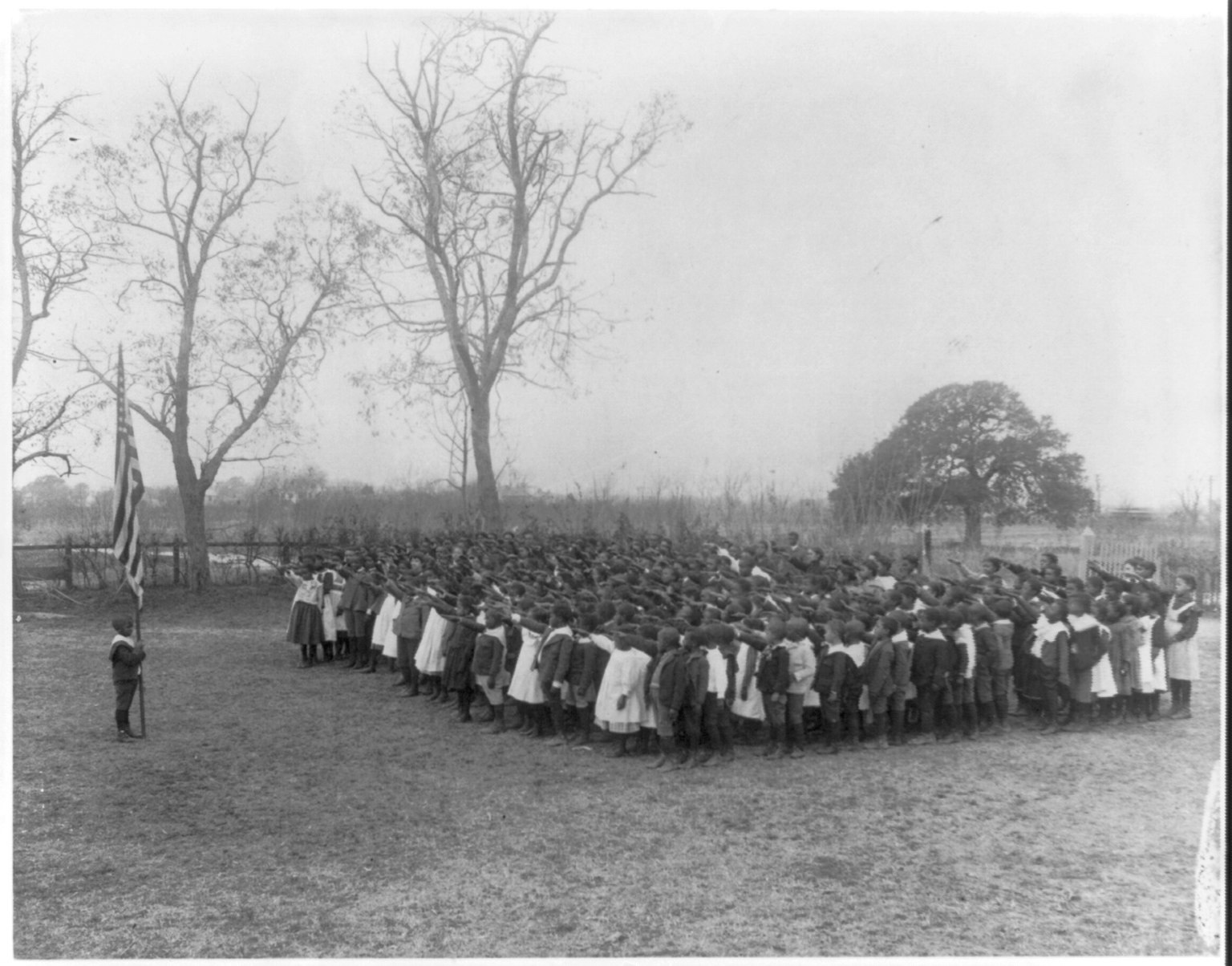
(Frances Benjamin Johnston. Library of Congress. No known restrictions.)
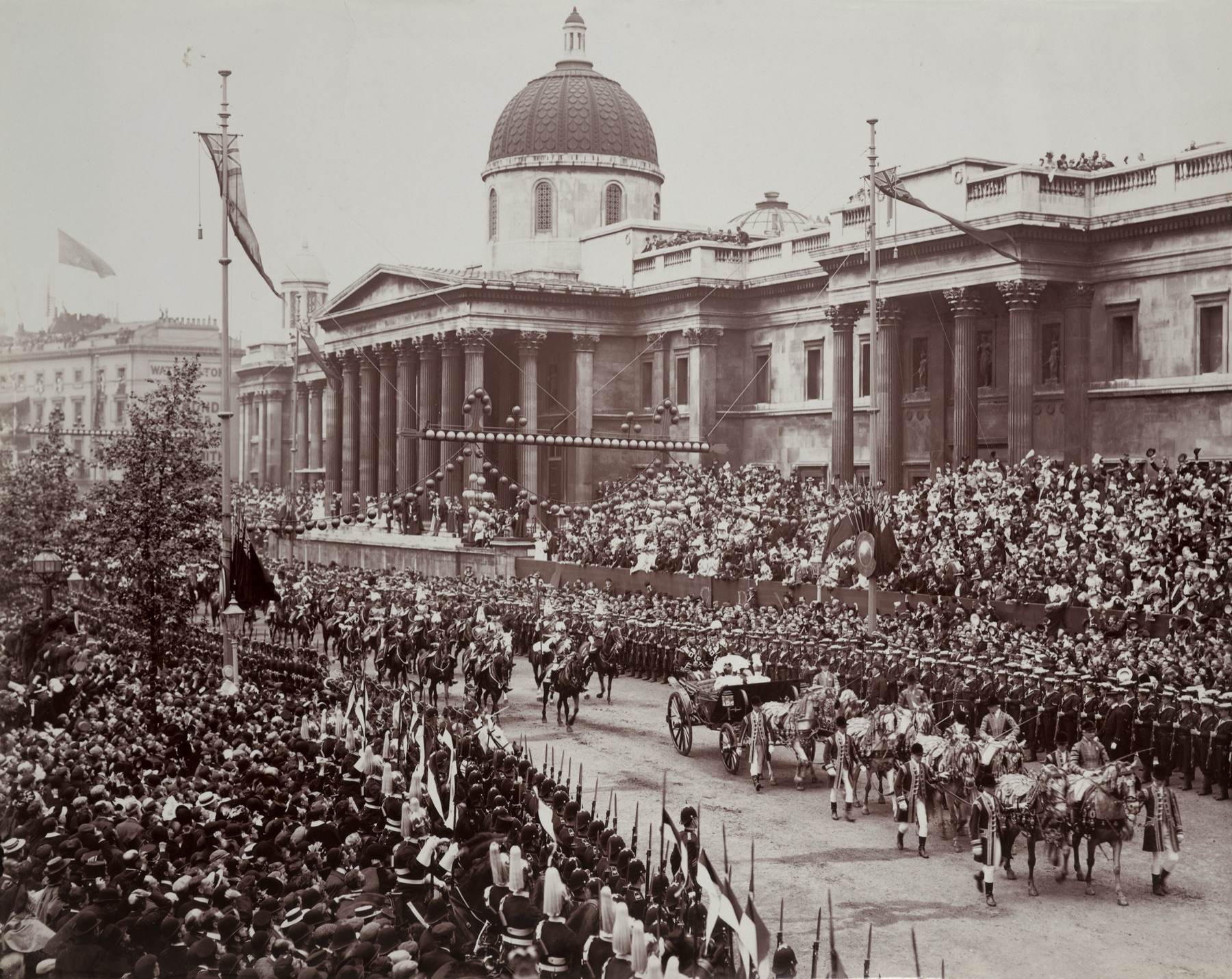
(Royal Collection Trust, RCIN 2109693. Public domain.)
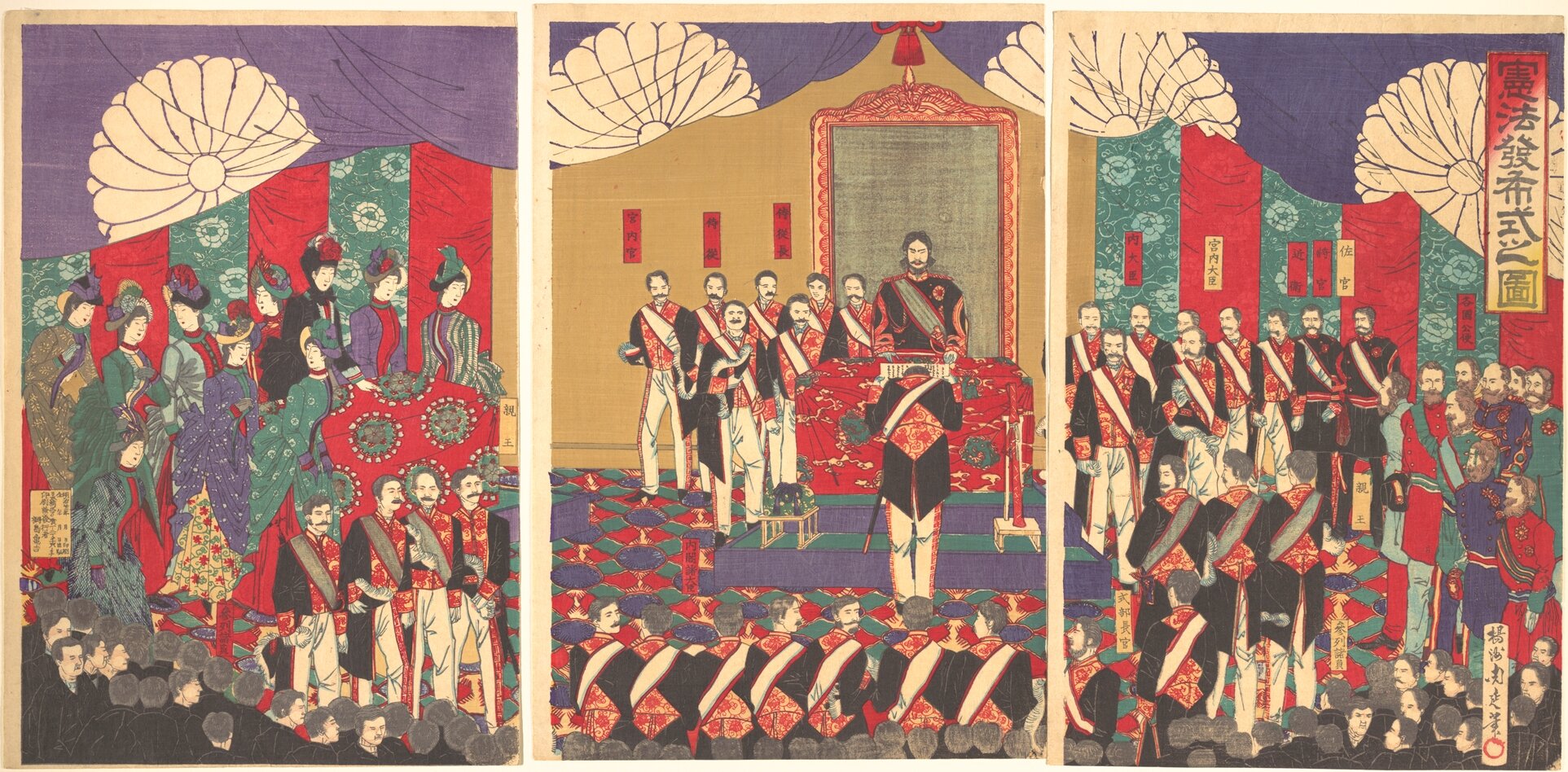
(Metropolitan Museum of Art. CC0.)
Nations and empire
Nationalism grew against empires: first in the Americas, last in Africa and Southeast Asia
“the earliest forms of modern nationalism were forged in North and South America in opposition to British and Spanish metropolitan power, and the latest, in twentieth-century Africa and Southeast Asia as part of a complicated dynamic of imitation and repudiation of foreign colonizers.”
Memory · 1882
Nations chose what to remember, and what to forget
“The essence of a nation is that all individuals have many things in common, but also that they have forgotten many things.”
After 1914 · war memorials
Since the Great War, memorials name ordinary soldiers as the proof of the nation
“the sheer number of the dead . . . provide a visceral demonstration that the ultimate proof of the nation’s existence is the purposeful mass sacrifice of ‘ordinary heroes’ on the battlefield.”
Before the twentieth century
Rulers like Alexander and Frederick the Great “won” the battles. The Great War was “a watershed in the democratization of national remembrance”: governments began recording the names of the ordinary dead (p. 54).
Compare · Anderson
His question was why such recent communities generate “such colossal sacrifices” (p. 7). Memorials make the answer visible.
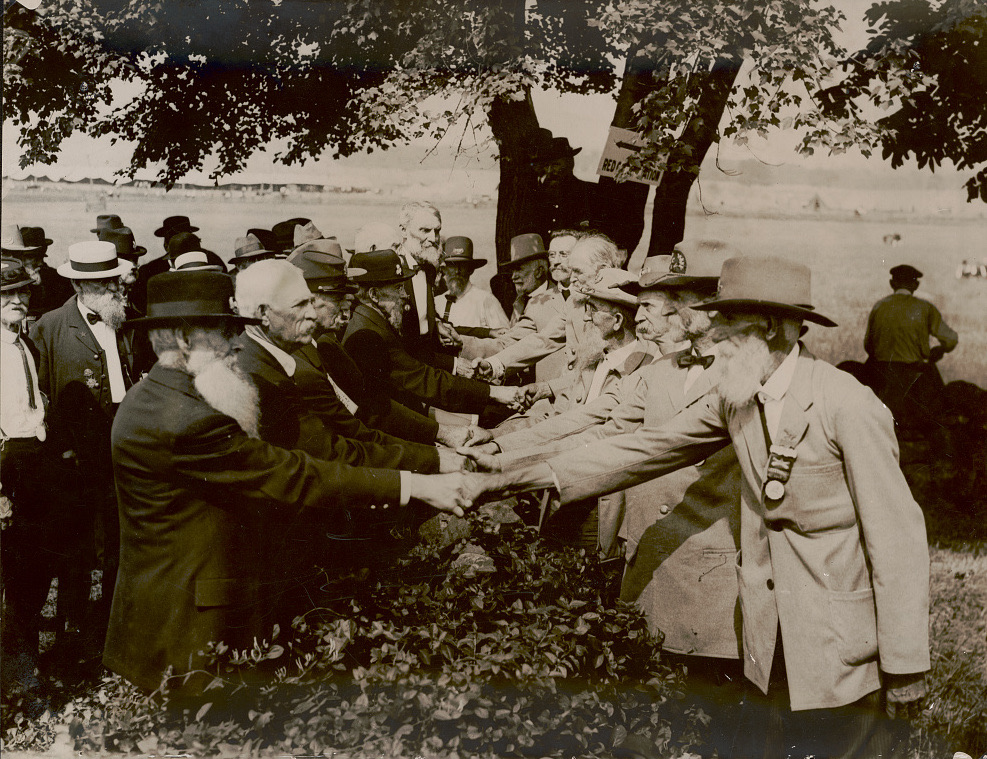
(International News Service, 1913. Library of Congress. No known restrictions.)
Part three · from the colonies
History became a profession under empire, so Europe’s past became everyone’s model
“Since professional historical scholarship came of age in the heyday of European imperialism, that continent’s history from the start served as a yardstick and model not only for Euro-American historians but their counterparts in Africa, Asia, and Latin America.”
Chatterjee · 1993 · agreement
Chatterjee accepts Anderson’s starting point: nations are imagined, and the state came from Europe
Nations are imagined
He builds on Anderson’s concept and does not try to overturn it.
The state form came from Europe
The nation-state took shape in Europe and the Americas, and colonial rule carried it to Asia and Africa.
Chatterjee · 1993 · disagreement
He disputes that the colonized could only copy the model Anderson calls “modular”
“If nationalisms in the rest of the world have to choose their imagined community from certain ‘modular’ forms already made available to them by Europe and the Americas, what do they have left to imagine?”
Where they part
Anderson’s story is a European one that the rest of the world joins late. For Chatterjee that leaves the colonized only a copy to make.
Chatterjee · 1993 · alternative
His alternative: the colonized imagined a nation of their own before they held the state
Outer domain
State, economy, science
The colonizer held it, so nationalists learned Western methods here.
Inner domain
Home, language, religion, the arts
They claimed it as the place where the nation was already sovereign, and kept it distinct from the West.
“The greater one’s success in imitating Western skills in the material domain, therefore, the greater the need to preserve the distinctness of one’s spiritual culture.”
Maza, 2017 · looking back
The nation made, explained, and seen from the colonies
01 · 1700s–1900s
Made, and given a past
Nations replaced dynasties as the source of power, and historians such as Michelet, Macaulay and Bancroft wrote each one a past.
02 · Anderson, 1983, and after
Imagined and remembered
The nation took over religion’s work of linking the dead and the unborn; new symbols and selective forgetting made it look ancient.
03 · Chatterjee, 1993
Imagined from the inside
Colonized nationalists copied Europe’s state and remade their culture as modern but not Western.
04 · Maza, 2017
No longer natural
Historians still work nation by nation, but have “long since lost our innocence about what nations are and how they came about” (pp. 81–82).
The take home
Leaving the nation behind means giving up the stories that gave history its shape
“There is a significant price to pay, however, for thinking outside of ‘the nation’ and ‘modernity’: it entails letting go of familiar stories (the ‘rise,’ ‘development,’ or ‘triumph’ of . . .), and possibly of any all-encompassing stories about the past whatsoever.”
Wrap-up · question 1
What is an “invented tradition”? Can you think of examples from your own life?
Ideas to keep in mind
- A practice that presents itself as ancient but was made recently, often on purpose
- Repetition and ritual: flags, anthems, holidays, ceremonies, uniforms
- Continuity is claimed, not inherited: a past is chosen to fit the present
- Maza’s examples: the Pledge, Columbus Day, jubilees, the Meiji emperor cult (pp. 52–53)
Wrap-up · question 2
Anderson says nations are “imagined.” Does that make them fiction?
Ideas to keep in mind
- “Imagined” is not “false”: Anderson contrasts styles of imagining, not real and fake
- Members never meet most of their fellow members, yet act as one community, linked by shared print such as the daily newspaper
- Real in effect: “bureaucracies, armies, schools, laws, police forces, censuses, passports” (Maza, p. 52), and “colossal sacrifices” (Anderson, p. 7)
- Made, not given: if a nation was made, it has a history we can ask about
- What is fictional is the claim to deep roots: Maza speaks of “fictions of the modern nation’s deep historical roots” (p. 52)
Wrap-up · question 3
Did colonized peoples follow Anderson’s model?
Ideas to keep in mind
- Anderson’s “modular” nation, available for copying, leaves the colonized nothing to imagine
- Colonial rule already held the state, the economy and “modern” institutions
- Two domains: the material and outer (state, science, economy) and the spiritual and inner (home, language, religion, culture)
- They copied the West in the first and kept the second distinct: modern, but not Western
- Nationalism begins before political power: in culture, well before the fight for the state
Wrap-up · question 4
How does history make a nation feel real?
Ideas to keep in mind
- Giving the nation a past: national histories (Michelet, Macaulay, Bancroft), admirable founders and values
- Symbols, rituals and schools: flags, holidays, pledges, anthems, monuments, war memorials
- Selective memory and forgetting (Renan); Gettysburg 1913 leaves out slavery and Black veterans
- Who imagines: states, historians, empires, colonized nationalists, excluded groups
- Conditions: ruling or ruled, empire or colony, state in hand or still to be won