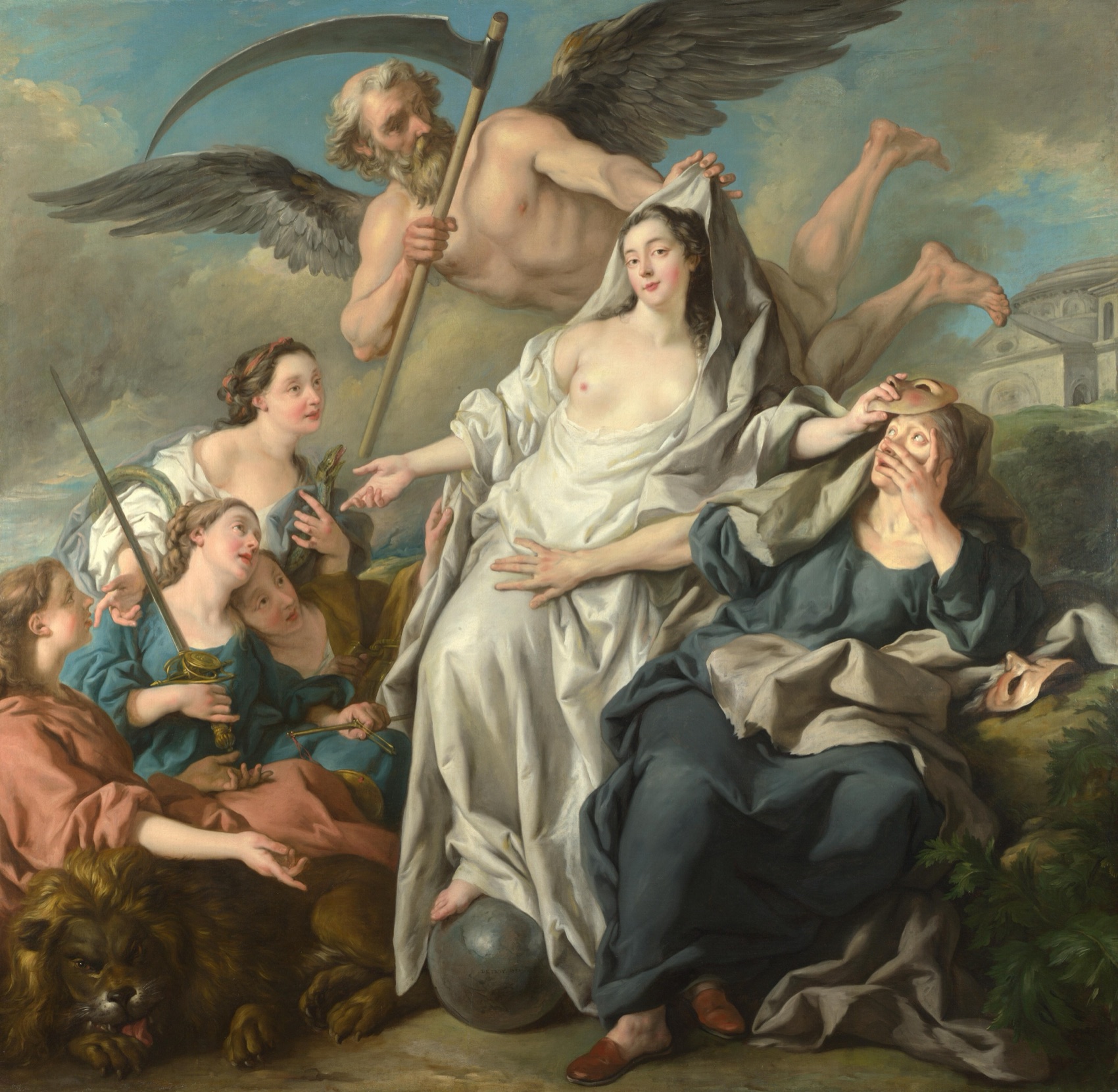
(National Gallery, London, NG6454. Public domain.)
- Time does the unveiling. The winged old man with the scythe is Time, and he is the one pulling the cloth back. Not revelation, not authority — the passage of years. That is the Enlightenment’s central historical claim in one gesture, and it is the exact reverse of every scheme we just looked at, where time makes things worse.
- Truth’s foot rests on the globe. She is bright, unclothed and universal — true everywhere, for everyone. That assumption is what makes a single standard of civilization thinkable, and it is precisely what Herder will refuse at the end of today.
- Falsehood recoils, clutching masks. Error is not shown as honest mistake; it is disguise, turning away from the light. Enlightenment writers cast their opponents the same way — superstition and priestcraft as interested concealment rather than sincere disagreement.
- Nothing here is argued. It is asserted, in the confident visual shorthand of an age that took the claim as settled. Voltaire and Kant have to do what this painting skips.
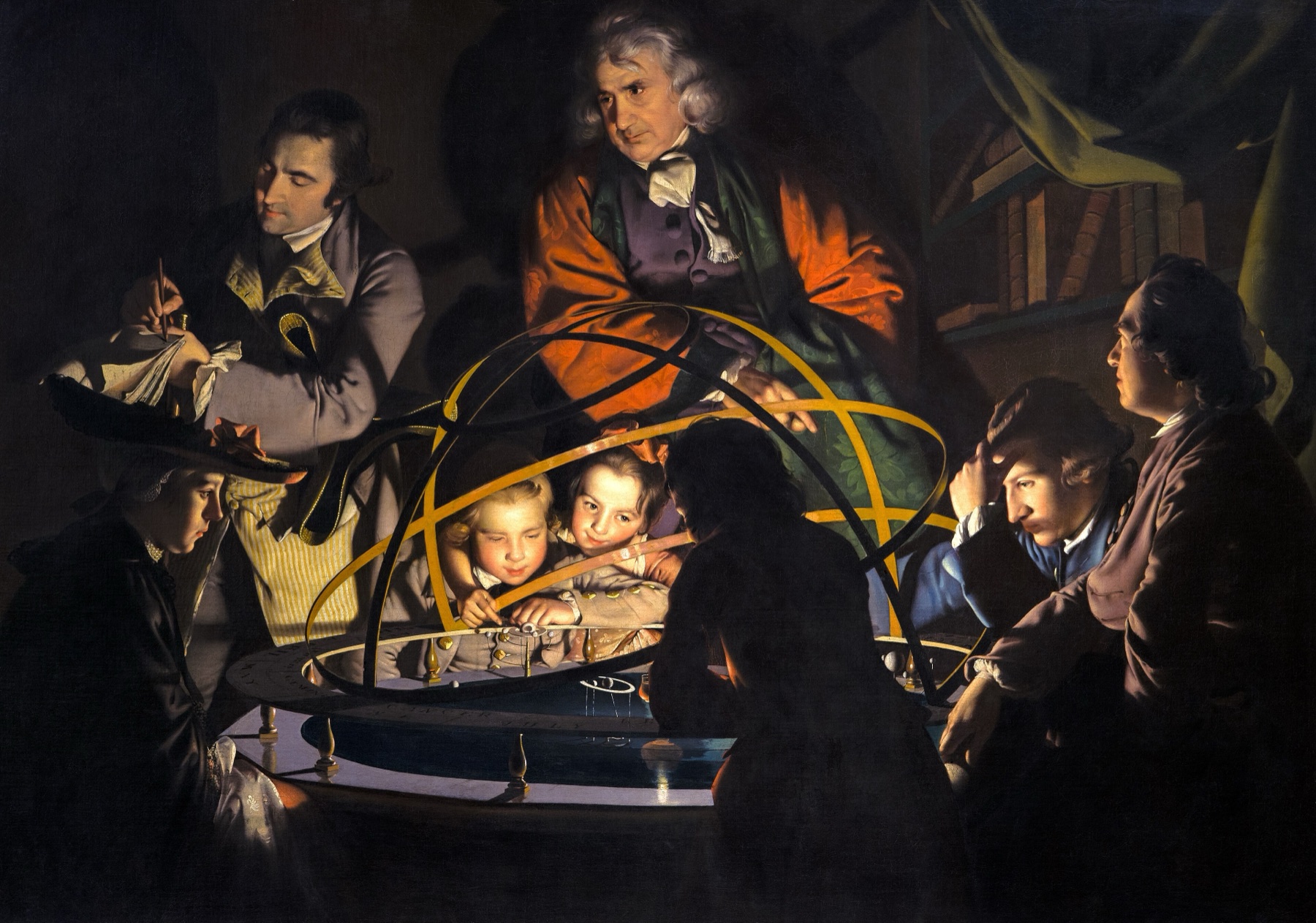
- The brass rings are an orrery, a working model of the solar system, and the lamp at its center stands in for the sun. The universe is being shown as a mechanism whose parts run on rules you can predict — the same kind of order Kant will claim history has, working whether or not anyone intends it.
- The light is inside the machine. Every face is lit by the model itself. The age’s favorite metaphor, made literal: illumination comes from the thing studied, not from above it.
- Someone is being paid to do this. Traveling lecturers sold natural philosophy to provincial audiences by subscription. Enlightenment is not only books and salons; it is a market — which is why the printers and booksellers matter, besides the writers.
- Two children are closest to the mechanism. The scene is arranged around who comes next. That is Diderot’s stated reason for the whole Encyclopédie: to transmit it to those who come after, so past labor is not wasted.
Before we start
Two questions to hold onto
- How did Enlightenment thinking change what history was for?
- Three hundred years later, what did it matter?
Making History • HIST 1105 • Week 4 · part one
Enlightenment Progress
- Voltaire, Age of Louis XIV (1751), Introduction
- Kant, “Idea for a Universal History with a Cosmopolitan Purpose” (1784)
- Background: Popkin, ch. 3, 61–69
Voltaire cited by page (Fleming translation, the edition on the syllabus); Kant by thesis number (Beck translation); Popkin by page.
The take home · three things
Progress was not discovered. It was argued for.
01 · Nobody observed it
Nobody in 1751 walked outside and saw that history was improving. Writers argued it — in books, for reasons, against opposition, and for different purposes.
02 · What they were arguing for
That human beings improve their own world by their own work — no providence, no golden age to get back to. Voltaire makes the case out of taste and cultural achievement, Kant out of theory. Both get called progress.
03 · And every case needs a measure
To argue that things got better you have to say better at what. Name it, and you have sorted everybody by it — whether or not that was the point.
Where we’re going · four parts
The idea, the two writers you read, and what the next generation did with it
01 · Before either book
Where the idea came from
The Renaissance had already cut time in three. A literary quarrel turned it around — and left history with a new job.
02 · Voltaire, 1751
Progress you can see
Four ages in the whole history of the world, ranked by taste and manners, with one court at the top.
03 · Kant, 1784
Progress you have to argue for
Not which age had the most taste, but why history as a whole should be going anywhere at all.
04 · What became of it
A ladder, and the objection
Condorcet and Ferguson turn the idea into a scale you can measure people on. Herder, the same year as Kant, refuses it.
Bridge between weeks 3 and 4
Before you can say history improves, you have to cut it into pieces
“Renaissance historians stopped dividing history according to the framework of the ‘four empires’ inherited from the Bible and began instead to speak of three periods, antiquity, a ‘middle age’ from the fall of the western Roman Empire to their own day, and the new era in which they themselves lived, a way of dividing history into periods that is still prevalent.” Popkin, From Herodotus to H-Net, pp. 50–51
What we saw last week
Valla proving the Donation of Constantine a forgery out of its own Latin. Machiavelli and Guicciardini writing what Popkin calls “purely secular narratives that made no pretense of trying to fit events into a divinely ordained plan or a grand scheme of universal history” (p. 52). Critical method and human causation are both in place a century before anyone says “Enlightenment.”
What a periodization does
Naming the blocks decides three things at once: where one age stops, what the next one is for, and which block the author is standing in. Nobody finds these seams in the evidence. They are drawn. The rest of this part is people drawing them.
Before either book · the inherited options
Three shapes time could have, and not one of them is progress
“Roman historians lamenting the corruption of republican values, Christian writers for whom human history began in the Garden of Eden, and Renaissance humanists for whom classical antiquity represented the pinnacle of human achievement had all agreed that the passage of time had left human beings worse off than they had once been.” Popkin, From Herodotus to H-Net, p. 62
This course has read all three
Classical: decline from a golden age. Livy, on Rome falling away from its own virtue — here the good part really is behind you. Christian: fallen, but aimed. Bede counts from the Incarnation toward a fixed end. The world is worse than Eden and still going somewhere, on a schedule nobody sets. Humanist: a standard not yet matched. Antiquity as the mark the present is trying to reach again.
What they share, and what they don’t
Popkin’s point is the agreement: all three hold that time has left people worse off than they once were. But only the first runs simply downhill; the Christian version has a destination — which is why it is the one Kant will still need when he takes God out. None of them offers a future better than any past, reached by human work.
The scheme being dropped · Daniel 2
The Bible already had a periodization, and you were living in its last age
“This image’s head was of fine gold, his breast and his arms of silver, his belly and his thighs of brass, His legs of iron, his feet part of iron and part of clay.” Daniel 2:32–33, King James Version
What the statue was taken to mean
Daniel reads the dream to Nebuchadnezzar as a sequence of kingdoms: “Thou art this head of gold. And after thee shall arise another kingdom inferior to thee, and another third kingdom of brass… And the fourth kingdom shall be strong as iron” (2:38–40). Medieval chroniclers inherited it as four empires — Babylon, Persia, Greece, Rome — and counted their own rulers as Rome still going. This is the “framework of the ‘four empires’” in the Popkin sentence you just read.
Read the metals in order
Gold, silver, brass, iron, then iron mixed with clay — and the last one is the one you are standing in. But notice where it is heading: there is no fifth kingdom, because what comes next is not another empire but the end — “in the days of these kings shall the God of heaven set up a kingdom, which shall never be destroyed” (2:44). This is not a story about decay. It is a story with an appointment.
Take home
For a thousand years this was the standard answer to “what period am I in?” The fourth one. The last one. And the ending is already written. History has a direction here — it just isn’t ours to steer, and there is nothing to build.
Petrarch · 1304–1374
The middle age begins as a complaint about being born at the wrong time
“there was a more fortunate age and probably there will be one again; in the middle, in our time, you see the confluence of wretches and ignominy.” Petrarch, Epistolae metricae III.33, trans. Theodor E. Mommsen, Medieval and Renaissance Studies (Cornell, 1959), pp. 127–128
Who is talking, and what he is actually doing
A Tuscan poet who spent his life hunting down, copying and correcting ancient Latin manuscripts — close enough to Cicero’s prose to hear how far his own century had drifted from it. He is not proposing a chronology here. He is complaining about his luck. But count the times: a better past, a possible better future, and in medium, “in the middle,” the present. The middle age exists because Petrarch needed somewhere to be standing.
And the metaphor that stuck to it
At the end of the Africa he writes to his own poem: “This sleep of forgetfulness will not last for ever. When the darkness has been dispersed, our descendants can come again in the former pure radiance” (IX.451–457, same translation, p. 127). Note what the better future is: a return. The best case is getting antiquity back. That is where “the Dark Ages” comes from — not from anyone who lived in them.
Take home
Petrarch cuts history in three by putting himself in the gap between two better times. Two centuries later Vasari fills the third period in with artists and calls it a rebirth. A periodization is always drawn by someone, standing somewhere — which is exactly what Voltaire will do with his four ages.
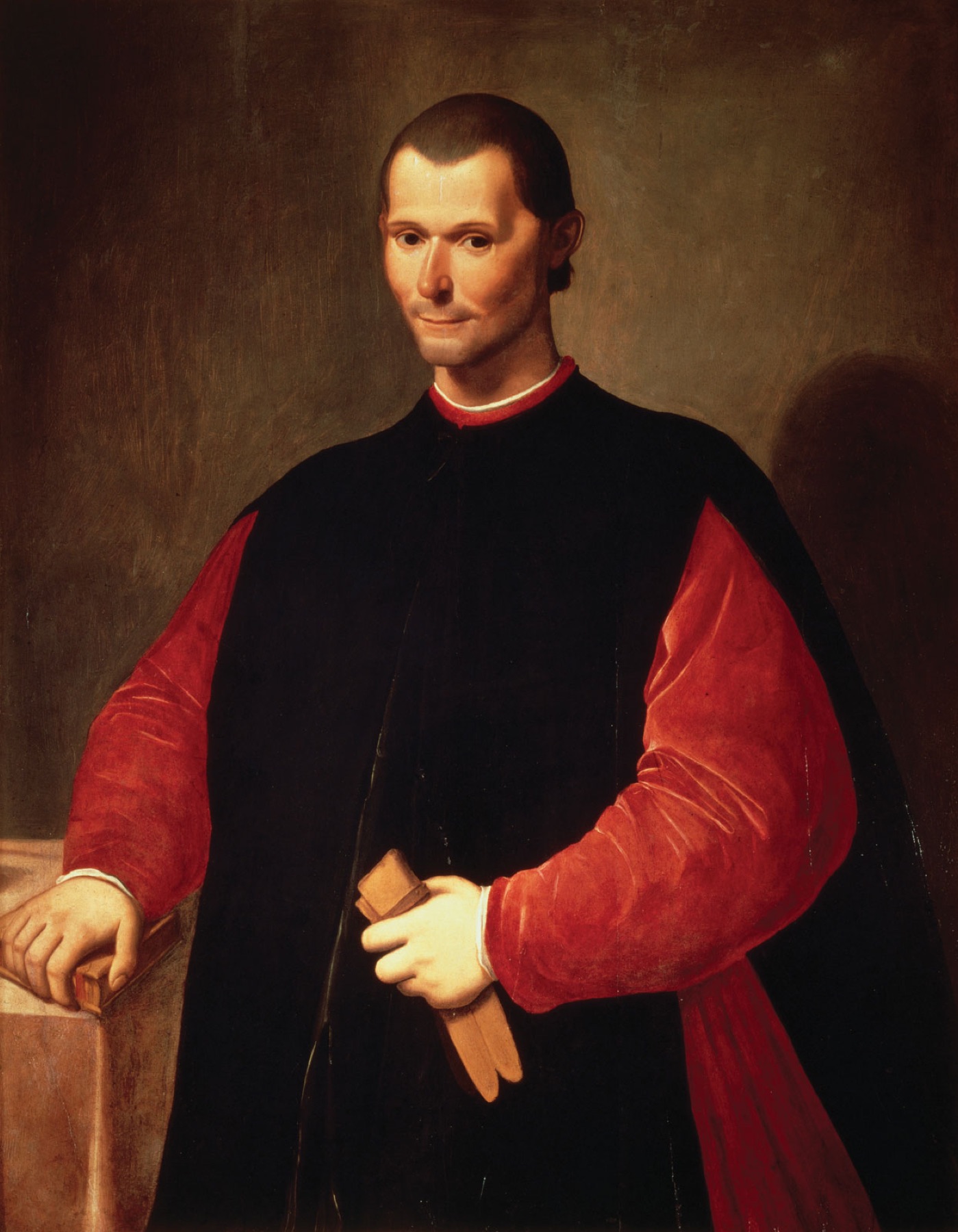
(Santi di Tito, Palazzo Vecchio, Florence. Public domain.)
Vasari · 1511–1574
The first history of art, written by a painter on the payroll
The man
Born in Arezzo in 1511; painter and architect to Cosimo I de’ Medici in Florence. He decorated the Palazzo Vecchio and, from 1560, designed the Uffizi. He is not a scholar looking in from outside the trade: he is inside it, and inside the patronage that pays for it.
The book
Le vite de’ più eccellenti pittori, scultori et architettori — Florence, 1550, much enlarged in 1568. Two hundred artists’ lives, and the first attempt to narrate art as a development rather than a list. He wrote it while helping Cosimo found the Accademia delle Arti del Disegno (1563).
Keep this in view
The first history of art was written by a man with a stake in its outcome, about a period that ends with his own colleagues, for the duke who employed them all. Nobody had to force a bias in later. It came built in.
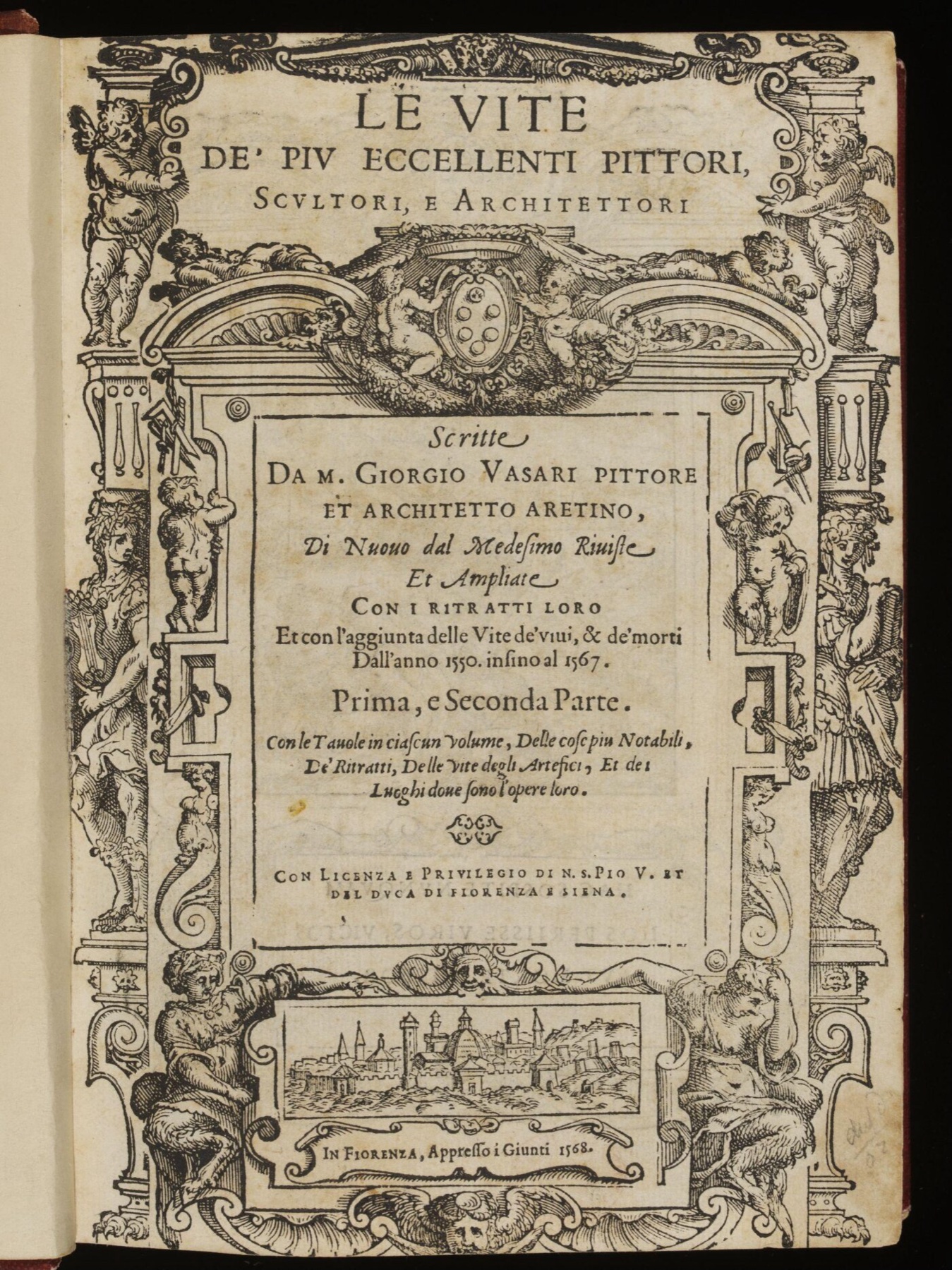
(Public domain.)
Vasari · Preface to the Second Part, 1550
Three ages, and the third one is his own
“having made a distinction and division… into Three Parts, or we would rather call them ages, from the second birth of these arts up to the century wherein we live, by reason of that very manifest difference that is seen between one and another of them.” Vasari, Lives, Preface to the Second Part, trans. Gaston du C. de Vere (1912–14)
“Second birth” is meant literally
His model is a life cycle. The arts, he writes in the Preface to the Lives, are “like human bodies,” and “have their birth, their growth, their growing old, and their death” — which is why he can speak of “the progress of her second birth and of that very perfection whereto she has risen again in our times.” Art died with Rome. Giotto is its infancy, the fifteenth century its adolescence, and his own generation its maturity. This is where our word Renaissance comes from: a rebirth, on the calendar.
And the third age has nowhere left to go
Of his own century he writes that “art has done everything that it is possible for her, as an imitator of nature, to do, and that she has climbed so high that she has rather to fear a fall to a lower height than to ever hope for more advancement.” The peak is now — and because the peak is recovery, the ceiling is antiquity regained. There is no room above it.
Take home
Two centuries before Voltaire’s four ages, here is a writer ranking periods by achievement and awarding the prize to his own. The move is old. What is missing is a future — and that absence is exactly what Kant and Condorcet will fill.
The Enlightenment · roughly the 1680s to the 1790s
Not a doctrine or a membership. A network, a print market, and a censor.
Who, and where
No institution, no manifesto, nobody who could say who was in it. A loose international traffic of writers, most of them not employed to think: Paris salons, Edinburgh clubs, Berlin, Naples, Philadelphia — and one salaried professor in Königsberg. They called it the Republic of Letters.
What made it possible
Two centuries of print. By 1700 there was “a large enough reading audience to support historical publications that were not underwritten by rulers or the church” (p. 59) — a writer could live on readers, not patrons. Learned journals reviewed the output; “[t]he system of ‘peer review’… began to take shape” (p. 58). Against it: “formal systems of censorship, which had not existed in the Middle Ages” (p. 56), requiring approval before a book could be printed.
Why this matters for today’s two texts
Both show their publishing situation on the page: Voltaire’s printed in Berlin under another man’s name, Kant’s a magazine piece answering a rumor in another magazine. The Enlightenment is not only a set of ideas. It is a print economy with a censor in it.
The idea · before either book
The turn happened in an argument about poetry
“As the ‘moderns’ began to prevail in this debate, they opened the way to a new vision of the meaning of time in which the future, with its possibilities for further achievement, loomed larger than the past.” Popkin, From Herodotus to H-Net, p. 62
The quarrel
Not a treatise, and not a discovery. In the last decades of the seventeenth century the “quarrel of the ancients and the moderns” set writers who held that the Greeks and Romans could never be surpassed against writers who held that their own century had already matched them. It was about poems, plays and prose style.
What the moderns’ win changed
Every scheme in the last four slides put the best age behind, or above, or already reached. Win the argument that living writers can beat the ancients, and the ceiling comes off: the best age can be one nobody has seen yet. That is the opening Voltaire and Kant walk through — and it is what makes their claim different from Vasari’s rebirth.
Take home
The most consequential idea in this week’s reading started as an argument about whether living poets were as good as Virgil.
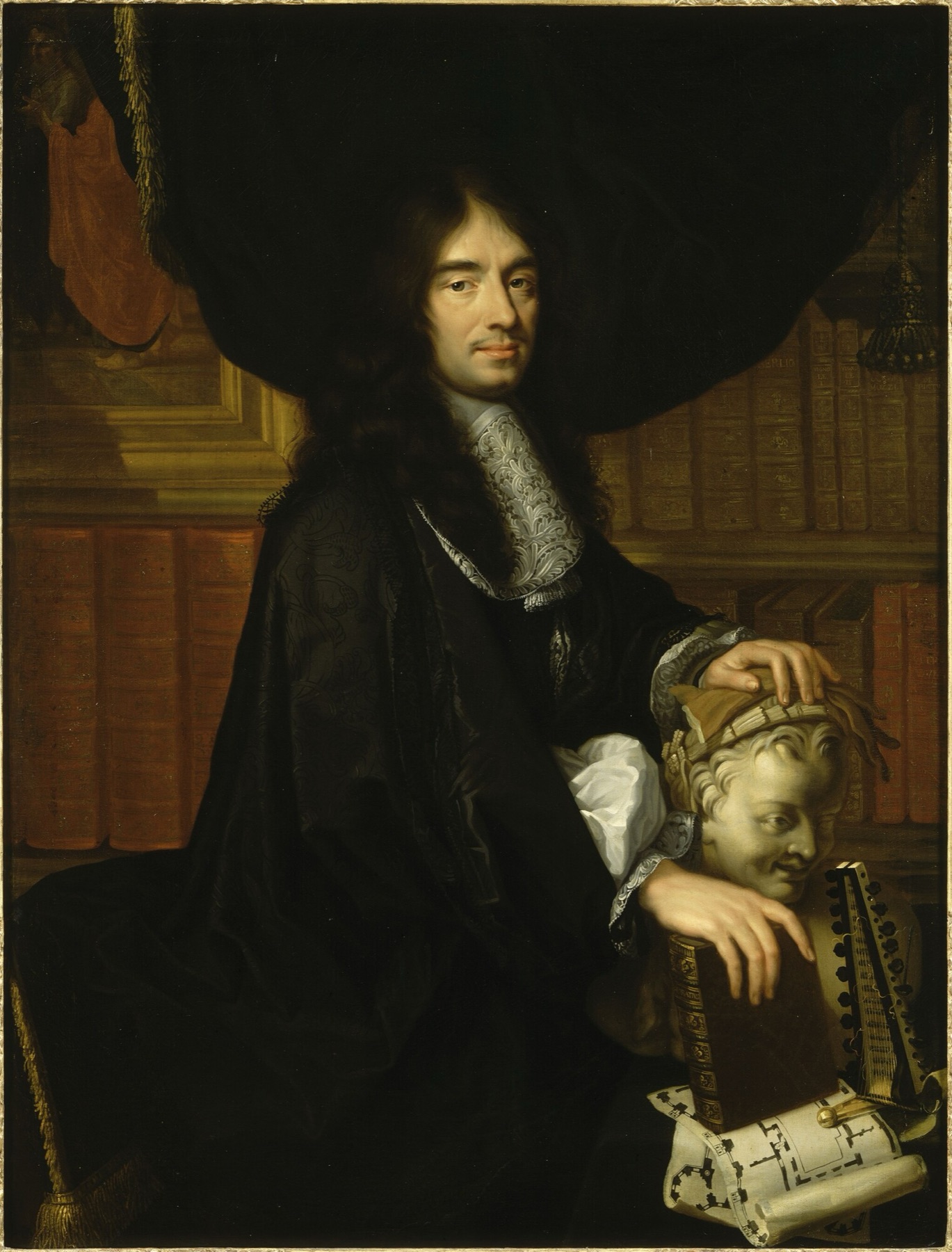
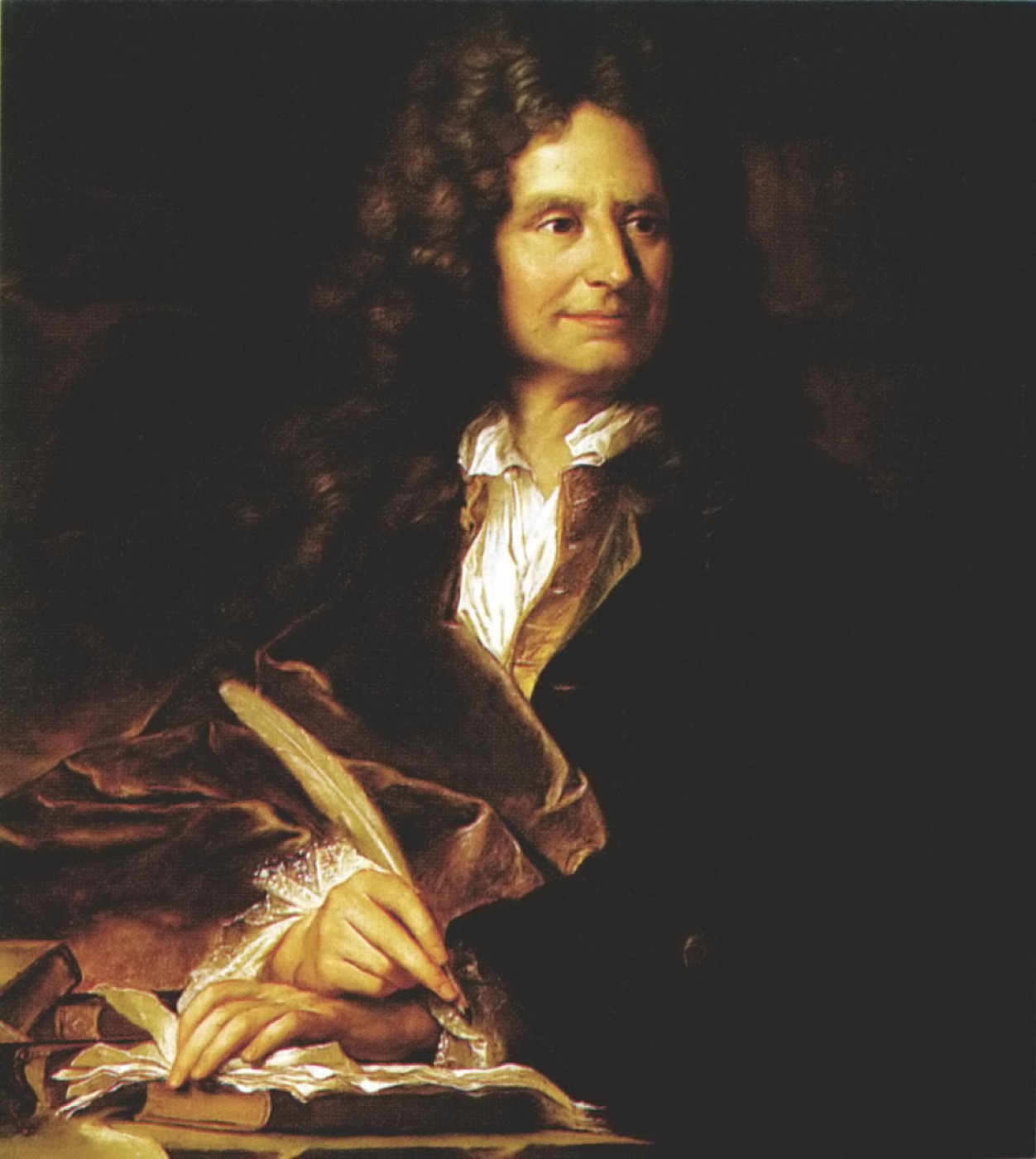
(Left: Philippe Lallemand after Charles Le Brun, Château de Versailles. Right: workshop of Hyacinthe Rigaud, 1704. Both public domain.)
The idea · the problem it creates
If the past was benighted, why study it?
“For some authors, this put the value of studying history in question: if previous ages had been thoroughly benighted, what could their experience teach the present?” Popkin, From Herodotus to H-Net, p. 62
The bind
A story of progress makes the present the best moment there has ever been. That is excellent news for the present and very bad news for the past, which becomes a record of error and superstition kept by people who didn’t know what we know. History has just been demoted to a museum of mistakes.
The answer that saved the field
Others “still saw the study of the past as crucial for identifying the factors that had made progress possible and the obstacles that had to be overcome to facilitate it” (p. 62). History earns its keep by explaining the machinery of improvement — which is also Popkin’s summary of the whole period: the idea of progress “challenged historians to defend the value of their discipline by arguing that it could contribute to the construction of a better future for humankind” (p. 69).
Take home
Every writer this term has had to answer “what is history for?” The Enlightenment is the moment the answer becomes: it shows you how to get where we’re going.
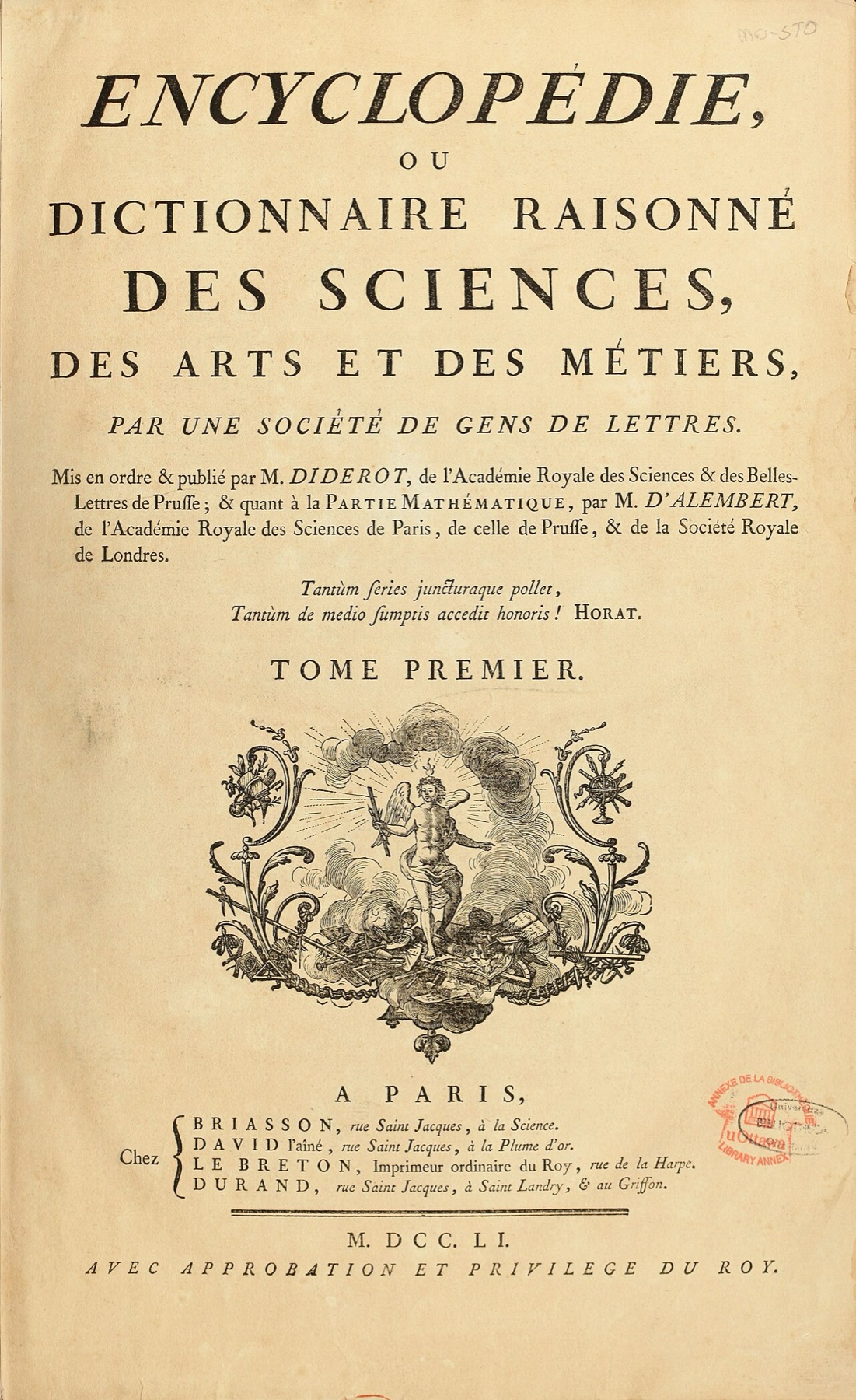
(University of Ottawa copy, via ARTFL. Public domain; the red stamp is a modern library mark.)
The Encyclopédie · Diderot’s own article, 1755
Not a place to store knowledge. A way to hand it on.
“the aim of an Encyclopédie is to assemble the knowledge scattered over the surface of the earth; to set out its general system to the men with whom we live, and to transmit it to the men who will come after us; so that the labors of centuries past shall not have been useless labors for the centuries that follow; that our descendants, becoming better instructed, shall at the same time become more virtuous and happier; and that we should not die without having deserved well of the human race.” Diderot, “Encyclopédie,” Encyclopédie vol. V (1755); my translation from the first-edition text
Read the verbs
Assemble, set out, transmit. The purpose is not that the book holds what is known but that it hands it forward — and the reason given is that otherwise the labor of past centuries is wasted. That is this week’s whole idea written as a job description, and it is the same answer Popkin reports historians reaching for: study the past to find what made improvement possible.
What it actually took
Twenty-eight folio volumes over twenty-one years — seventeen of text (1751–1765), eleven of plates (1762–1772). More than 70,000 articles from more than 140 contributors, Voltaire among them. Sold by subscription to make the money back, printed under the royal license you just saw on the title page, and carried on after 1759 without it.
The question it leaves open
“The knowledge scattered over the surface of the earth” — collected by whom, and arranged into whose general system? The sentence assumes there is one, and that a few men in Paris are the ones to set it out. Hold that against Voltaire’s four ages, twenty minutes from now.
The craft · what “a history” was in 1751
Two respectable things to do with the past, and a gap between them
“[R]ather than following Vico, the most widely read historians of the Enlightenment era claimed to make use of the critical methods developed by their predecessors from the Renaissance onward, but they complained that the careful analysis of sources recommended by Mabillon too often resulted in dry antiquarian publications that discouraged readers and failed to teach useful lessons.” Popkin, From Herodotus to H-Net, p. 63
Option one · the narrative of deeds
Wars, treaties, reigns, embassies, set down in sequence. This is what most readers meant by “a history,” and it is exactly what Voltaire’s own title promises: the age of a king. It is also the job he will hand off to “the compilers of annals.”
Option two · the document scholars
Since Valla, and far more since the Benedictine Jean Mabillon (1632–1707) set out rules for judging whether a document is genuine, there was a rigorous alternative: establish what the sources are before anyone tells a story with them. “Mabillon’s guidelines for the evaluation of evidence are still echoed in the training professional historians receive” (p. 60). Rigorous — and, per the complaint above, unread.
The gap Voltaire aims at
He wants the readability of the first and the seriousness of the second, pointed at a subject neither one covers: how people lived, thought, traded, and behaved. That subject is the new part. The genre is not.
Discussion · part one
What does a historian gain by taking God out of the causal story?
Enlightenment writers insisted that “the motor forces of history were human rather than divine” (Popkin, p. 62). In Week 3 we read Bede, for whom God acts in the events being narrated.
- What can a historian do with human causes that they cannot do with divine ones?
- And what does the change cost — what could Bede explain that Voltaire cannot?
Answer · part one
Causes you can argue with, and a meaning nobody is guaranteeing
The gain
A human cause can be checked. If the claim is that a printing market and a censor produced a certain kind of writing, someone else can go look at printers and censors and disagree. Providence cannot be examined that way — it can only be believed or not. Once causes are human, history becomes a field where evidence settles arguments, which is the discipline this course has been watching get built.
What it costs
Bede’s history has a guaranteed meaning: however far the world has fallen since Eden, it is still going somewhere, because God is taking it there. Remove that and the direction has to be argued for from scratch. Kant’s secret plan of Nature is built to fill the hole that opens here.