Making History • HIST 1105 • Week 3
Divine Power and Statecraft
- Popkin, ch. 2 (40–47) and ch. 3
- The Anglo-Saxon Chronicle
- Bede, Ecclesiastical History
- al-Biruni, Kitab al-Hind
- Machiavelli, The Prince
Popkin cited by page; the primary sources by book and chapter.
The claim for today
Four more answers to an old question: what makes history trustworthy?
The trap to avoid
It is very easy to read today’s medieval sources as bad history — credulous, disorganized, superstitious. Don’t. Each of these writers has a rule about what counts as proof, and each rule is defensible on its own terms.
How today is organized
Three medieval answers first: a chronicle that only records, a monk for whom miracles are evidence, a Muslim scholar who screens his sources before he starts. Then the 1450s, when a forged document is exposed as fake, and Machiavelli uses the past as a source of practical lessons.
Part one · 3.1
Popkin, ch. 2 — the conditions medieval historians worked in
Rome falls in the west. Knowledge of Greek disappears. Almost the only people still literate are clergy — “their ranks would provide almost all of the authors of history for the next several centuries” (p. 41). Literacy now lives where the books are, and the books are in monasteries — Bede’s monastery at Jarrow was filled with volumes hauled back from Rome.
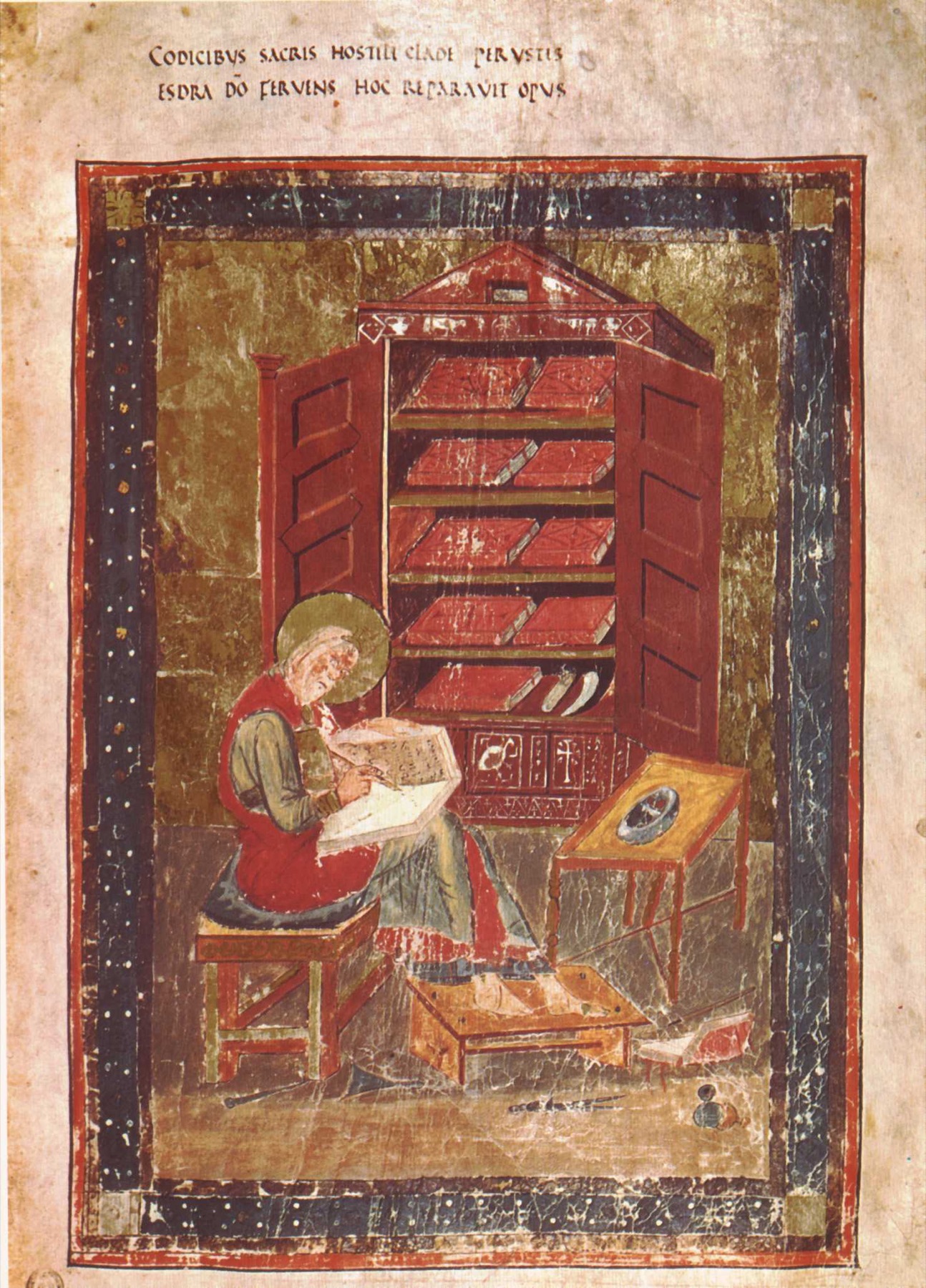
(Biblioteca Medicea Laurenziana, MS Amiatino 1, fol. 5r. Public domain.)
Popkin 02 · The characteristic medieval form
Events in a row, with nothing connecting them
“William Raleigh was elected Bishop of Norwich on 10th April. That horrible race of men known as the Tartars… laid waste Hungary and the neighboring territories. On 18th June Eleanor, queen of England, gave birth to her eldest son Edward.” a typical chronicle entry for 1239, quoted in Popkin, p. 43
What is missing, and on purpose
Annals record events “in the sequence in which they happened, without any attempt to connect them to each other” (pp. 42–43). No causes, no argument, no narrative arc. Popkin: they “made no attempt to explain the causes of the events they described, leaving it to readers to make sense of them” (p. 43).
Two things that follow
These were compiled by the monks of particular monasteries, often over centuries, so they have many different authors, with no single point of view. And they are not neutral: “chronicles kept in a particular monastery often reflected the influence of local rulers who protected the institution” (p. 43).
Where the form comes from
Annals were not invented as history. Monasteries had to know when Easter fell, so they ruled out paschal tables — one line per year, decades in advance, with blank space beside each number. Monks began jotting events into that space. The genre is a byproduct of calendar arithmetic, which is why it has a line for every year whether or not anything happened in it, and why nothing in it explains anything. The blank margin came first; the history was written into it.
Take home
History even with no argument is still making one — about what deserves a line at all.
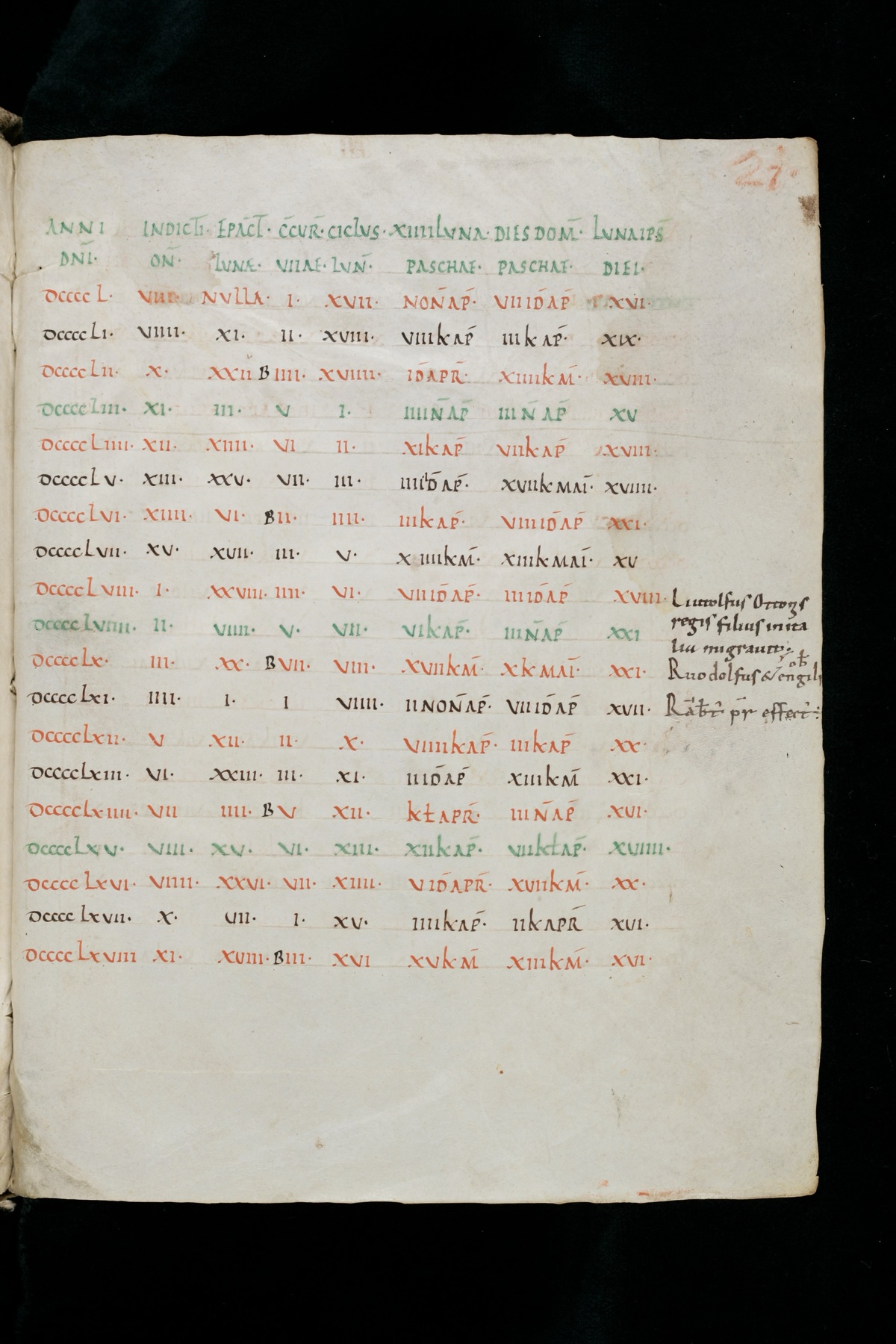
(St. Gallen, Stiftsbibliothek, Cod. Sang. 459, p. 21. e-codices, CC BY-NC 4.0.)
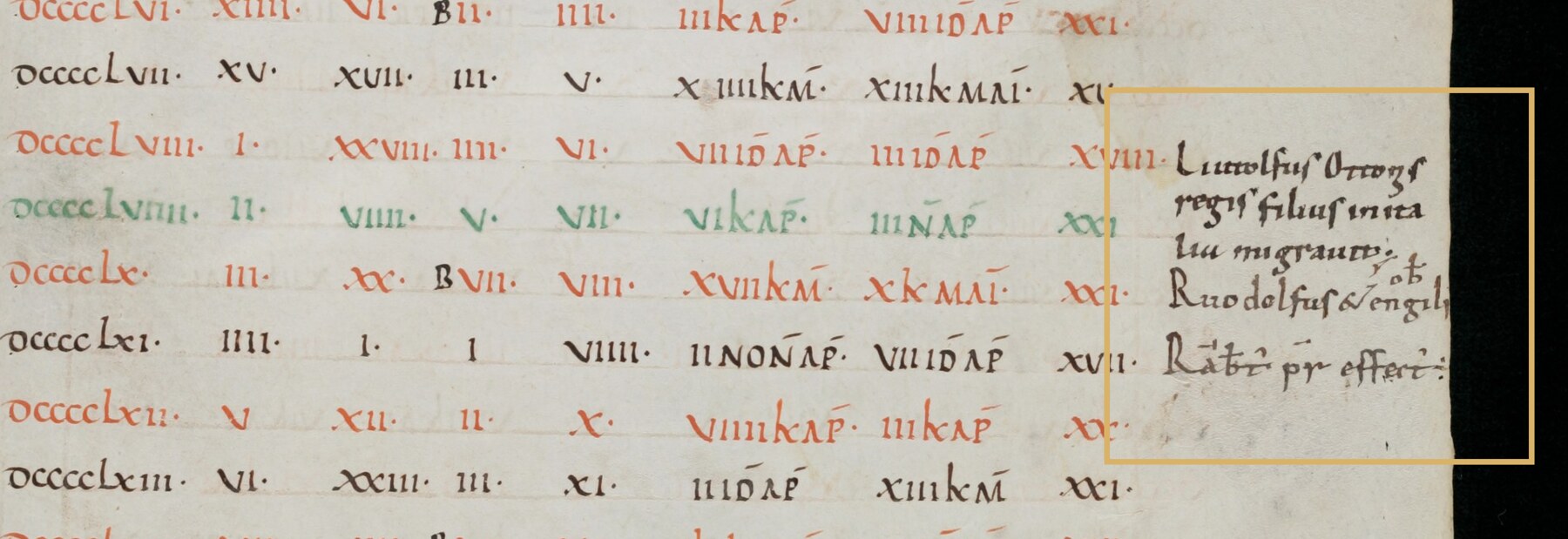
(Cod. Sang. 459, p. 21. e-codices, CC BY-NC 4.0.)
Part two · Anglo-Saxon Chronicle 01 · the year 793
Dragons, a famine, a massacre, and a man named Siga
“This year dire forwarnings came over the land of the North-humbrians… excessive whirlwinds, and lightnings; and fiery dragons were seen flying in the air. A great famine soon followed these tokens; and a little after that, in the same year, on the 6th before the Ides of January, the ravaging of heathen men lamentably destroyed God’s church at Lindisfarne through rapine and slaughter. And Siga died on the 8th before the Kalends of March.” Anglo-Saxon Chronicle, annal for 793 (Giles trans.) — northern recension, MSS D and E; absent from A, B, C
Look at the sequence, not the dragons
Everything is joined by and. Portents, famine, the sack of Lindisfarne, and one man’s death sit on the same flat list, at the same rank. The chronicle never says the dragons caused anything — but it puts them first, and calls them “forwarnings.” Then look at the date it gives the raid: January — before the famine that “soon followed” the portents. The order isn’t chronology. The order is the argument — it is the only tool this form allows for making one.
And the “heathen men”
This is the Lindisfarne raid — conventionally the start of the Viking age, and the most consequential event in the entry. It gets one clause, barely more than Siga’s death. The scale of an event and the space it gets are unrelated here. (Historians read the chronicle’s January as a slip for 8 June 793 — the form cannot flag its own errors either.)
What was actually lost, and who said so
Lindisfarne held Cuthbert’s shrine and had made the Lindisfarne Gospels around 700: the holiest place in Northumbria, and undefended. Alcuin, a Northumbrian at Charlemagne’s court, wrote that “never before has such terror appeared in Britain… nor was it thought that such an inroad from the sea could be made” — and blamed the sins of the king. The chronicle blamed dragons. Nobody blamed the ships.
Take home
“No interpretation” is a style, not an absence. Sequence is an argument.
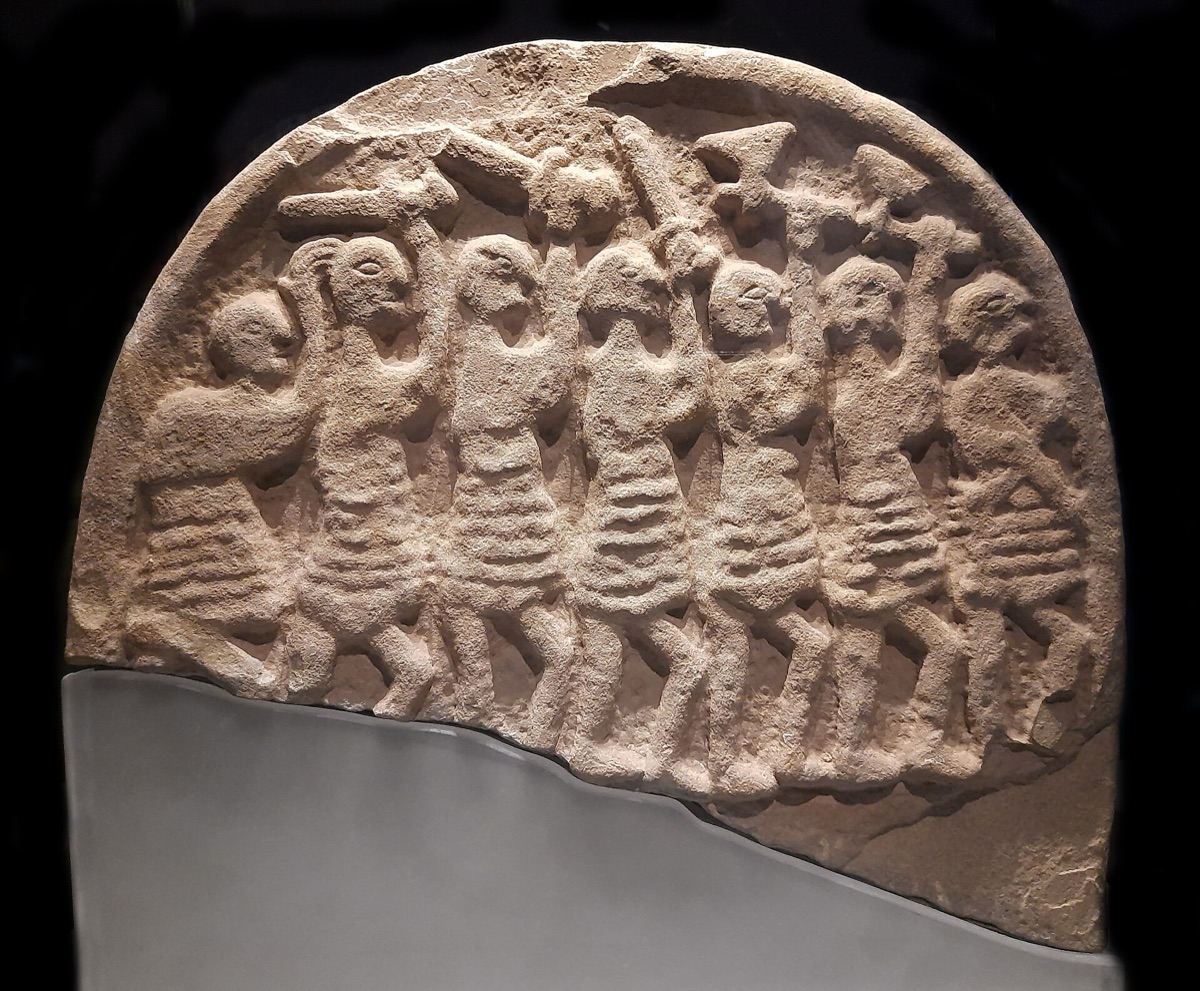
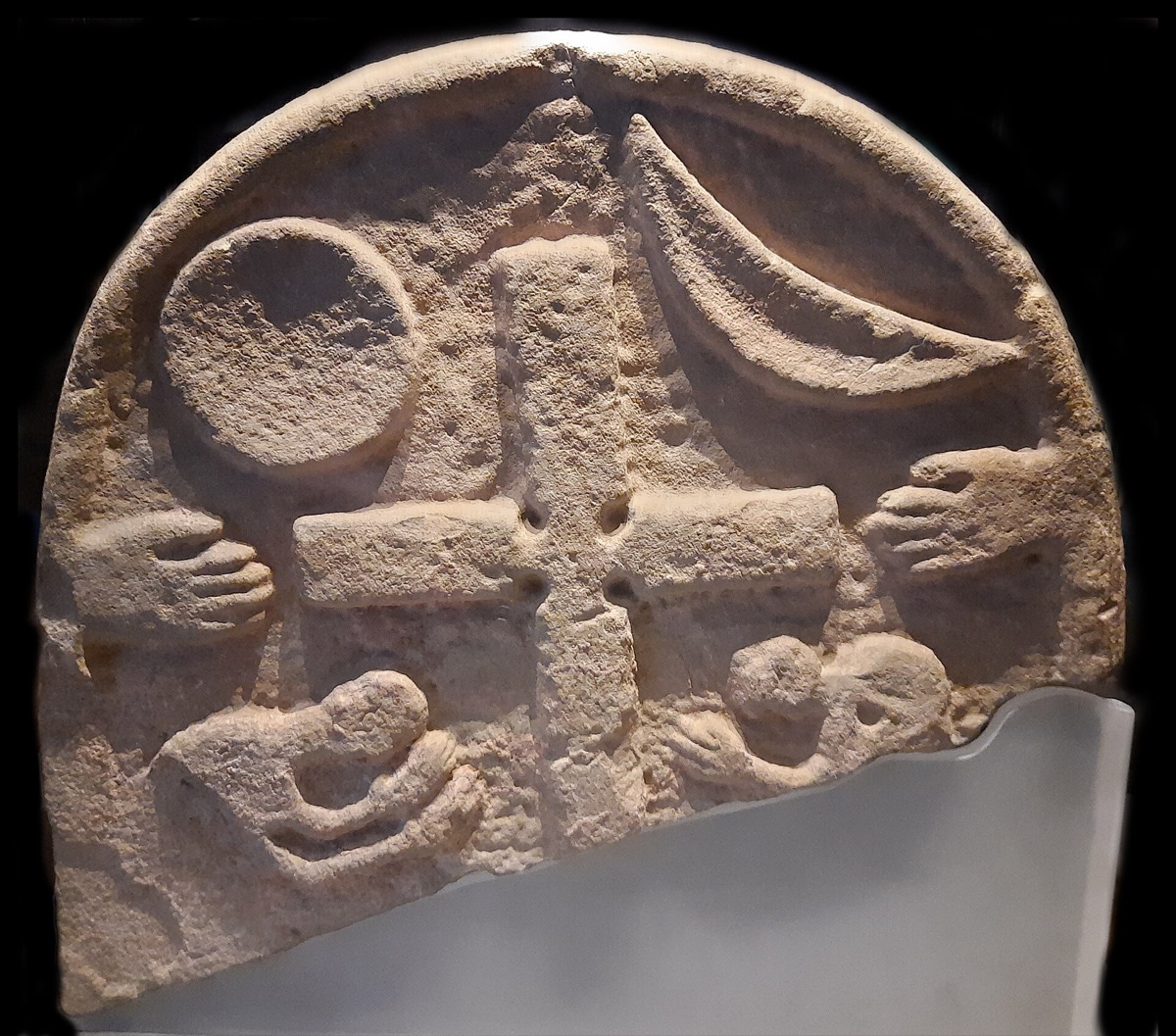
(Lindisfarne Priory, English Heritage, inv. 81077057. Photos Schillerwein, CC0.)
Anglo-Saxon Chronicle 02 · what doesn’t get written
Some years are just a number
“A. 786.” · “A. 807. 808.” · “A. 810. 811.” complete entries, Anglo-Saxon Chronicle (Giles trans.; other editions fill some of these from other manuscripts)
Nothing happened?
Obviously a great deal happened in 786. What the blank means is that nothing happened to the people who counted, of a kind that counted — no king died, no bishop was consecrated, no army moved. The empty year is the clearest statement of the chronicle’s theory of history, precisely because nobody wrote it down. What historian should this remind you of?
Then, once, a voice
In 897 the compiler breaks form. The Danish army “had not utterly broken down the English nation” — but three years of murrain and mortality came closer — and he lists the dead by name, adding “and many also besides these, though I have named the most distinguished.” An editorial decision, stated out loud, in a genre that pretends not to make any.
Take home
Ask of any archive: what did it never occur to these people to record? That question runs the rest of this course.
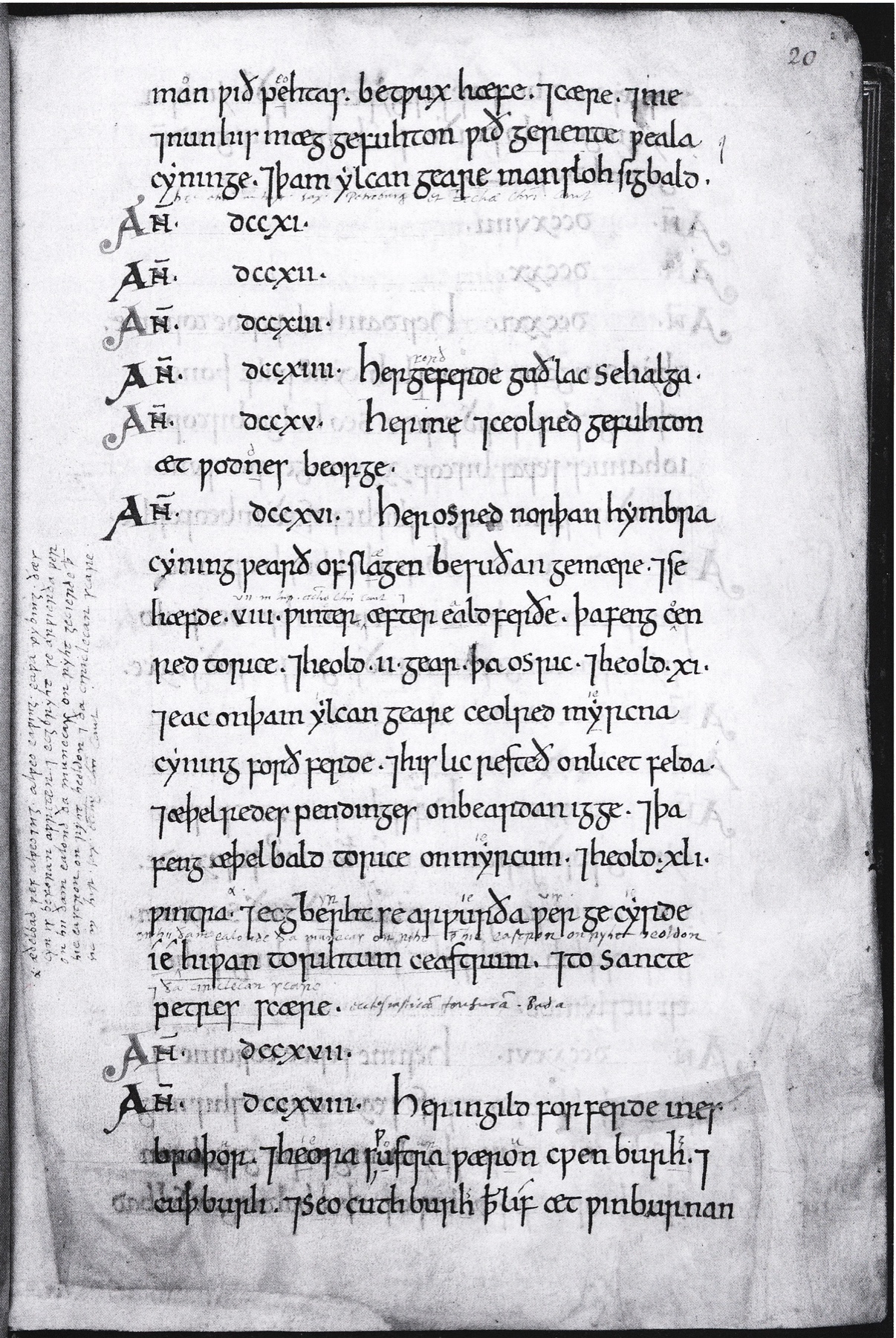
(British Library, Cotton MS Tiberius B.iv, fol. 20r. Public domain.)
Anglo-Saxon Chronicle 03 · which chronicle?
There is no such thing as the Anglo-Saxon Chronicle
One book, then many
It was assembled in Wessex around 890. Copies were then sent out to monasteries that carried on adding to them independently, for another two and a half centuries — the Peterborough copy is still being written in 1154. Seven manuscripts survive, A to G.
And they disagree
Different years filled, different silences, different kings worth a line. The 793 dragons are in D and E and absent from A, B, and C — the entry we spent ten minutes reading is not in most copies of the book it comes from. So “the Chronicle says” is already a choice about which house’s copy you are reading.
Take home
Every quotation from a medieval chronicle is a quotation from one manuscript. Somebody chose it. Usually an editor, centuries later, and usually without telling you.
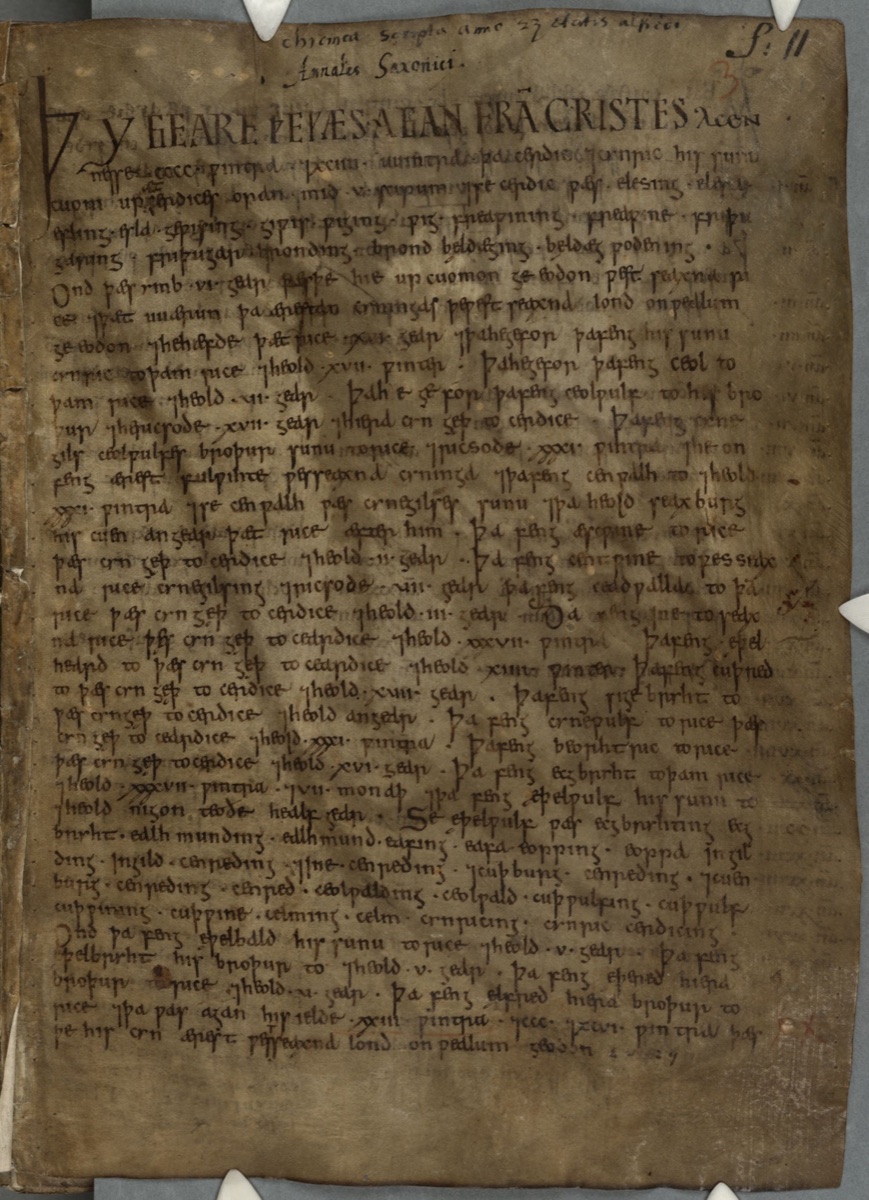
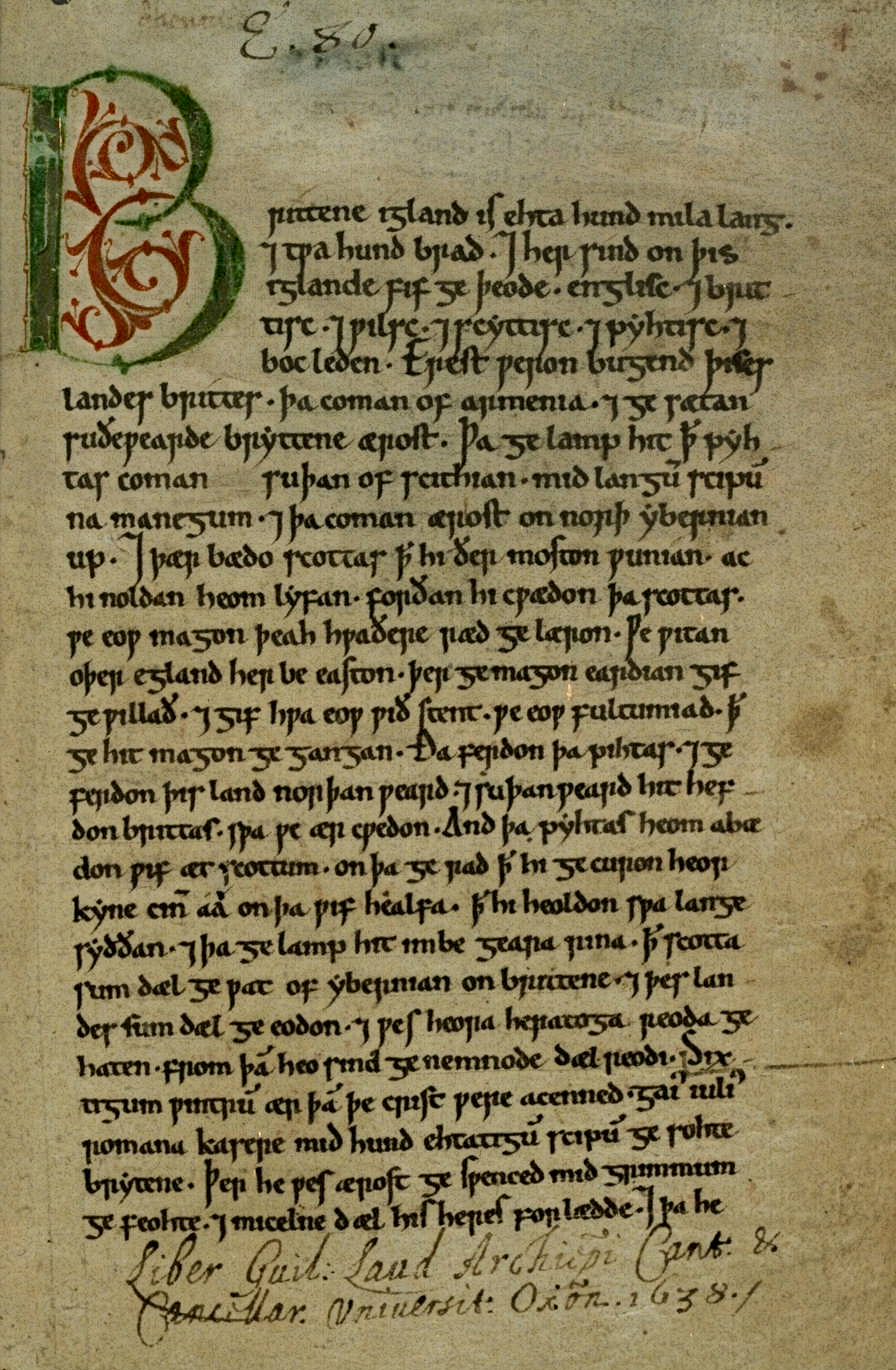
(Cambridge, CCCC MS 173; Bodleian MS Laud Misc. 636. Public domain.)
Bede · 673–735
A man who never went anywhere, and wrote the book
The life
Given to Wearmouth–Jarrow at the age of seven and never really left — one or two trips in sixty-two years. He describes his own life as spent “amid the observance of monastic rule and the daily charge of singing in the church, always delighted to learn, to teach, and to write.”
The desk
The monastery held one of the best libraries in Europe, stocked by Benedict Biscop from Rome. Bede wrote some sixty works — commentary, computus, saints’ lives — and finished the Ecclesiastical History in 731, four years before he died.
Why this matters
Herodotus traveled; Thucydides commanded. Bede did neither. His method has to be built out of letters, informants, and other people’s books — which is exactly why he tells you where each one came from.
Bede 01 · The preface, 731 CE
Livy’s preface, rewritten in a monastery
“For if history relates good things of good men, the attentive hearer is excited to imitate that which is good; or if it recounts evil things of wicked persons… the devout hearer or reader, shunning that which is hurtful and wrong, is the more earnestly fired to perform those things which he knows to be good.” Bede, Ecclesiastical History, Preface
Put it next to last week
Livy: “from these you may choose… what to imitate, from these mark for avoidance what is shameful.” Bede: imitate the good, shun the wrong. Seven and a half centuries, two religions, one job description. The only thing Bede adds is the last clause — the good is “worthy of the service of God.”
Now the surprise
“To the end that I may remove all occasion of doubting what I have written… I will take care briefly to show you from what authors I chiefly learned the same” — and he does, by name, for pages: Albinus, Nothelm (who searched the papal archives in Rome), Bishop Daniel, the brethren of Lindisfarne. Popkin calls Bede “unusual among medieval historians in his scrupulous concern for accuracy and his acknowledgment of his sources” (p. 42).
Who is writing, and what he wants
Bede was handed to the monastery at seven and never really left; he almost certainly never traveled further than York. The whole book is written from one library. And it is not a neutral survey — it argues for the Roman method of dating Easter over the Irish one his own region had used, and it addresses something it calls the English people, the gens Anglorum, at a moment when no such nation existed politically. There were rival kingdoms. Bede’s writing helps create that idea of a unified people.
Take home
A named-source apparatus that would satisfy a modern editor — attached to a moral purpose Herodotus would have recognized.
Bede 02 · The martyrdom of St. Alban (I.7)
Miracles are not incidental details. They are the evidence.
One sentence of context
Alban shelters a fugitive priest, converts, and is condemned. On the way to execution the river dries up to let him pass; his executioner throws down the sword and asks to die with him; and the man who finally strikes the blow has his eyes fall out at the same moment as Alban’s head.
“For it was impossible that the martyr, who had left no water remaining in the river, should desire it on the top of the hill, unless he thought it fitting.” Bede, Ecclesiastical History I.7
Watch what that sentence is doing
This is not credulity. It is reasoning — Bede notices an apparent inconsistency (why be thirsty after drying a river?) and resolves it with a premise about the saint’s intent. The rigor is real; the premises are different.
And it is checkable
The chapter ends at the church built on the site, where “the cure of sick persons and the frequent working of wonders cease not to this day.” That is an appeal to present, public, verifiable evidence: go and look. By his own standard, Bede is showing his work.
Take home
If God acts in history, miracles are data. Does this practice “disagree” with modern practice?
Bede 03 · King Edwin’s council, 627 CE (II.13)
The most famous speech in English history — and Bede wasn’t there
“The present life of man upon earth, O king, seems to me… like to the swift flight of a sparrow through the house wherein you sit at supper in winter… The sparrow, flying in at one door and immediately out at another… passing from winter into winter again. So this life of man appears for a little while, but of what is to follow or what went before we know nothing at all.” an unnamed counselor, in Bede II.13
Do the arithmetic
The council meets at Goodmanham in 627. Bede writes at Jarrow in 731 — over a century later, in his own kingdom but well outside living memory, and the speaker is not even named. Nobody transcribed this. Set it beside Thucydides 1.22: make the speakers say what was called for by each situation. Bede does the same thing and, unlike Thucydides, does not tell you.
And notice the argument it carries
The speech makes the conversion look reasonable — a considered decision by thoughtful men weighing an epistemological problem, not a conquest or a royal whim. Coifi, chief priest of the old religion, has already spoken first, with a blunter reason: the gods he served most diligently never made him prosperous. Then “the other elders and king’s counsellors… spoke to the same effect.” Nobody in the room argues the other side. It looks like a debate, but everyone was already in agreement.
Take home
The man with the scrupulous source list also wrote the most memorable passage in his book.
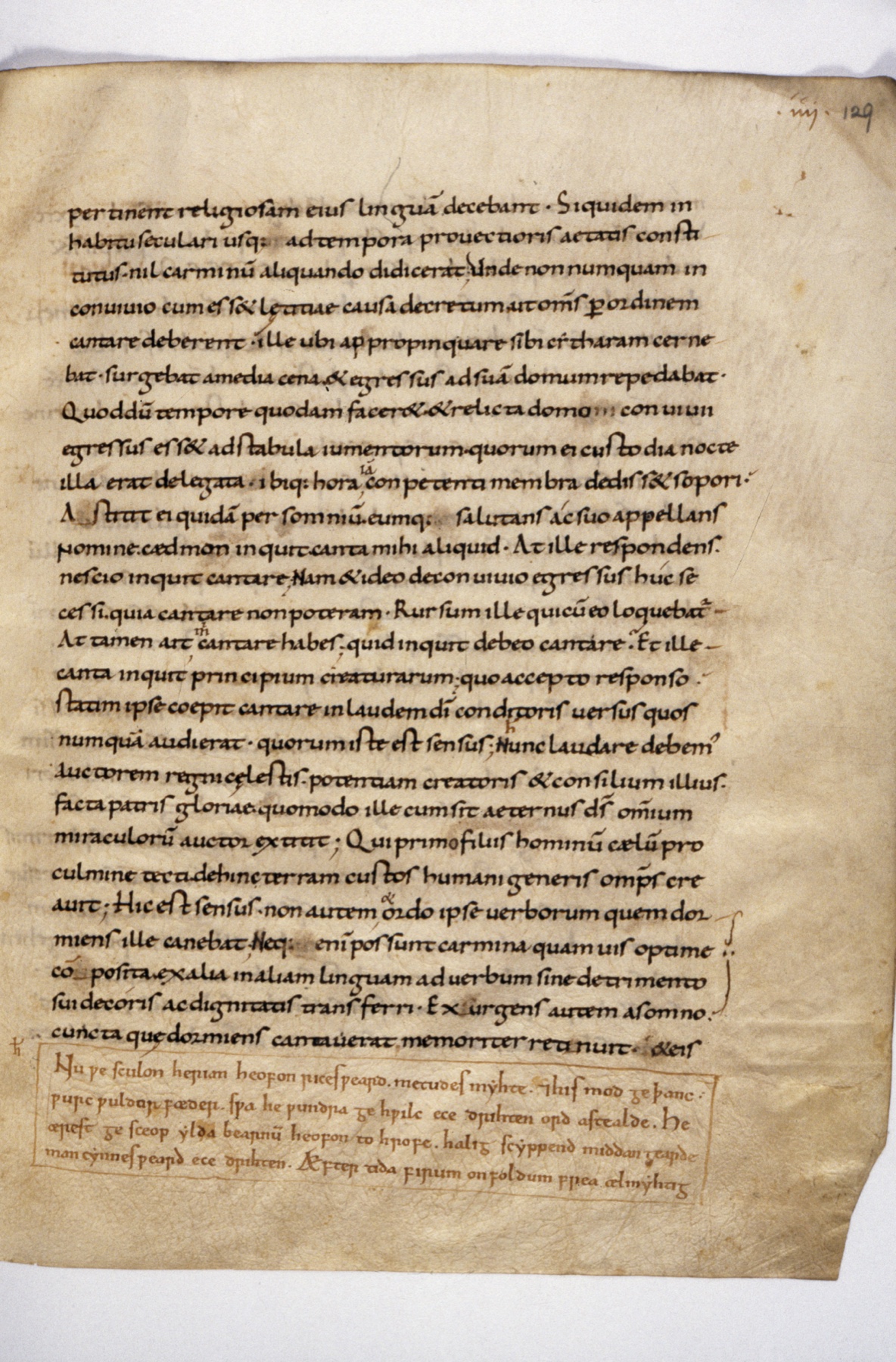
(Bodleian Libraries, Oxford, MS Hatton 43, fol. 129r. CC BY-SA 4.0.)
al-Biruni · c. 973 – c. 1050
An astronomer who turned the instruments on people
The scientist
Born in Khwarezm, on the Aral Sea; a Persian speaker writing in Arabic. Astronomer and mathematician first — he worked on the size of the Earth and whether it turns, and argued about gravity by letter with the young Avicenna. Over a hundred works; twenty-two survive.
The comparatist
At twenty-seven he finished the Chronology of Ancient Nations — every calendar he could document, because to line up two eras you must first decide whose dating to trust. Taken to Mahmud of Ghazna’s court in 1017, he traveled to India and learned Sanskrit rather than work through informants.
Where the method comes from
Bede’s instrument is a list of informants. Valla’s is an ear for Latin. al-Biruni’s is a chain of transmission — a discipline built to track how sayings attributed to Muhammad “had been transmitted” (Popkin, p. 44), now turned on history.
al-Biruni 01 · Kitab al-Hind, c. 1030 CE
A methodology section, three hundred years early
“No one will deny that in questions of historic authenticity hearsay does not equal eyewitness… Written tradition is one of the species of hearsay — we might almost say the most preferable. How could we know the history of nations but for the everlasting monuments of the pen?” al-Biruni, preface to the Kitab al-Hind (Sachau trans.)
What this quote does
He ranks his evidence, concedes the weakness of his best source (writing is hearsay), and then argues for using it anyway — because eyewitness can only reach “actual momentary existence,” while written tradition reaches the past at all. He is arguing with himself in public, in a preface.
Take home
Herodotus let you see where his account might be weak. al-Biruni states his rules for evaluating evidence before he even begins.
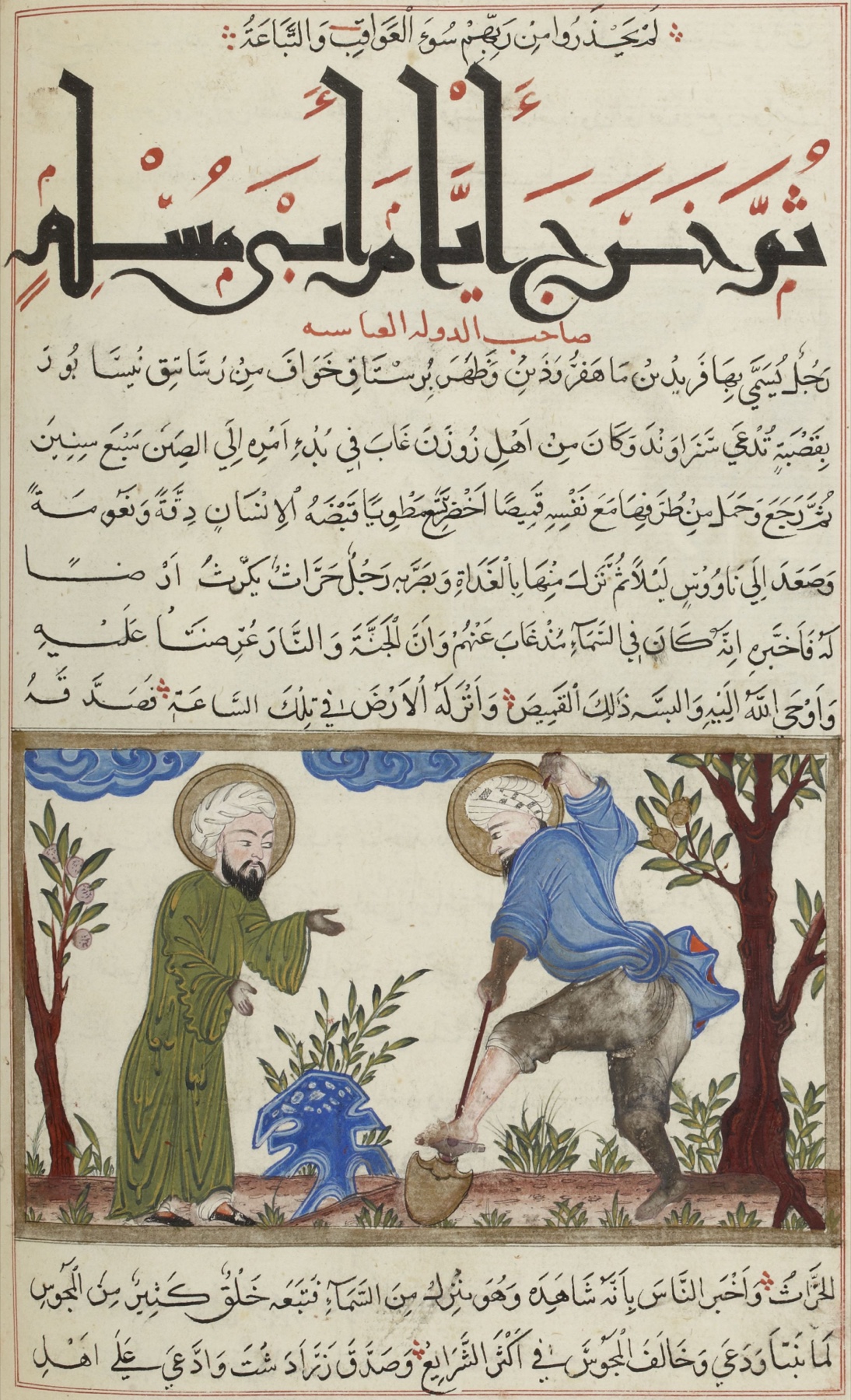
(Bibliothèque nationale de France. Public domain.)
al-Biruni 02 · The screen and the taxonomy
Five kinds of liar — and one thing he throws out first
“The tradition regarding an event that in itself does not contradict either logical or physical laws will invariably depend for its character as true or false upon the character of the reporters.” al-Biruni, Kitab al-Hind, preface
Read the subordinate clause — it does all the work
Source criticism applies only to reports that are physically possible in the first place. Anything that breaks natural law never reaches the interview stage. Bede’s drying river would be screened out before al-Biruni asked who told the story. Two devout men, two incompatible rules, roughly three centuries apart.
Then the taxonomy
Five liars: the partisan for his own family or nation; the man under obligation or nursing a grudge; the coward or profiteer; the habitual liar; and — his sharpest — the one who lies “from ignorance, blindly following others who told him.” Strip out the repeaters, he says, and “there remains the originator of the story.” That is a modern citation chase, in 1030.
Take home
His hardest case is the one he names himself: bias is hardest to detect when the system you describe is foreign.
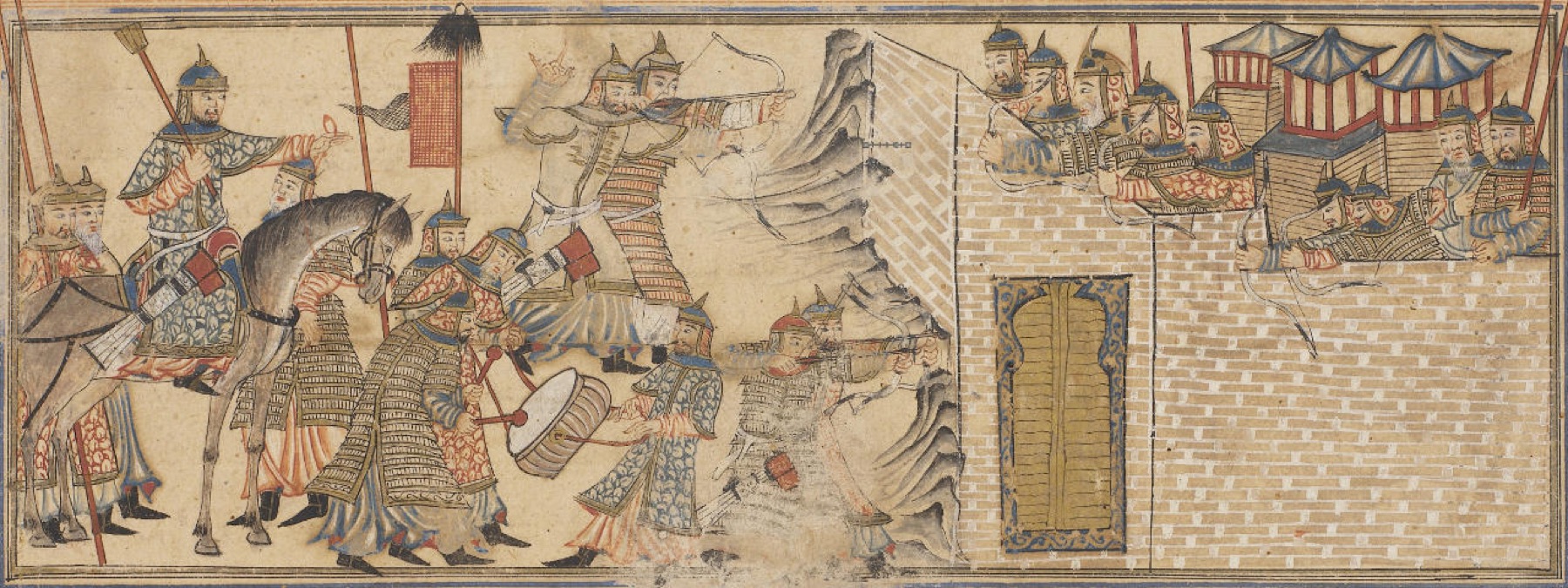
(Rashīd al-Dīn, c. 1314 — an imagining, not a witness. Public domain.)
Comparison · Bede and al-Biruni side by side
Which one is doing history?
Bede · 731
Names every informant. Distinguishes what he read from what he was told. And treats a river parting as a fact with a cause, because in his world it is one.
al-Biruni · c. 1030
Declares his biases, ranks his evidence, chases claims to their originator. And rules the miracle inadmissible before asking who reported it.
The question that actually separates them
Not rigor — both are rigorous. Not honesty — both are scrupulous. The difference is a prior claim about what kinds of things can happen. Every evidence standard rests on one of those, including ours, and ours is not visible to us for the same reason Bede’s was not visible to him.
One more point from Popkin
Three centuries later Ibn Khaldun (1332–1406) writes the systematic version — errors from “partisanship toward a creed or opinion,” “over-confidence in one’s sources,” “the inability rightly to place an event in its real context,” and the wish to please a patron (p. 44). Popkin calls it “far more probing than anything written in the European west until the era of the Renaissance.” al-Biruni got most of the way there first.
Take home
“Medieval” is a period, not a method. Two writers in it disagree more sharply than Herodotus and Thucydides did. So what do we do with a period that argues with itself?
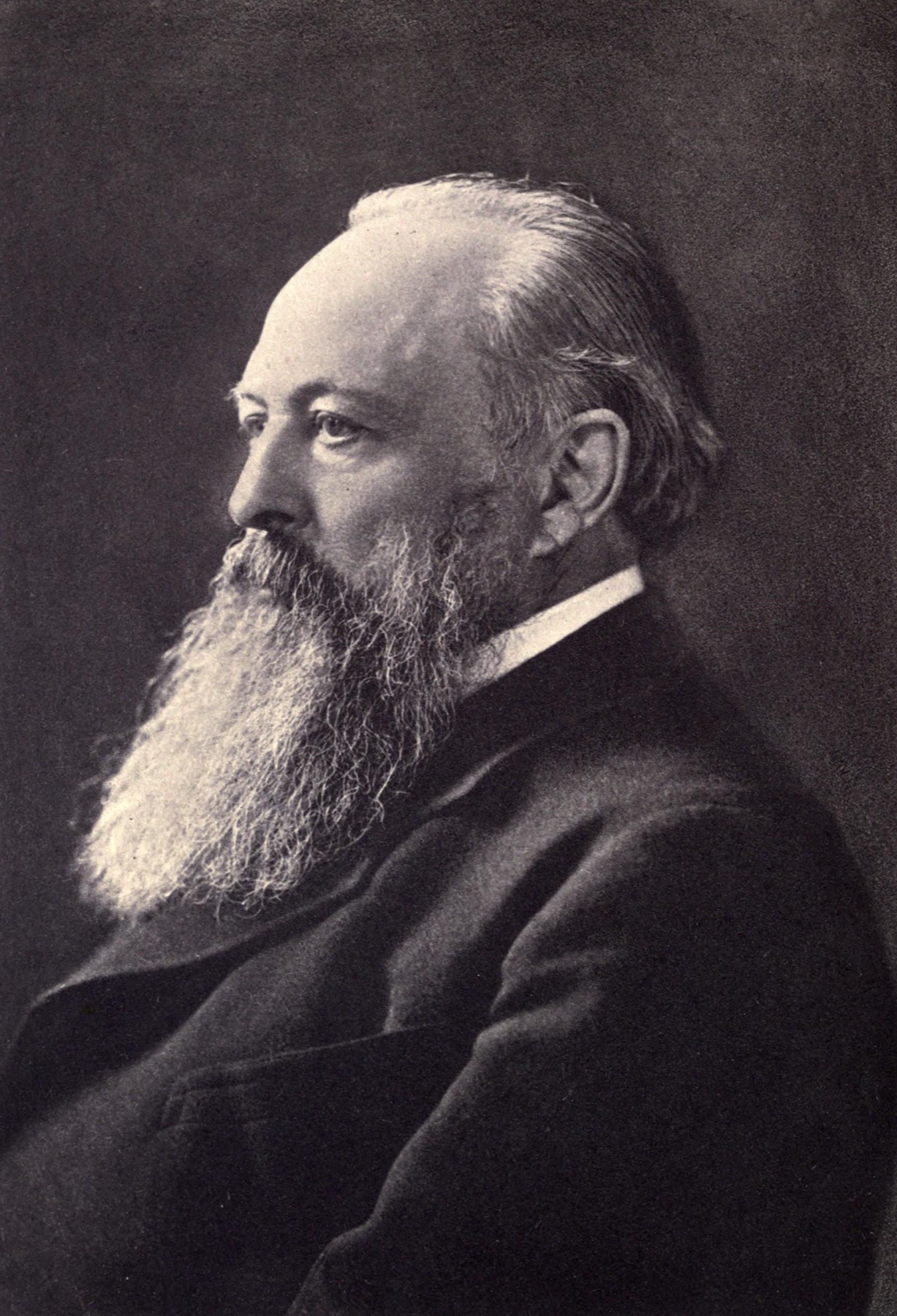
(Allen & Co., before 1902. Public domain.)
The choice · judging medieval sources
So how do we judge any of that?
What you now know
A chronicle that records dragons and explains nothing. A monk who reasons carefully about a river that dried up. A scholar who rules that river inadmissible before asking who saw it. Three defensible rules, none of them ours — and two things you can do about it.
Choice A — dismiss. The Middle Ages “possessed good writers of contemporary narrative,” but they “were careless and impatient of older fact. They became content to be deceived, to live in a twilight of fiction.” Lord Acton, 1895, quoted in Popkin, pp. 40–41
Choice B — ask what they were for
Popkin’s reply is not that Acton was rude but that he mistook a different purpose for a failure. Medieval writers “adapted history to a new framework, dominated by religious belief, but they still saw themselves as serving the cause of truth. Their purpose, however, was to present truths that would convince their readers of appropriate moral and religious lessons” (p. 41).
The sentence to keep
Popkin quotes the medievalist Walter Goffart on Gregory of Tours, and says it applies to nearly all of them: “Gregory’s goal was pastoral, and contemporary history was his means of persuasion” (p. 41). Swap in any writer from week 2 and ask what their goal was. Nobody in this course is doing history for its own sake.
Why this choice has a cost
Choice A is cheap, and it is not stupid — the dragons are in the entry. But notice the cost: if credulity is the whole story, you cannot explain why Bede names his informants, or why al-Biruni built a taxonomy of liars. Choice B has to explain the dragons. Choice A has to explain everything else.
Take home
Acton is measuring them against a purpose they never had. That’s the “ladder” error from week 2, at its most confident.
Part three · 3.2
1440 — old assumptions start to break down
Printing, the Americas, the Reformation, and a revival of the ancient historians all arrive within a century of each other. Popkin’s claim for the period: “many of our tacit assumptions about modern historical thought emerged piecemeal in the scholarly debates of the Renaissance” (p. 50).
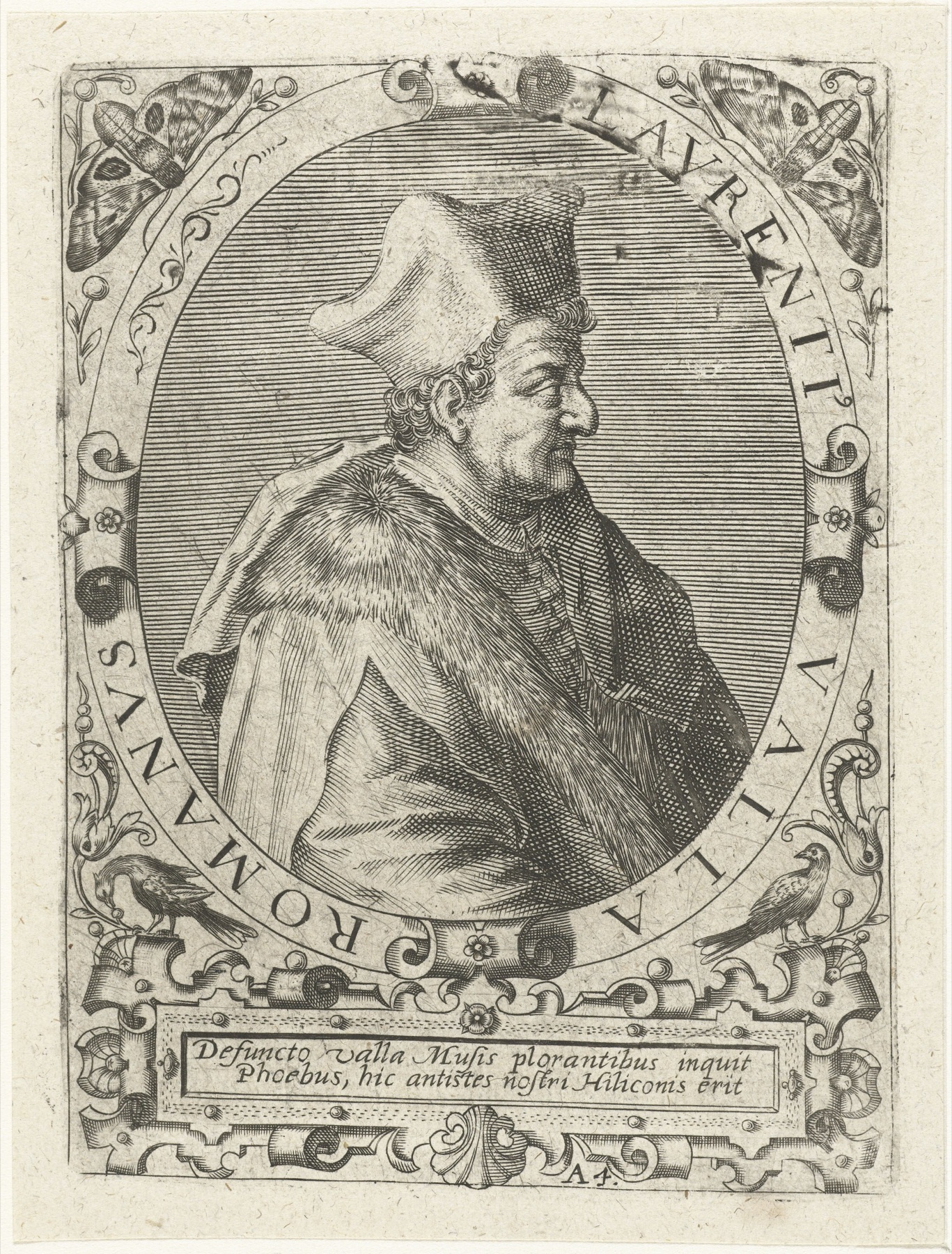
Lorenzo Valla · c. 1407–1457
Not a historian. A grammarian.
The training
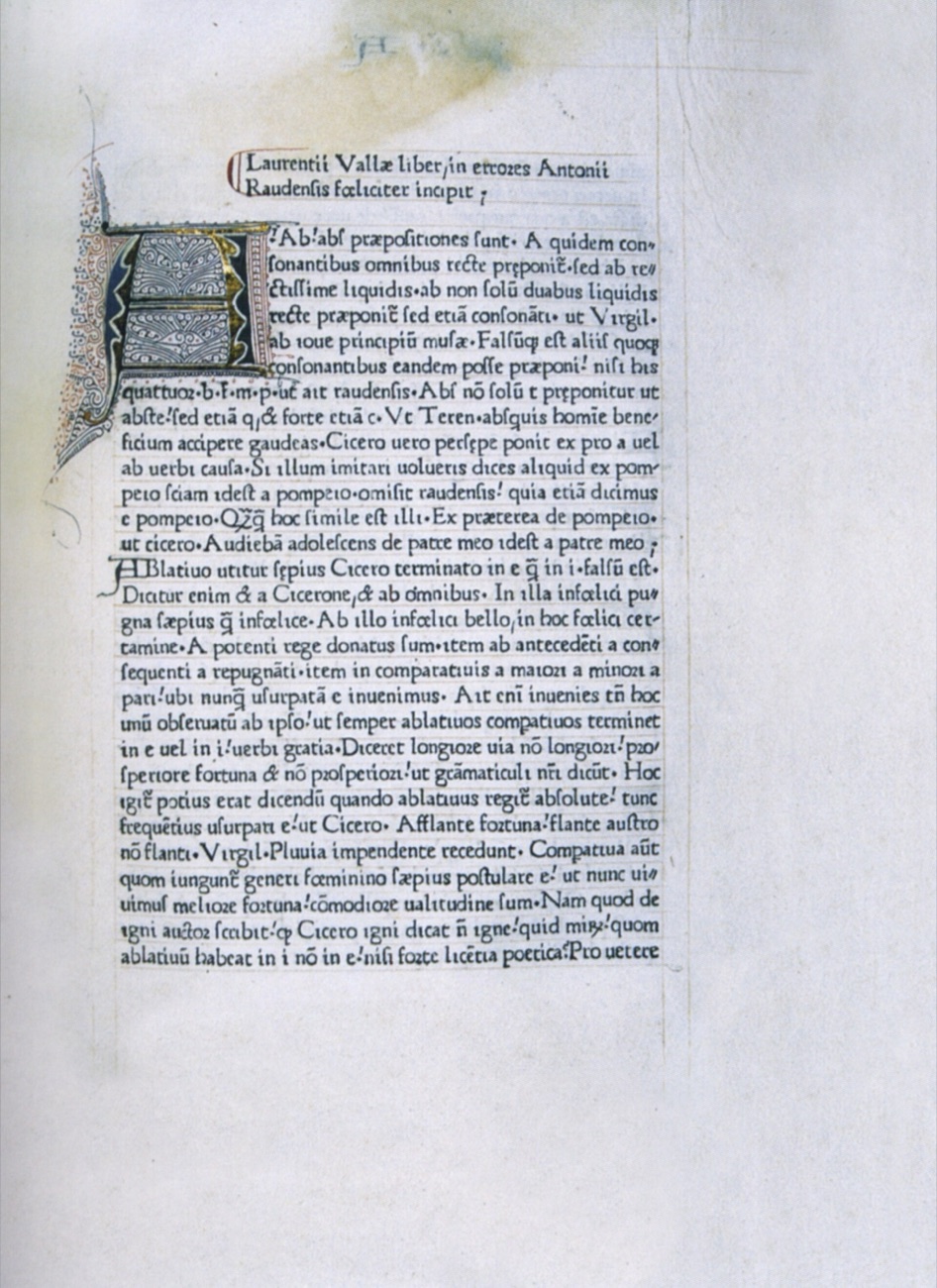
Roman, schooled in the new humanist curriculum. His life’s work is the Elegantiae linguae Latinae — six books on how classical Latin actually worked, word by word: which form a Roman would use, which he would not, and when usage changed. It became the standard reference for a century.
The job
From 1435, secretary to Alfonso of Aragon, king of Naples — a court, not a university. Later, and worth holding onto, he took a post in the papal curia under Nicholas V: employed by the institution whose oldest charter he had destroyed.
Why this matters for what follows
He has no archive, no witnesses, and no interest in going to look. What he has is an ear for Latin exact enough to hear a century in a word choice. That is the entire instrument.
(Prädikantenbibliothek Isny, Phil. 22. Public domain.)
(Unknown Italian master, 13th c., Web Gallery of Art. Public domain.)
Why it matters · Lorenzo Valla, 1440
A grammar lesson destroys a papal claim
What the document said
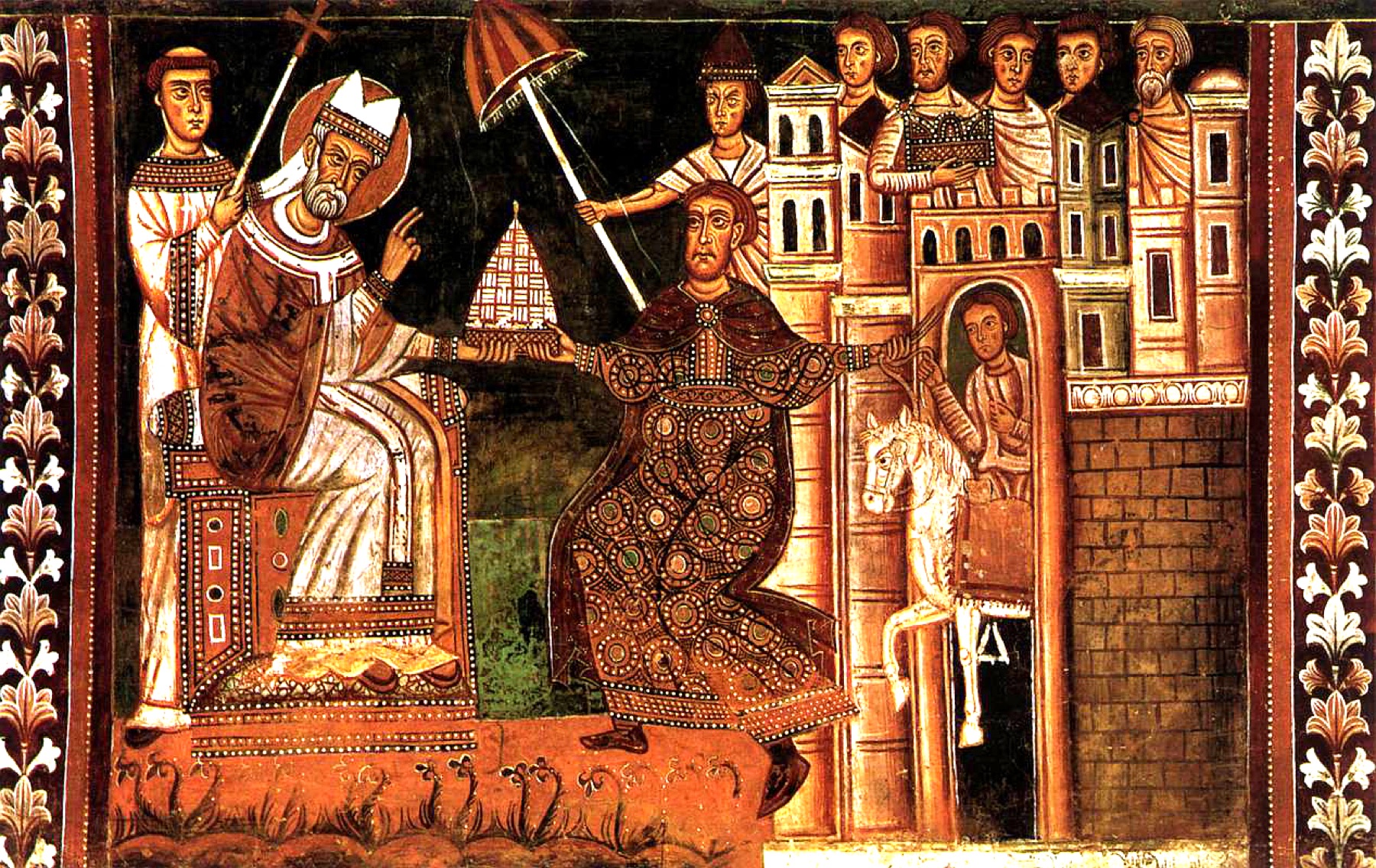
The Donation of Constantine — cited in medieval histories for centuries as proof that the emperor had handed sovereignty over Rome to the Pope in the fourth century. Valla showed it used words and turns of phrase that did not exist when it was supposedly written, and that no source from that period mentions it (Popkin, p. 50).
Why this matters
Nobody had to go anywhere, interview anyone, or witness anything. The text’s own language proved it was a forgery. A text now has a date written into its language whether the forger likes it or not — which means evidence can be tested without a witness, and tradition can lose to a philologist.
The bigger consequence
If Latin changed that much, the present is not a continuation of antiquity. Renaissance historians drop the Biblical “four empires” and invent the scheme we still use — antiquity, a “middle age,” and their own new era (pp. 50–51). The Middle Ages get named by the people who declared them over.
What happened to it next
Nothing, for seventy years. The treatise sat in manuscript while the Donation went on being cited. Then Ulrich von Hutten printed it in 1517 — the year of the Ninety-Five Theses — and it went straight into Luther’s hands. A scholarly argument about language became a tool the Reformation used against the Church. Note the lag: the proof was finished long before anyone was ready to act on it.
Take home
Anachronism becomes a detection tool. That is the beginning of source criticism as we practice it.
(Rijksmuseum, RP-P-1909-4359. CC0.)
(Palazzo Vecchio, Florence. Public domain.)
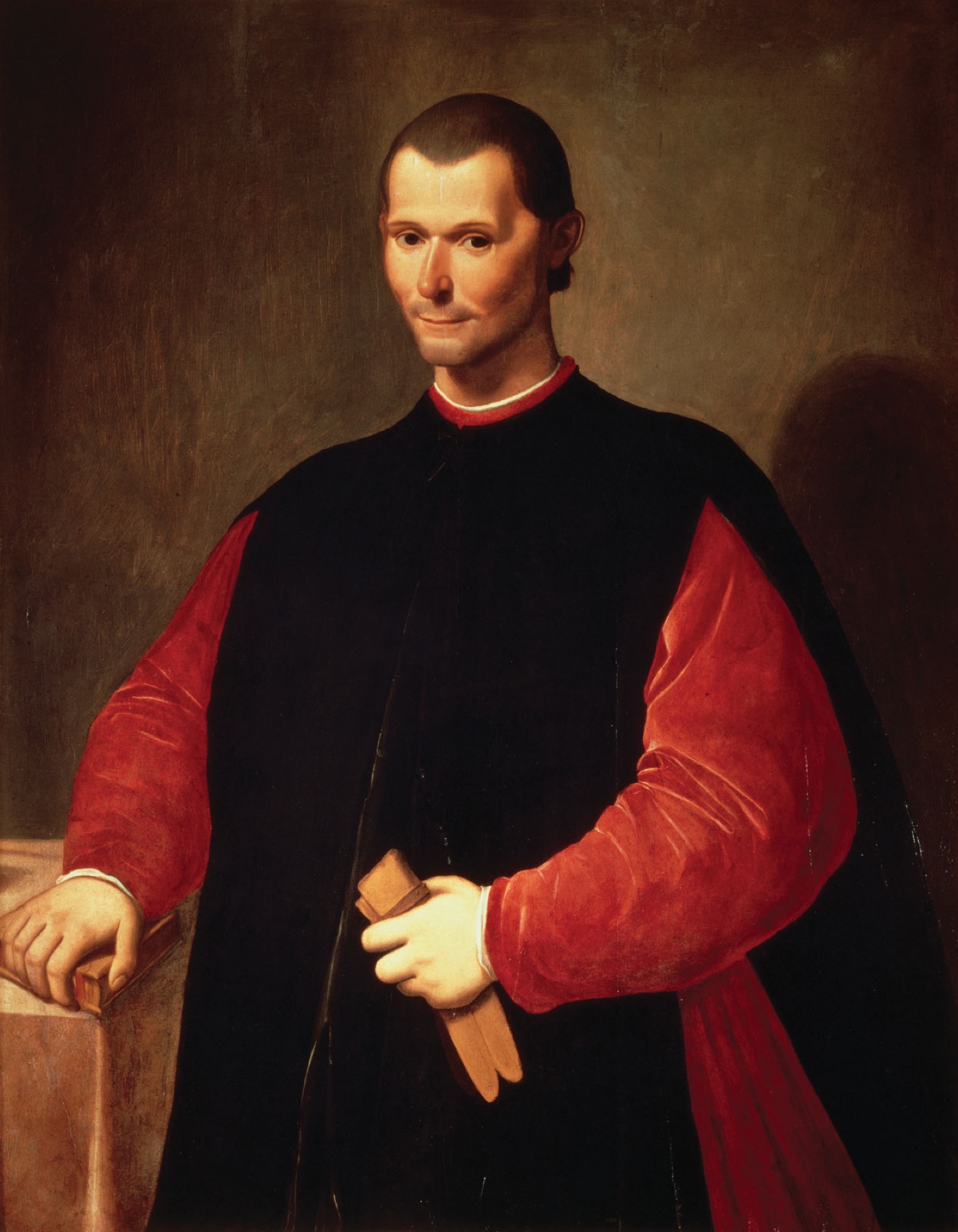
Machiavelli 01 · The Prince, written 1513, published 1532
The past as a set of instructions
“A wise man ought always to follow the paths beaten by great men, and to imitate those who have been supreme, so that if his ability does not equal theirs, at least it will savour of it… like the clever archers who… take aim much higher than the mark.” Machiavelli, The Prince, ch. 6 (Marriott trans.)
The same word, a different job
Imitate. Livy said it; Bede said it. But they wanted you to imitate virtue, and the payoff was a better soul or a better republic. Machiavelli wants you to imitate technique, and the payoff is that you keep your state. Same verb, and the history it produces is unrecognizable.
Note who is speaking to whom
Bede addressed a king so the king would be good. Machiavelli addresses a prince so the prince will be effective. The audience barely changes; the promise changes completely. Popkin: he and Guicciardini wrote “purely secular narratives that made no pretense of trying to fit events into a divinely ordained plan” (p. 52).
Take home
History stops teaching virtue and starts teaching technique.
Machiavelli 02 · What he does with God
Moses goes in the list
“Moses, Cyrus, Romulus, Theseus, and such like are the most excellent examples. And although one may not discuss Moses, he having been a mere executor of the will of God, yet he ought to be admired…” Machiavelli, The Prince, ch. 6
A polite dismissal
He declines to discuss Moses — and then puts him in a list with two mythical founders and a Persian king he knows mostly through Xenophon’s idealized portrait, then analyzes all four by the same criteria. He even concludes the others “will not be found inferior to those of Moses, although he had so great a preceptor.” Divine backing is mentioned, then set aside as irrelevant to the analysis.
And then the conclusion he actually draws
“All armed prophets have conquered, and the unarmed ones have been destroyed… it is necessary to take such measures that, when they believe no longer, it may be possible to make them believe by force.” Prophecy is redescribed as a problem of persuasion, solved by force. Bede would not recognize this as an account of anything.
Take home
Thucydides removed the gods as causes — Herodotus never did. Machiavelli keeps the gods in the story but treats them as having no real power to explain anything, which goes further than either.
Machiavelli 03 · How an example is used
Two cruelties, two verdicts
Ramiro d’Orco · ch. 7
Cesare Borgia installs a “swift and cruel man” to pacify the Romagna, then has him cut in two and left in the piazza at Cesena “with the block and a bloody knife at his side.” The result: the people were “at once satisfied and dismayed.” 26 December 1502 — and Machiavelli was the Florentine envoy attached to Borgia’s court that winter, in the Romagna, sending dispatches home. This is not a story he read.
Agathocles · ch. 8
Rose to rule Syracuse by massacring the senate. Machiavelli grants his courage and “greatness of mind” — then rules that “such methods may gain empire, but not glory.”
He does deliver a verdict — just not a moral one
Cruelties are “properly used” when “applied at one blow… and not persisted in”; badly used when they “multiply with time.” “Injuries ought to be done all at one time, so that, being tasted less, they offend less; benefits ought to be given little by little, so that the flavour of them may last longer.” The criterion is timing, not justice.
So what is the Ramiro story for?
Compare Livy on Lucretia. Livy’s dead body founds a republic and teaches you what to be. Machiavelli’s dead body is a demonstration of a repeatable technique: transfer the blame, stage the punishment, benefit from the people’s relief. The anecdote is not a symbol. It is a worked example.
Take home
He is not amoral about history. He has replaced a moral standard with a practical, technical one.
Contrast · Two readers of the same Rome
Do they want the same kind of lesson?
Livy wants
A citizen who reads the Republic’s past and becomes worthier of it — history as a monument you choose examples from, so that the state deserves to survive.
Machiavelli wants
A reader — prince or republic, depending on the book — who studies the same Rome and learns what worked, so that the state survives, whether or not it deserves to.
The awkward part
Machiavelli was Livy’s most devoted reader — he wrote a whole book of commentaries on him, the Discourses (c. 1517), and Popkin notes that Livy’s “meditations on the fall of the Roman republic” had special force in Florence after 1494 (p. 52). And his two books disagree with each other: the Discourses argues that republics outlast principalities, which is close to Livy’s idea. The Prince argues something different. Same reader, same Rome, opposite lesson. That is Carr’s point about the historian and their audience.
Take home
“The past is useful” is not one position. It splits the moment you ask useful for what, and to whom.
Week 3 Recap
Six things
01 · p. 41
Pastoral, not incompetent
“Gregory’s goal was pastoral, and contemporary history was his means of persuasion.”
02
Sequence is argument
The chronicle claims to only record. Order, rank, and the empty years do the arguing.
03
Miracles as data
Bede reasons about the miracle. The rigor is real; the premise about the world is different.
04
The screen comes first
al-Biruni tests reporters — but only for events that don’t break physical law. Every method has a prior.
05 · p. 50
The text proves the forgery
Valla needs no witness. Language carries its own date, so tradition can now lose to evidence.
06
Imitate — what?
Livy and Bede say virtue. Machiavelli says technique. What do you think history is for?
Discussion · 3.1 + 3.2
Discussion Ideas
- What makes Bede’s history different from Herodotus or Thucydides? From Livy — or is the preface the same preface?
- What role does God play as a historical actor for Bede? What plays the comparable role for al-Biruni?
- al-Biruni tells you what good history requires. Do miracles count? Where exactly in his method does Bede’s river get thrown out?
- How does Machiavelli use historical examples — and would Livy recognize what he is doing with them?
- What’s the difference between using history to teach virtue and using it to gain power? Is one of them not history?