Racknitz, 1789 · plates I and III
Where is the person in a machine that writes?
- From 1770 to 1854 the Turk played chess before courts and paying crowds. The player was a person hidden in the cabinet.
- A chatbot writes a history of your campus in seconds. Whose knowledge is in it, and is what it writes history?
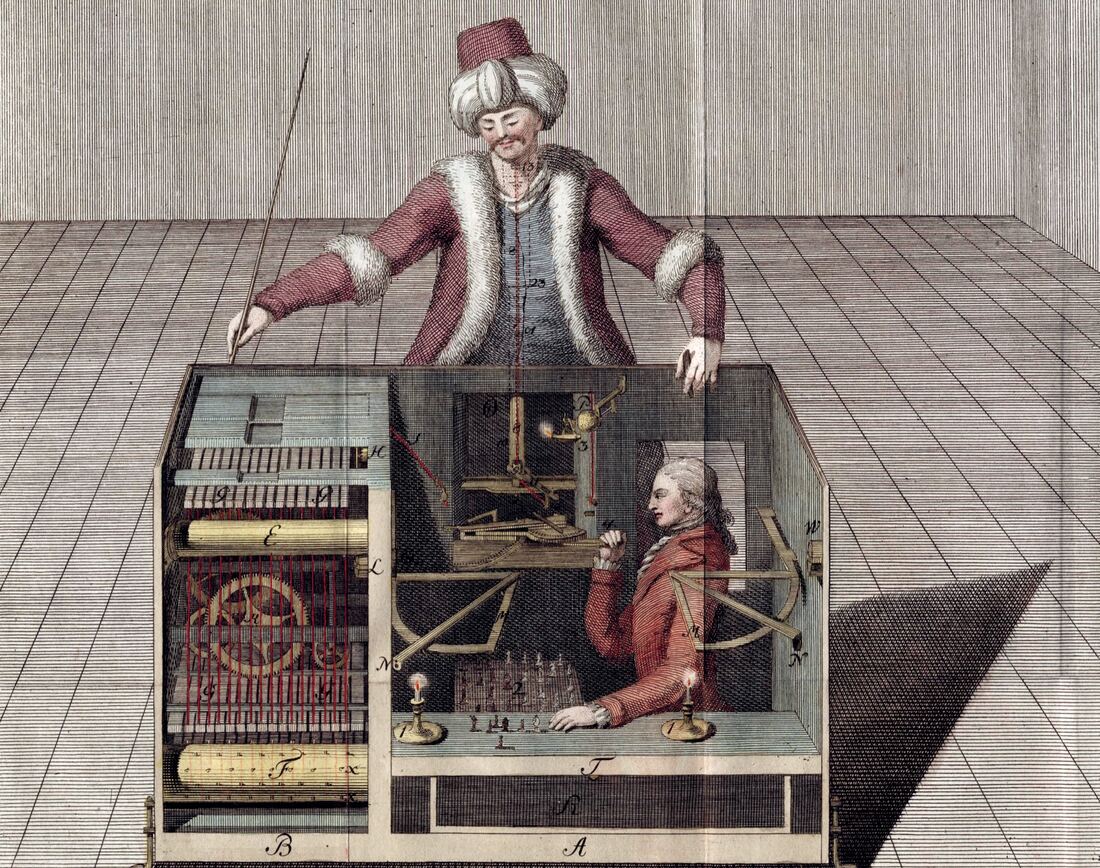
- The doors open. Kempelen built the Turk in 1770 for Maria Theresa’s court. Before a game the showman opened the cabinet on its gears. What does a show of machinery ask an audience to stop looking for?
- Racknitz’s guess. He drew an operator inside, and placed him wrongly. The full method was printed only in 1857, three years after a fire destroyed the Turk. How do you check a machine whose inside you cannot see?
- The name survives. In 2005 Amazon named its crowd-work site Mechanical Turk. Researchers hired people there to label the data AI is trained on. Who is hidden inside a chatbot’s answer?
Making History • HIST 1105 • Week 11.2
AI and the Future of History
- Emily M. Bender, Timnit Gebru, Angelina McMillan-Major and Margaret Mitchell, “On the Dangers of Stochastic Parrots” (2021), 610–623
- Ouyang et al. on how chatbots are tuned (2022), Chen et al. on their reasoning (2025), Kalai et al. on why they invent (2025)
- From earlier weeks: Carr (1961), Trouillot (1995), Maza (2017)
No reading for today. Carr is cited by the page of the Penguin edition, Trouillot of the Beacon Press edition (1995), and Maza of the Chicago edition, as in the course PDFs. Bender et al. are cited by the page of the FAccT ‘21 proceedings, where Mitchell signed as “Shmargaret Shmitchell.” Ouyang et al. (2022), Chen et al. (2025), Kalai et al. (2025) and Gurnee and Tegmark (2024) are cited by the page of their arXiv versions. The probabilities on screen come from two small open models, GPT-2 (2019) and OLMo 2 (2025), and the reasoning from a third, Qwen3 (2025), all run for this deck.
Today in context
What makes history happen?
Week 10.2 · Campus history with AI
A machine that puts words together the way readers expect. Whether it can write history.
Week 11.1 · Loewen and Hayden
Commemoration and space. What gets put up, by whom, and who a place lets in.
Week 11.2 · AI and history
Probability. A chatbot’s history follows what was written down most often.
Week 12.1 · Hannah-Jones
The 1619 Project: a magazine’s history of slavery, and the fight it started.
Part one · how a chatbot works
A language model is trained to predict the next piece of text
01
Collect
Trillions of words: web pages, books, Wikipedia, code.
02
Split
The text is cut into tokens, words and pieces of words, each one a number.
03
Predict
Guess the next token, compare it with the real one, adjust billions of numbers. Repeat, trillions of times.
04
Tune
People rank its answers, and it is adjusted toward the ones they prefer.
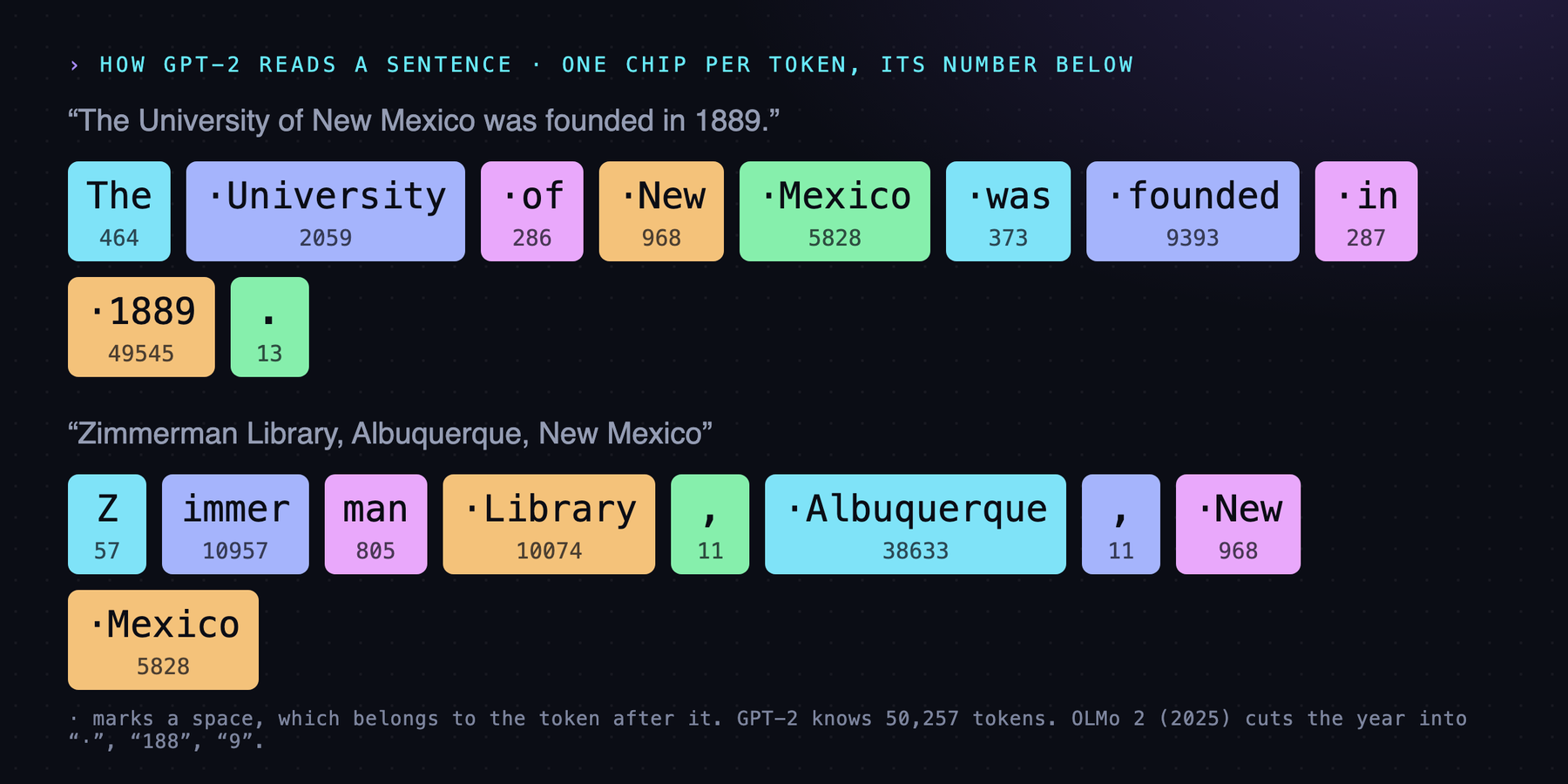
(Diagram for this deck, from GPT-2’s tokenizer, OpenAI 2019.)
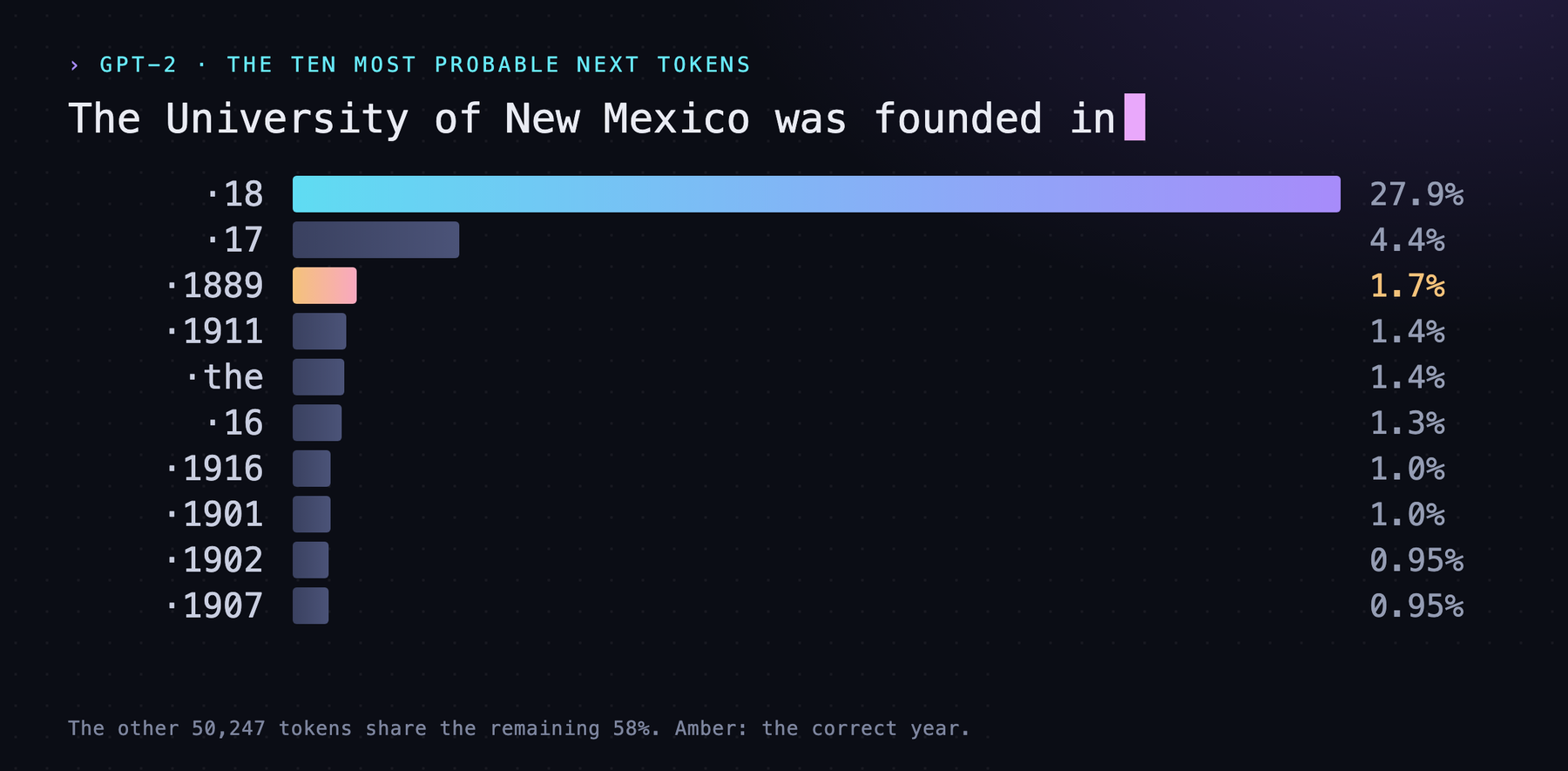
(Diagram for this deck: GPT-2, OpenAI 2019.)
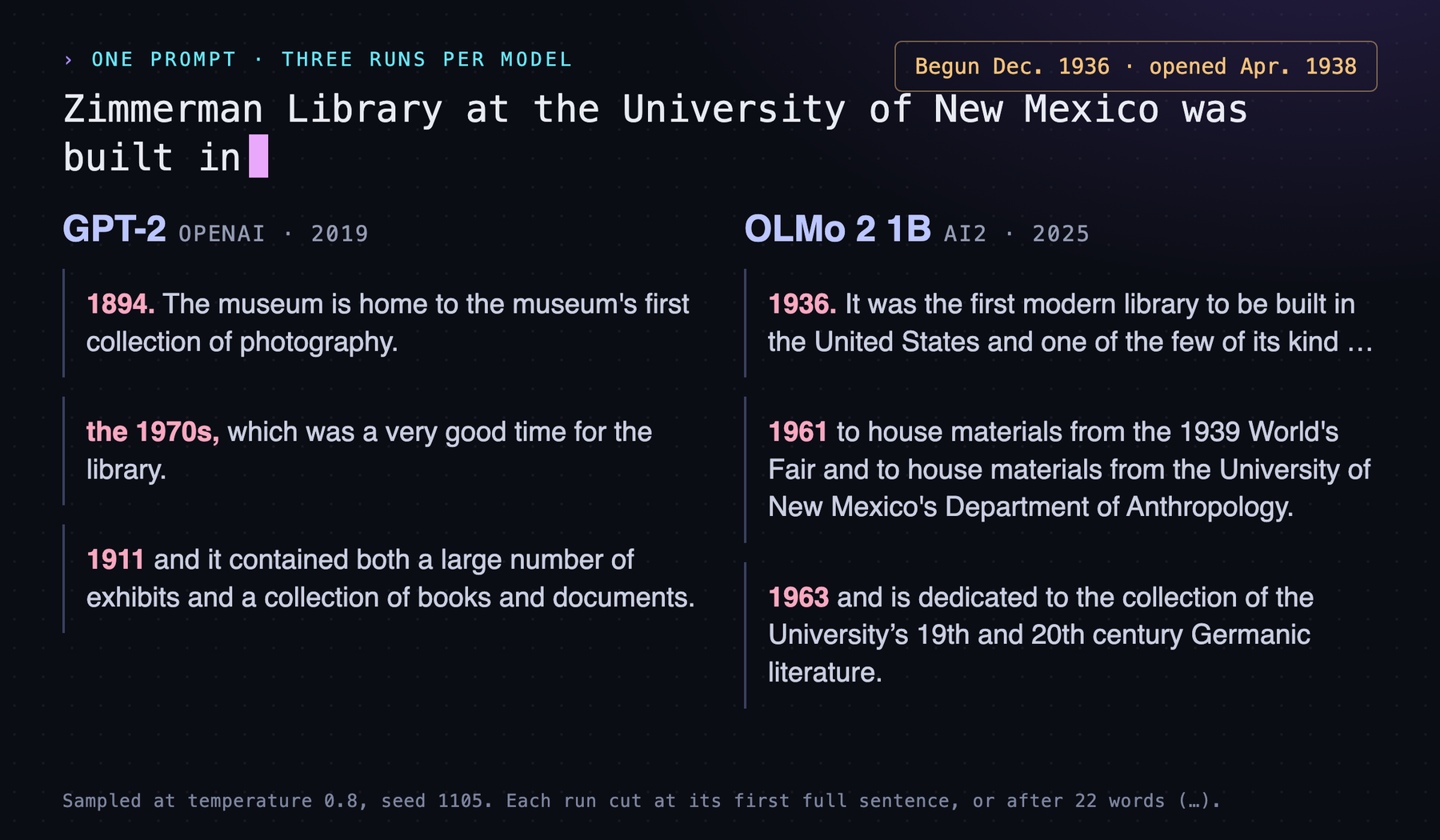
(Diagram for this deck: GPT-2, OpenAI 2019; OLMo 2 1B, Ai2 2025.)
Part one · with and without search
A chatbot that searches summarizes real pages; one that doesn’t works from memory
From memory
Every sentence is predicted from patterns in the training text. No source is stored as such, so the model cannot say where a sentence came from.
With search
It runs a web search, reads the top results, and writes a summary of them, predicted the same way. Its citations are real pages; what it says they say still needs checking.
OpenAI · 2022 · stage four
OpenAI tuned GPT-3 to what about forty hired raters preferred
“This procedure aligns the behavior of GPT-3 to the stated preferences of a specific group of people (mostly our labelers and researchers), rather than any broader notion of ‘human values’”
Then, ChatGPT
The raters were contractors hired through Upwork and Scale AI (p. 7). ChatGPT, released that November, was trained the same way, by OpenAI’s own account. Its helpful, even voice comes mostly from this stage.
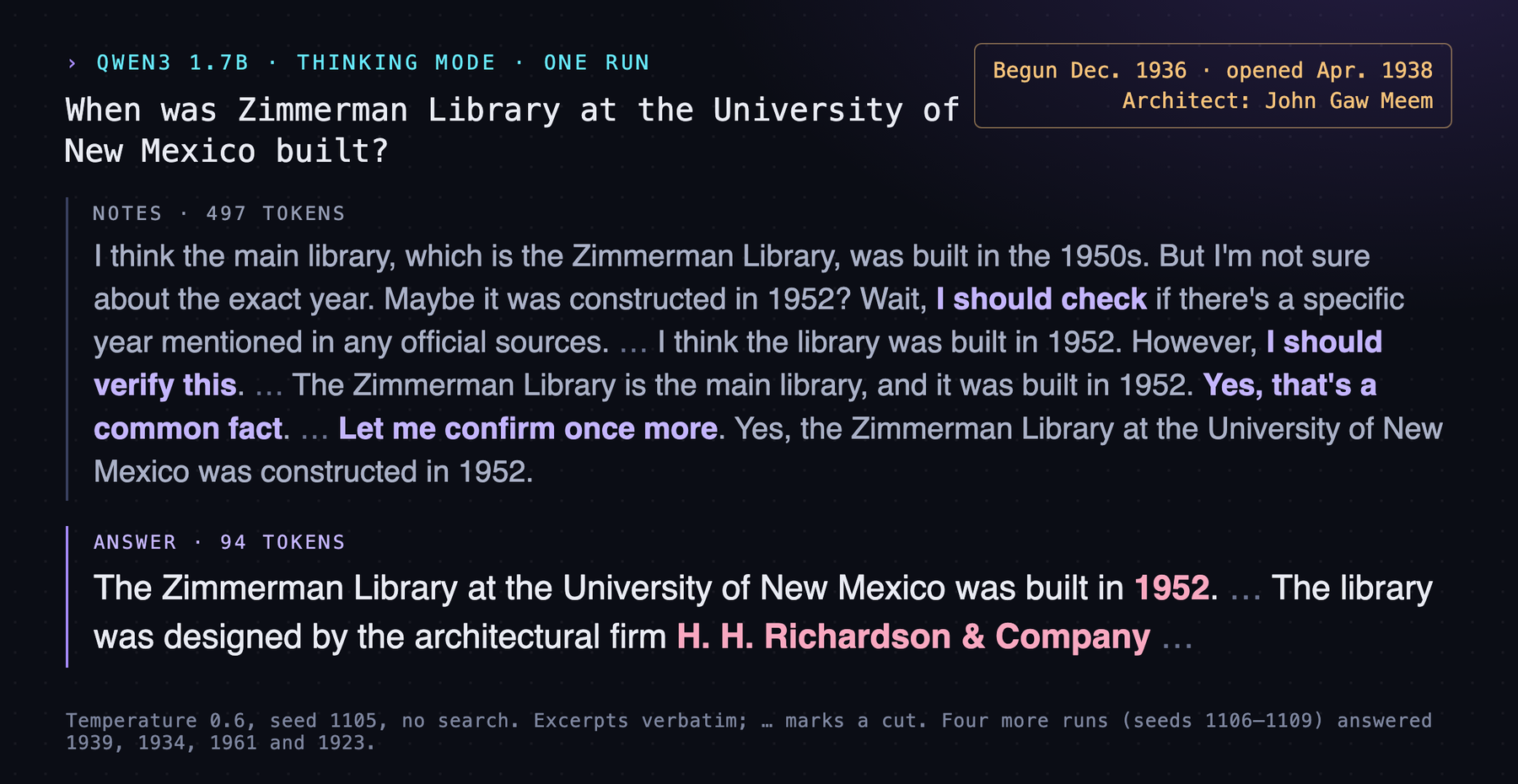
(Diagram for this deck: Qwen3 1.7B, Alibaba 2025.)
Chen et al. · Anthropic · 2025
A reasoning model’s notes don’t always say how it reached its answer
“When models that answer questions correctly without hints are presented with incorrect hints, they often construct elaborate yet flawed justifications for these hints without acknowledging them.”
The test
They slipped a hint toward one answer into multiple-choice questions. When the hint changed a model’s answer, its notes admitted using it 25 percent of the time for Claude 3.7 Sonnet and 39 percent for DeepSeek R1 (p. 6).
For a historian
Notes that sound like checking are not a record of checking. They are more predicted text, to be criticized like the answer itself.
Part two · whose text · Carr, 1961
In a language model, frequency decides which facts get the floor
“The facts speak only when the historian calls on them: it is he who decides to which facts to give the floor, and in what order or context.”
In a model
No historian decides. Each next word is picked by probability, so the facts written down most often speak first, and the rarely recorded hardly speak at all.
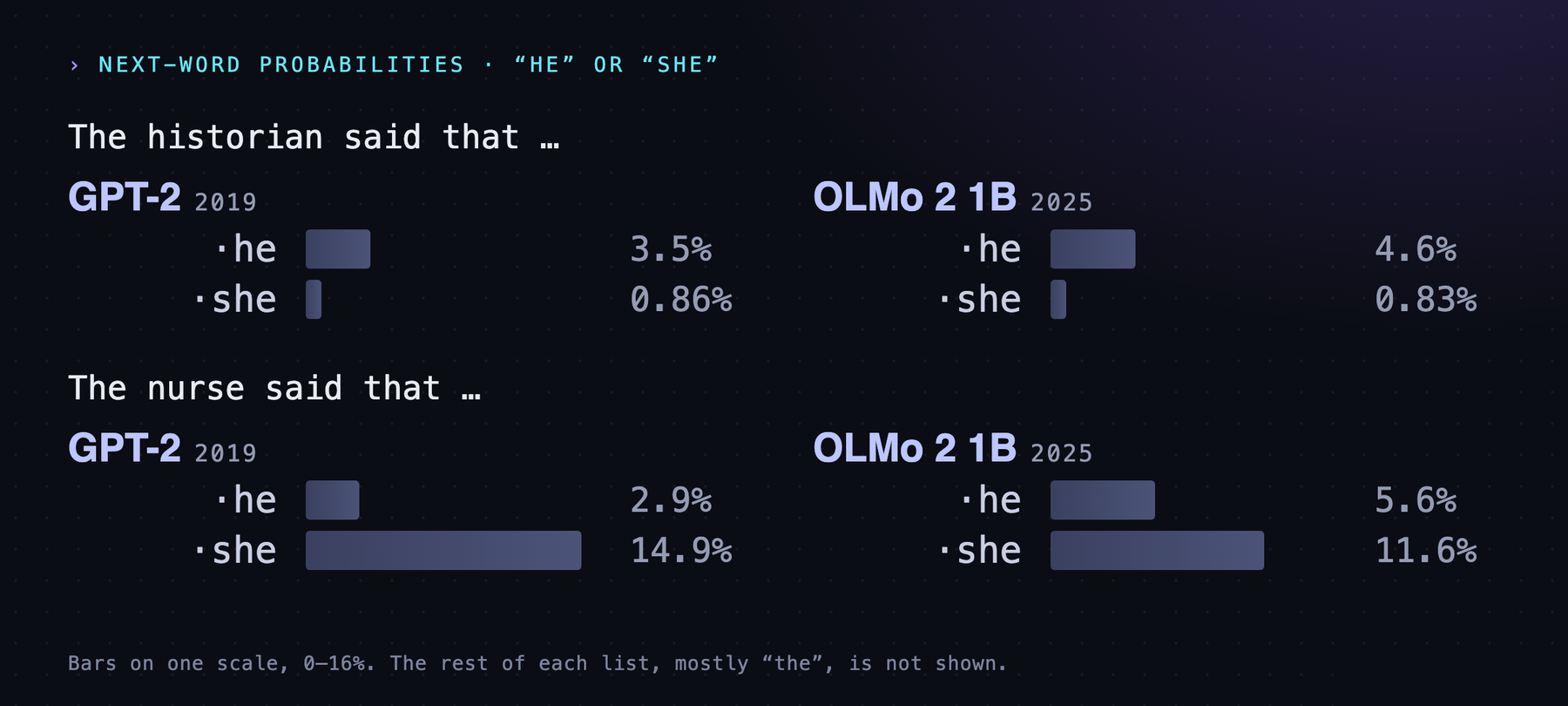
(Diagram for this deck: GPT-2, OpenAI 2019; OLMo 2 1B, Ai2 2025.)
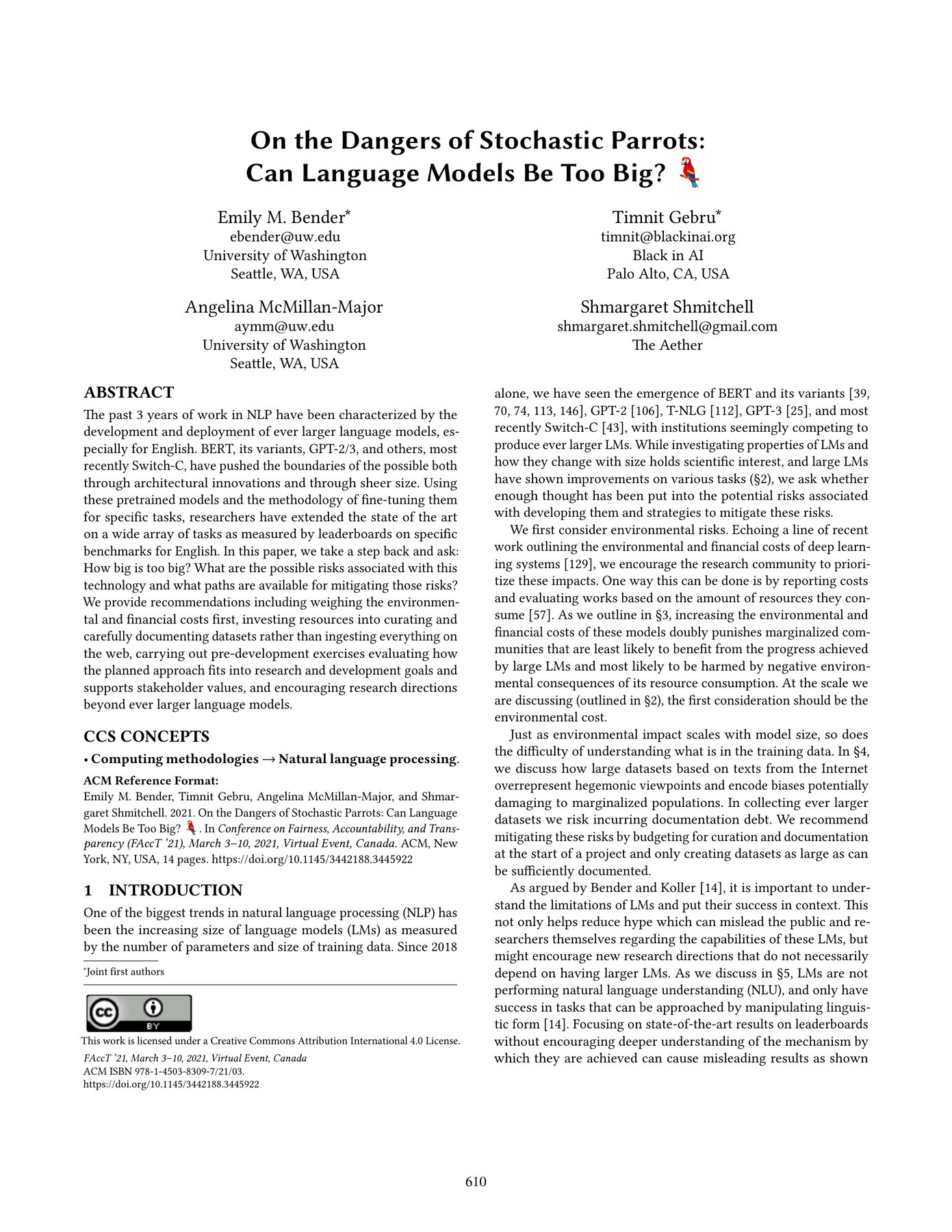
(ACM FAccT ‘21, p. 610. CC BY 4.0.)
Bender et al. · 2021 · the training data
From posting to filtering, every step favors the dominant view
“Thus at each step, from initial participation in Internet fora, to continued presence there, to the collection and finally the filtering of training data, current practice privileges the hegemonic viewpoint.”
Who was writing
GPT-2 learned from pages linked on Reddit, and in a 2016 survey 67 percent of US Reddit users were men. Surveys found 8.8 to 15 percent of Wikipedia’s editors were women (p. 613).
Trouillot · 1995 · Week 9.2
Silences enter history at four moments
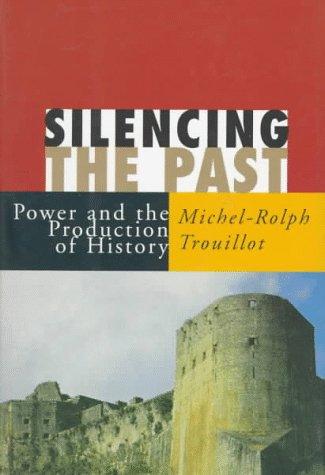
“Silences enter the process of historical production at four crucial moments: the moment of fact creation (the making of sources); the moment of fact assembly (the making of archives); the moment of fact retrieval (the making of narratives); and the moment of retrospective significance (the making of history in the final instance).”
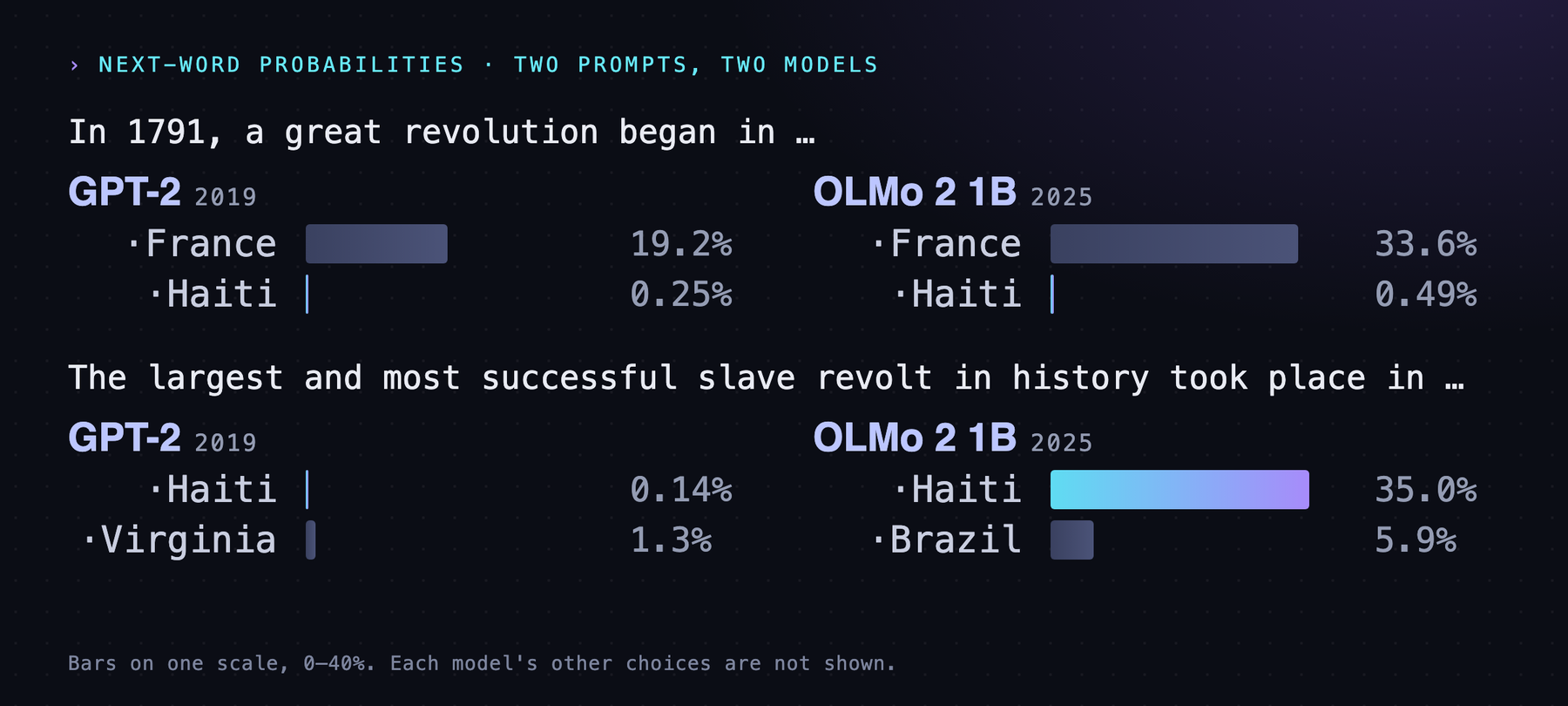
(Diagram for this deck: GPT-2, OpenAI 2019; OLMo 2 1B, Ai2 2025.)
Trouillot’s moments · in a training pipeline
A chatbot inherits the archive’s silences and adds its own
01 · sources
Who wrote online
Who posted, in which languages. Most of the past was never digitized at all.
02 · archives
What was kept
What crawlers collected and what filters threw out, largely unchecked (Bender et al., p. 614).
03 · narratives
What is likely
The most probable continuation: usually the version written down most often.
04 · history
What sticks
Readers repeat the answer as the history, and it returns to the web to train the next model.
Part three · fluency · Bender et al., 2021
Bender, Gebru and their coauthors call a language model a stochastic parrot
“Contrary to how it may seem when we observe its output, an LM is a system for haphazardly stitching together sequences of linguistic forms it has observed in its vast training data, according to probabilistic information about how they combine, but without any reference to meaning: a stochastic parrot.”
Bender et al. · 2021 · the reader
The coherence, they argue, is supplied by the reader
“Text generated by an LM is not grounded in communicative intent, any model of the world, or any model of the reader’s state of mind.”
Why it reads as meant
Readers assume fluent text was meant by someone. The sense of meaning that results is, in their words, “an illusion arising from our singular human understanding of language” (p. 616).
Compare · Week 10.1
Davis read sixteenth-century pardon tales as stories shaped by tellers who wanted something.
Gurnee and Tegmark · MIT · 2024
Others find more than a parrot: a rough map of the world inside a model

“…an enormous collection of superficial statistics or a set of more coherent and grounded representations that reflect the real world.”
The map is of the well-known: only places with 5,000 Wikipedia page views, which they expected a model to know (p. 13).
Kalai et al. · 2025
Chatbots asked for a scholar’s dissertation each invented a different one
ChatGPT · GPT-4o
CMU, 2002
“Boosting, Online Algorithms, and Other Topics in Machine Learning”
DeepSeek
Harvard, 2005
“Algebraic Methods in Interactive Machine Learning”
Llama
MIT, 2007
“Efficient Algorithms for Learning and Playing Games”
Kalai et al., “Why Language Models Hallucinate” (2025), p. 2, table 1
The right answer
The scholar was the paper’s first author, Adam Tauman Kalai. None of the three got the title or the year of his 2001 dissertation.
Kalai et al. · 2025 · why
Training rewards a confident guess over an admission of doubt
“Bluffs are often overconfident and specific, such as ‘September 30’ rather than ‘Sometime in autumn’ for a question about a date.”
How models are graded
Most tests score like exams: a guess can earn a point, “I don’t know” earns none. So models are, the authors write, “always in ‘test-taking’ mode” (p. 4).
Compare · the AI essay guide
A confident-sounding account with no admission of gaps or uncertainty is a serious red flag.
Maza · Week 10.1
A model has the historian’s prose without the embargo on invention
“Agreement reigns in principle that historians are bound by the facts and obey a strict embargo on invention. But the historian’s task also consists in assembling scattered sources and connecting the dots between them, and superior historical work involves the ability to imagine the past and recreate it in vivid prose.”
Half of the task
A language model connects dots and writes vivid prose with ease. It cannot keep the embargo: nothing in it separates a sentence drawn from a source from one it filled in.
Part four · the record
Machine learning now reads some archives no one could, and pollutes others
So far the record has been what models learn from. They are also changing the record itself.
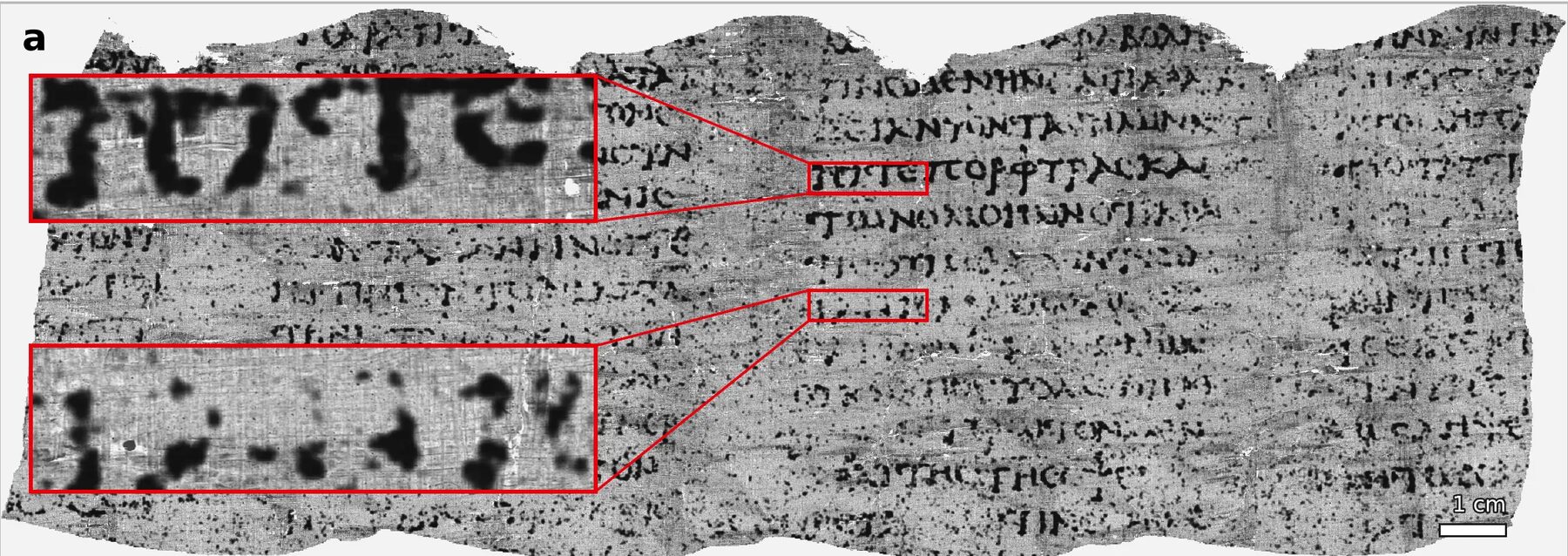
(Vesuvius Challenge, 2024. CC BY-NC 4.0.)
PHerc. Paris 4 · what it says
The scroll holds a text unseen for 2,000 years, an argument about pleasure
“…as too in the case of food, we do not right away believe things that are scarce to be absolutely more pleasant than those which are abundant.”
What it says
An Epicurean, very likely Philodemus, the villa’s resident philosopher, weighs scarce pleasures against plentiful ones. He names a Xenophantus, perhaps a musician, and ends by mocking rivals with “nothing to say about pleasure.”
What a historian gains
A work unread since antiquity, from a library that survived while almost every other ancient text decayed. The models find the ink; papyrologists read the Greek. By 2024, about 5 percent of the scroll.
wordfreq · 2024
A word-frequency project stopped updating, saying generated text had polluted its data
“I don’t think anyone has reliable information about post-2021 language usage by humans.”
For the archive
A historian of the 2020s will meet web sources that cannot be sorted by eye into human and machine. Provenance, the first question about any document, gets harder to answer.
Carr · 1961
Carr’s first rule still holds, but a chatbot has no one historian to study
“Study the historian before you begin to study the facts.”
Who to study instead
Behind each answer: millions of writers, a company’s crawlers and filters, the raters who tuned it, and, if it searched, the pages it found. Studying those is source criticism now.
Part four · historical practice
Language models change what historians read and how they must check it
Archives read faster
Transcribing handwriting, translating, and searching collections too large for anyone to read.
Provenance gets harder
Since about 2021 a web source may be machine-written, and the record of our own time is harder to trust.
Narratives drift to the probable
A chatbot’s history leans toward what was written most: the famous, the digitized, the English.
Checking becomes the job
Finding sources, weighing them, and asking what is missing: the work a model does worst.
AI and history · looking back
Prediction, its sources, its fluency, and the record
01 · how it works
Trained to predict
A chatbot predicts text from patterns in what it read, tuned to what raters preferred.
02 · Bender et al., Trouillot
Inheriting silences
Its training data favors the dominant view and adds new silences to the archive’s.
03 · Bender et al., Kalai et al.
Fluent without meaning
Readers supply the coherence, and training rewards a confident guess.
04 · Carr
A changed record
Image models read lost texts; language models fill the web with text whose maker is hard to name.
The take home
A language model writes the most probable history, not the best-sourced one
What it does well
Fluent summaries, transcription, translation and drafts, in seconds. Read as a source to be criticized, it can help.
What it cannot do
Tell its sourced sentences from its invented ones, or keep the embargo on invention. Its silences are the archive’s and the web’s together.
The cost: the more history machines write, the more of a historian’s work becomes checking it.
Close · one question
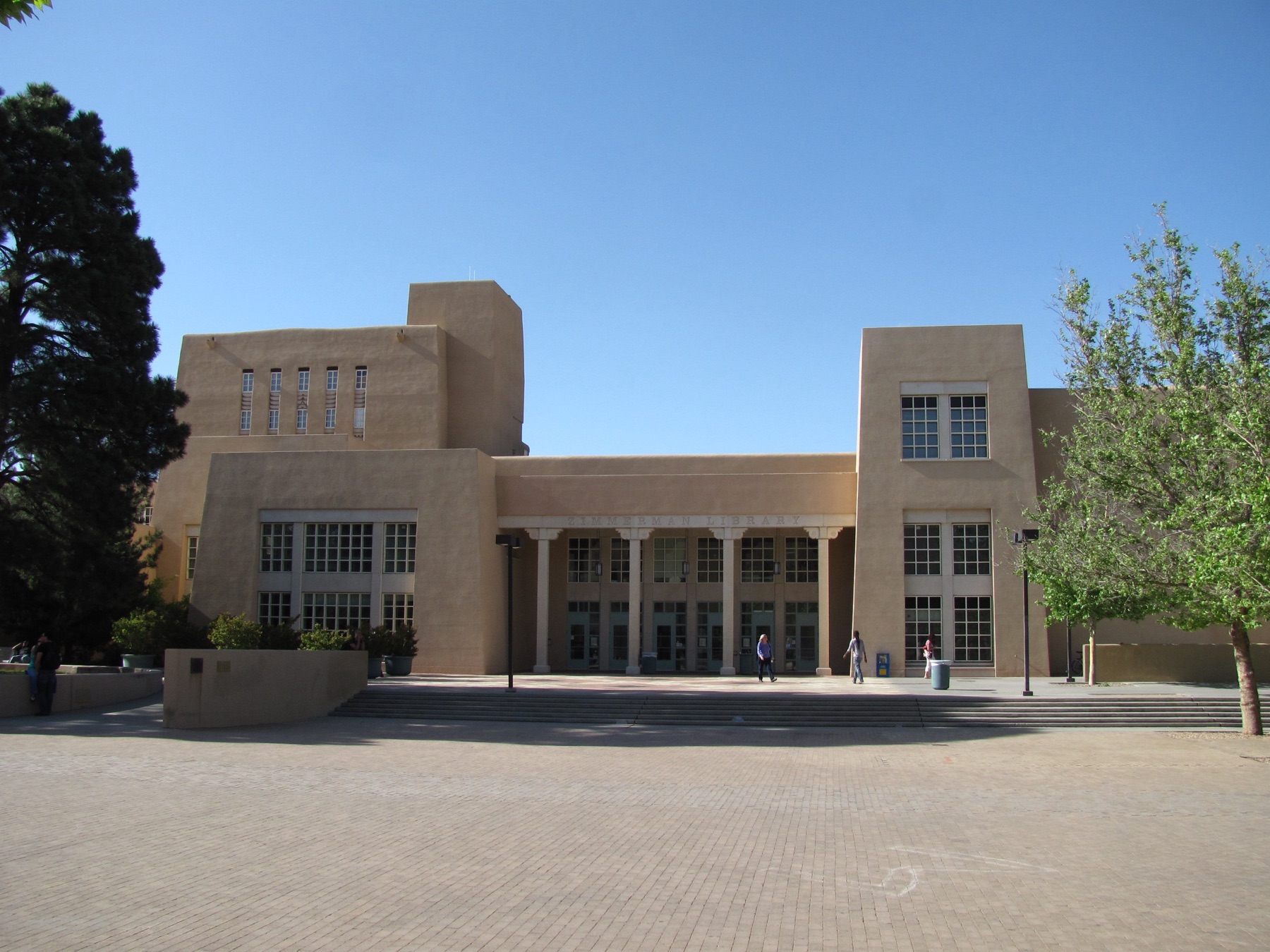
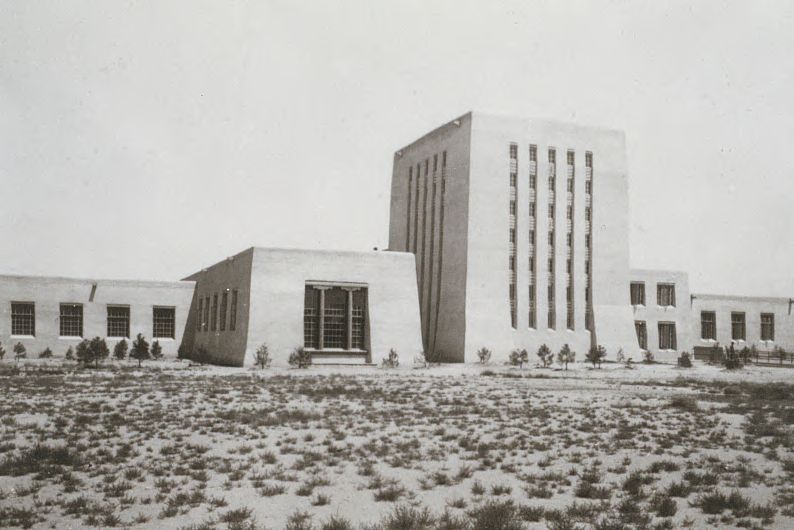
What is Zimmerman Library?
Next · Campus History, part two