Making History • HIST 1105 • Weeks 12.1 and 12.2
The 1619 Project, and the fight over it
- Background: Adam Serwer, “The Fight Over the 1619 Project Is Not About the Facts,” The Atlantic (December 23, 2019)
- Nikole Hannah-Jones, “The Idea of America,” The New York Times Magazine (August 18, 2019), 16–26
- Conor Friedersdorf, “1776 Honors America’s Diversity in a Way 1619 Does Not,” The Atlantic (January 2020)
Hannah-Jones is cited by Magazine page, which the Pulitzer Center PDF keeps. Serwer and Friedersdorf are cited by article, since the online texts have no pages.
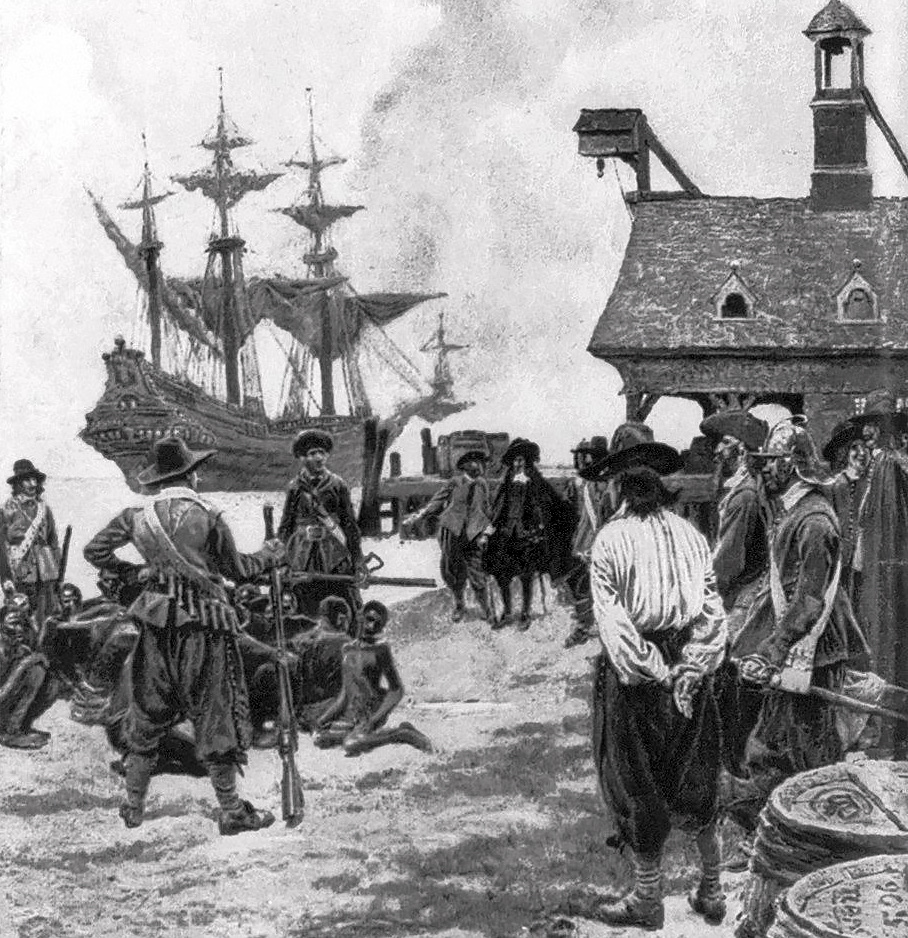
(Howard Pyle, 1901. Wikimedia Commons. Public domain.)
Today in context
What makes history happen?
Week 11.1 · Loewen and Hayden
Commemoration and space. What gets put up, by whom, and who a place lets in.
Week 11.2 · AI and history
Probability. A chatbot’s history follows what was written down most often.
Week 12 · The 1619 Project
A public argument about the founding, and whether the fight is over facts.
Week 13 · Science and nature
Who gets to say what counts as knowledge, and what follows from that authority.
Part one · Hannah-Jones · the opening
Hannah-Jones opens with her father’s flag and what school taught her
“I had been taught, in school, through cultural osmosis, that the flag wasn’t really ours, that our history as a people began with enslavement and that we had contributed little to this great nation.”
Her father
He flew the flag anyway. He knew, she writes, “that our people’s contributions to building the richest and most powerful nation in the world were indelible, that the United States simply would not exist without us” (p. 16).
Part one · Hannah-Jones · the claim
The essay argues that 1619 is as important as 1776
“…that the year 1619 is as important to the American story as 1776. That black Americans, as much as those men cast in alabaster in the nation’s capital, are this nation’s true ‘founding fathers.’”
The project’s aim
Serwer quotes the project’s own statement of it: to place “the consequences of slavery and the contributions of black Americans at the very center of our national narrative.”
Part one · Hannah-Jones · the contradiction
She calls the founding both an ideal and a lie
“The United States is a nation founded on both an ideal and a lie. Our Declaration of Independence, signed on July 4, 1776, proclaims that ‘all men are created equal’ and ‘endowed by their Creator with certain unalienable rights.’ But the white men who drafted those words did not believe them to be true for the hundreds of thousands of black people in their midst.”
The other half
Black Americans, she writes, “believed fervently in the American creed” and “helped the country live up to its founding ideals” (p. 16).
Part one · Hannah-Jones · the Revolution
The essay makes slavery a primary reason for the Revolution
“Conveniently left out of our founding mythology is the fact that one of the primary reasons the colonists decided to declare their independence from Britain was because they wanted to protect the institution of slavery.”
Her evidence
In London, she writes, “there were growing calls to abolish the slave trade,” which “would have upended the economy of the colonies, in both the North and the South” (p. 18).
Part one · Hannah-Jones · the democracy claim
She says Black Americans have been democracy’s perfecters
“Black Americans have also been, and continue to be, foundational to the idea of American freedom. More than any other group in this country’s history, we have served, generation after generation, in an overlooked but vital role: It is we who have been the perfecters of this democracy.”
Her evidence
During Reconstruction, “The South, for the first time in the history of this country, began to resemble a democracy, with black Americans elected to local, state and federal offices” (p. 20).
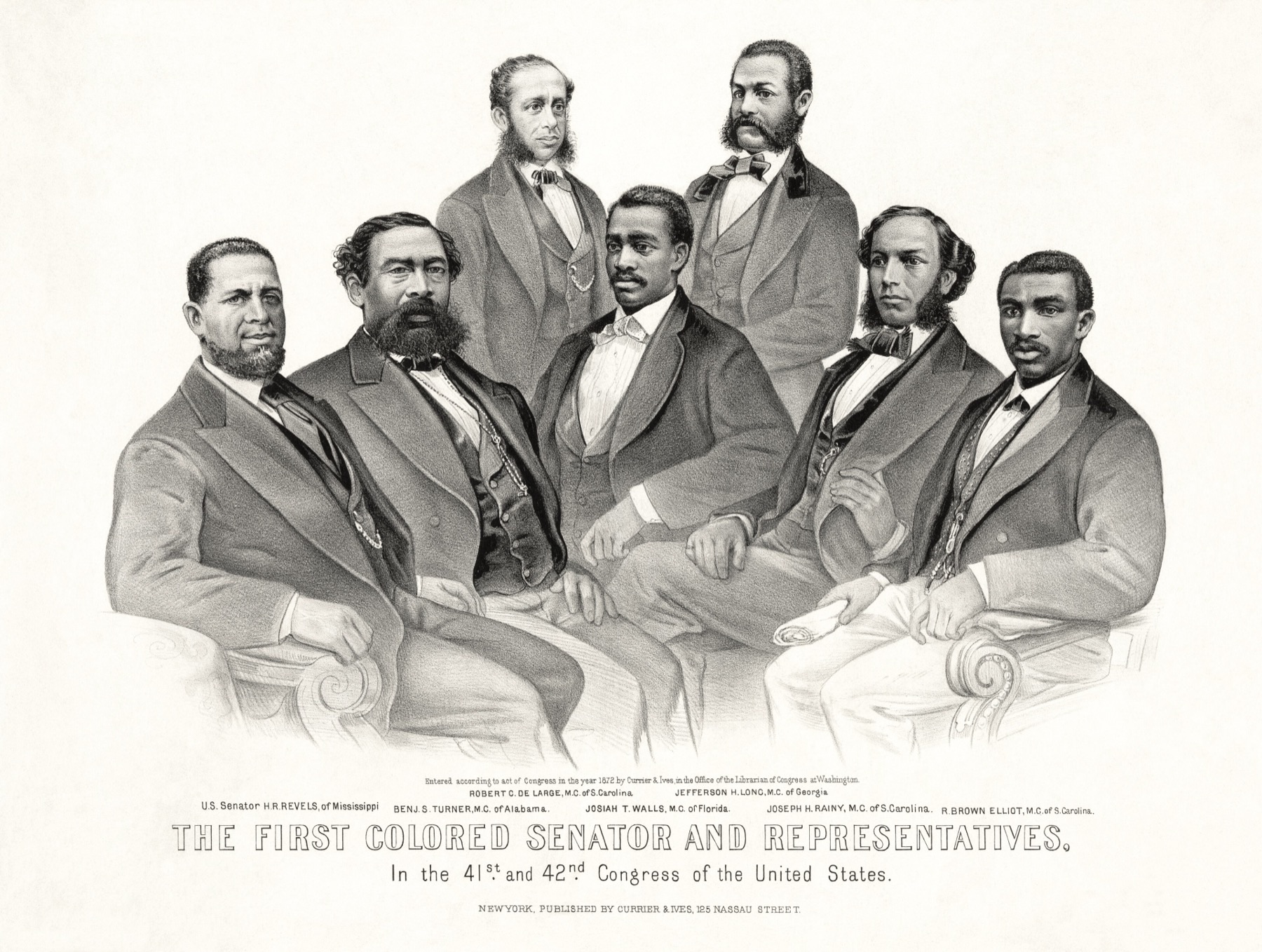
(Currier & Ives, 1872. Library of Congress, via Wikimedia Commons. Public domain.)
Part two · Serwer · December 2019
A letter from five historians escalated the fight over the project
“Underlying each of the disagreements in the letter is not just a matter of historical fact but a conflict about whether Americans, from the Founders to the present day, are committed to the ideals they claim to revere.”
The letter
Sean Wilentz, a Princeton historian, circulated it. Four others signed, including James Oakes. It reached the Times on December 4, and a version ran on December 20 beside a rebuttal from the magazine’s editor. Wilentz calls the project’s idea “fantastic” and the letter a way “to help it.”
Part two · the case for the project
Defenders say it fills a gap in what Americans learn
A gap in what students learn
Few high-school students know that slavery caused the Civil War or that the Constitution protected it without naming it, the Southern Poverty Law Center found. Yale historian David Blight blames the American need to see history as “progress.”
Readers say it changes what they see
Hannah-Jones says people tell her they “feel like they are understanding the architecture of their country in a way that they had not.”
It gave writers a platform
Nell Irvin Painter, a Princeton historian who disagrees with parts of it, supports the project “as kind of a cultural event” that let Black journalists and writers “speak up in a really big way.”
Serwer, quoting the Southern Poverty Law Center, Blight, Hannah-Jones and Painter.
Part two · the case against the project
Critics object to the facts, the pessimism, and the method
The Revolution claim
Teaching children that the Revolution was fought in part to secure slavery would give “a fundamental misunderstanding” of what America “stood for and has stood for since the Founding,” Wilentz says.
The “DNA” claim
Of her line that anti-black racism “runs in the very DNA of this country” (p. 21), Oakes says “there’s nothing you can do,” and the idea “leads to political paralysis.”
Fact called framing
The letter says the errors “cannot be described as interpretation or ‘framing,’” that they are “matters of verifiable fact,” and that they “suggest a displacement of historical understanding by ideology.”
Serwer, quoting Wilentz and Oakes; the historians’ letter, as published December 20, 2019.
Part two · Serwer’s verdicts
Serwer splits his verdict on two disputed claims
The Revolution claim
“On this question, the critics of the 1619 Project are on firm ground.” The Revolution was “kindled in New England,” though “some southern slave owners likely were fighting the British to preserve slavery.” Hannah-Jones: “I do still back up that claim,” but of her wording, “I accept that criticism, for sure.” A Times editor’s note of March 11, 2020 adjusted the passage to cover “some of the colonists.”
The struggle “alone”
The essay: “For the most part, black Americans fought back alone” (p. 24). Hannah-Jones to Serwer: “It is not saying that black people only fought alone. It is saying that most of the time we did.” Serwer finds “largely alone” “more than defensible” for slavery and Jim Crow, though the struggle “has been an interracial struggle.”
Part two · Friedersdorf · The Atlantic, January 2020
Friedersdorf says 1776 includes more Americans than 1619 does
“Placing America’s founding moment in 1776 honors the diversity of its people in a way that 1619 does not.”
His reasoning
He argues that “no racial group belongs” at the center of U.S. history “more or less than any other.” The ideals of 1776, he writes, are ones “that all can share,” and the Times offers no “adequate or even straightforward defense” of 1619 as the “true founding.”
Where he agrees with her
He concurs “that black abolitionists warrant status as Founding Fathers” and that “no people has a greater claim” than African Americans to the flag.
Part two · Wilentz and Hannah-Jones
The two sides also disagree about whether history can be objective
Nikole Hannah-Jones, to Serwer
On her tweets about white scholars: “I would never discount the work of any historian because that person is white or any other race.” Her point “was that history is not objective. And that people who write history are not simply objective arbiters of facts.”
Sean Wilentz, in reply
“Fact and objectivity are the foundation of both honest journalism and honest history.” He says she “says it’s about the inability of anybody to write objective history. That’s objectionable too.”
Part two · discussion
Where evidence stops
Serwer says the letter’s disagreements are “not just a matter of historical fact” but a conflict over whether Americans, “from the Founders to the present day,” are committed to their ideals. What can evidence settle?
Evidence can settle much of what colonists said and did about slavery and independence. Whether the ideals they proclaimed were sincere is interpretation.
Discussion post · writing
Write toward your discussion post
Hannah-Jones begins with her father’s flag. Your post is due by midnight Sunday.
- Which side of the debate do you find more convincing, and what is the best thing the other side has?
- What from your own life does this connect to? A history class, a family argument, a statue or a street name.